


Page 766 - Economia Azul - versão: inglês
P. 766
3.2 Mapping and indicators               in common (historical, cultural, econom-                                    The second dimension considered is re-  specialization in tourism in coastal areas
                                                        ic  and/or  geographic  identity),  sometimes                            lated to the fact that a tourist region in Brazil   compared to other tourist regions in Brazil.
                                                                                                                                                                                         o

                 The idea of   evaluating the ability of   composed of different municipalities. These                           is composed or not by coastal municipalities.   Thus, let us call  it the number of people
               blue tourism to boost local economies re-  municipalities are articulated, normally in an                         This definition takes into account the liter-  employed in economic sectors i linked to
               quires empirical strategies capable of scal-  instance of regional governance to develop                          ature on coastal and maritime tourism, in   tourism in the coastal tourist region (blue)
               ing the relative size of economic activity in   tourism in a joint and regionalized way. In a                     which the IBGE classification of coastal mu-  t . The locational quotient of tourism in the
               coastal and marine regions (NAVARRO JU-  tourist region, there may be municipalities                              nicipality  is adopted. According to the IBGE   tourist region t, then, can be defined as:
                                                                                                                                         1
               RADO et al., 2012). For the Brazilian case,   that do not receive tourists, but benefit from                      (2021), about 26% of the Brazilian popu-               o it
               it is necessary to incorporate the territorial   the activity by providing products and ser-                      lation lives in municipalities in the coastal          ∑ o
               dimension of spaces that are coastal, at   vices. This concept is related to the logic of                         zone, which is equivalent to approximately       LQ  =  ∑ o it              (1)
                                                                                                                                                                                     t
               the same time that we must incorporate   the Tourism Regionalization Program, which                               50.7 million inhabitants. Part of this popu-           ∑o t

               regions  that  have  characteristics  condu-  presupposes the idea of  integrated territorial                     lation is engaged in activities, directly or in-
               cive to tourism. In particular, in this chap-  tourism, since it is assumed that tourists are                     directly, linked to tourism, the production of   Where:
               ter, three main aspects are considered:  encouraged to stay longer in the region, gen-                            oil and natural gas, fishing and services that   o it is employment in tourism in coastal
                 . Definition of tourist region, following   erating more resources for the municipalities                       meet the economic dynamics generated by   tourist region t;
               the classification proposed by the Ministry   involved. In practice, different municipalities                     these municipalities and nearby regions.  ∑ o it  is employment in tourism in all tourist
               of Tourism (MTur).                       and local governments already incorporate                                   The third dimension considered iden-  regions (coastal or not);
                 . Identification of coastal municipalities   this logic, sometimes adopting the terms ‘cir-                     tifies  the  relevance  of  economic  activities  ∑ o t  is total employment in tourist region t;
               comprising the tourist region, according to   cuits’, ‘zones’ or tourist ‘poles’.                                 linked to tourism in relation to the total   and
               the classification of the Brazilian Institute of   From the identification of Tourist Re-                         economic activity in tourist regions. For   ∑o is the total employment of tourist re-
               Geography and Statistics (IBGE).         gions, the MTur adopted some variables                                   this, we will use labor market data to es-  gions (coastal and non-coastal).
                 .  Level  of  economic  activity  of  the   that translate the tourism economy  and                             timate the relative share of employment
               municipalities that make up the tourist re-  uses them to guide the elaboration of pub-                           in the lodging and lodging sectors in each   Thus, values   of LQ >1 indicate regional
                                                                                                                                                                                              t
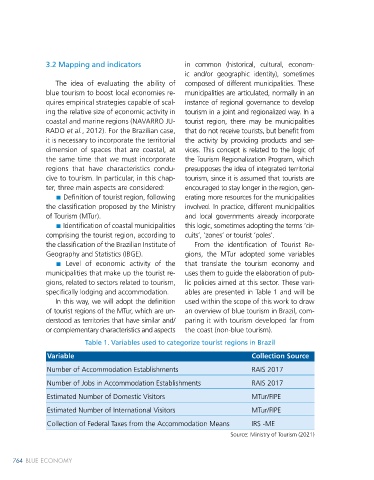
               gions, related to sectors related to tourism,   lic policies aimed at this sector. These vari-                    tourist  region in relation  to the sectorial   specialization in tourist activities in a giv-
               specifically lodging and accommodation.  ables are presented in Table 1 and will be                               total of each tourist region and also in re-  en region t and the higher the value, the
                 In this way, we will adopt the definition   used within the scope of this work to draw                          lation to the participation of each tourist   greater the region’s specialization in that
               of tourist regions of the MTur, which are un-  an overview of blue tourism in Brazil, com-                        region in relation to the sectorial total from   activity. In other words, the region t is rel-
               derstood as territories that have similar and/  paring it with tourism developed far from                         all tourist regions in the country.      atively more important, among all tourist
               or complementary characteristics and aspects   the coast (non-blue tourism).                                         In this way, we will calculate an index   regions, in terms of the relative share of
                          Table 1. Variables used to categorize tourist regions in Brazil                                        similar to the location quotient (LQ), which   tourism activity than in general terms of all
                                                                                                                                 will allow us to differentiate the level of   other economic sectors.
               Variable                                                    Collection Source
                                                                                                                                 4. Overview of blue tourism in Brazil
               Number of Accommodation Establishments                      RAIS 2017
                                                                                                                                    To outline an overview of blue tourism   defined 333 tourist regions in Brazil, of
               Number of Jobs in Accommodation Establishments              RAIS 2017
                                                                                                                                 in Brazil, the three dimensions discussed   which 58 are considered blue, as described
               Estimated Number of Domestic Visitors                       MTur/FIPE                                             above are used. A Blue Tourist Region (RTA -   in Section 3.2. More than half of the BTRs
                                                                                                                                 Região Turística Azul) is a Tourist Region, as   are located in the northeast region (33),
               Estimated Number of International Visitors                  MTur/FIPE
                                                                                                                                 defined by the MTur, in which at least one   followed by the southeast region (13), the
               Collection of Federal Taxes from the Accommodation Means    IRS -ME                                               of  its  constituent  municipalities  is  coastal,   south region (8) and the north region (6).

                                                                     Source: Ministry of Tourism (2021)                          according to IBGE information. The MTur   The BTRs include environmental protection


     764   BLUE ECONOMY                                                                                                                                                                                Blue Tourism in Brazil 765

