


Page 764 - Economia Azul - versão: inglês
P. 764
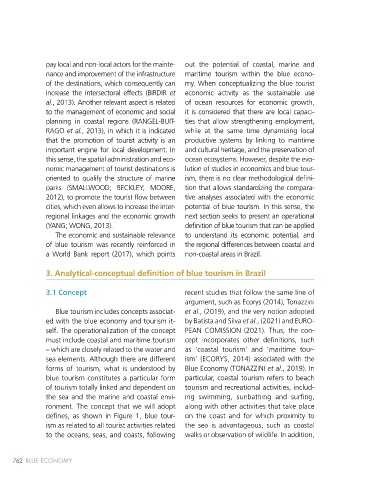
pay local and non-local actors for the mainte- out the potential of coastal, marine and Figure 1. Definition of Blue Tourism
nance and improvement of the infrastructure maritime tourism within the blue econo-
of the destinations, which consequently can my. When conceptualizing the blue tourist Regions with maritime and coastal capital
increase the intersectoral effects (BIRDIR et economic activity as the sustainable use
al., 2013). Another relevant aspect is related of ocean resources for economic growth, Typical Economic activity Related Economic activity
to the management of economic and social it is considered that there are local capaci-
planning in coastal regions (RANGEL-BUIT- ties that allow strengthening employment, Beach tourism and recreational activities, along with
RAGO et al., 2013), in which it is indicated while at the same time dynamizing local Coastal Tourism other activities that take place on the coast and for
which the proximity to the sea is advantageous
that the promotion of tourist activity is an productive systems by linking to maritime
important engine for local development. In and cultural heritage, and the preservation of Blue Tourism
this sense, the spatial administration and eco- ocean ecosystems. However, despite the evo-
nomic management of tourist destinations is lution of studies in economics and blue tour- Maritime tourism Tourism related to predominantly water-based
activities, with sailing, yachting and cruising, and
oriented to qualify the structure of marine ism, there is no clear methodological defini- other water sports, often held in coastal waters
parks (SMALLWOOD; BECKLEY; MOORE, tion that allows standardizing the compara-
2012), to promote the tourist flow between tive analyses associated with the economic
cities, which even allows to increase the inter- potential of blue tourism. In this sense, the Source: the authors
regional linkages and the economic growth next section seeks to present an operational
(YANG; WONG, 2013). definition of blue tourism that can be applied maritime tourism refers to predominant- makes it possible to consider tourism as a
The economic and sustainable relevance to understand its economic potential, and ly water-based activities such as sailing, relevant element for local development, es-
of blue tourism was recently reinforced in the regional differences between coastal and yachting, and cruising, and other water pecially if elements that are naturally coastal
a World Bank report (2017), which points non-coastal areas in Brazil. sports, often performed in coastal waters. and/or maritime are attributed to the space.
Our conceptual approach considers that Other attributes of tourist trips, such as cruis-
3. Analytical-conceptual definition of blue tourism in Brazil blue tourism covers a wide range of activities es or sailing, or even accommodation, such
that revalue natural aspects associated with as resorts or eco-spaces, are also directly and
3.1 Concept recent studies that follow the same line of blue elements in coastal and maritime re- indirectly considered in the concept of blue
argument, such as Ecorys (2014), Tonazzini gions. In this sense, two concepts are related. tourism. In addition, water-based leisure ac-
Blue tourism includes concepts associat- et al., (2019), and the very notion adopted The first is related to the economic activity of tivities and water sports (often carried out in
ed with the blue economy and tourism it- by Batista and Silva et al., (2021) and EURO- tourism, which is defined from the perspec- coastal waters) include diving, underwater
self. The operationalization of the concept PEAN COMISSION (2021). Thus, the con- tive of demand, that is, as the economic result fishing, water skiing, windsurfing, trips to
must include coastal and maritime tourism cept incorporates other definitions, such of the consumption of visitors in a given ter- marine parks, observation of wild mammals,
– which are closely related to the water and as ‘coastal tourism’ and ‘maritime tour- ritory. Included are economic activities mainly etc. Marine tourism, while the vast majority
sea elements. Although there are different ism’ (ECORYS, 2014) associated with the associated with accommodation and leisure of activities take place at sea, its support fa-
forms of tourism, what is understood by Blue Economy (TONAZZINI et al., 2019). In at destination locations. The second concept cilities and infrastructure are usually found on
blue tourism constitutes a particular form particular, coastal tourism refers to beach is associated with the natural attractiveness of land. These facilities (infrastructure) can vary
of tourism totally linked and dependent on tourism and recreational activities, includ- territories with blue elements, such as coastal between ports and marinas (serving cruis-
the sea and the marine and coastal envi- ing swimming, sunbathing and surfing, and maritime areas. In this way, the coast- es, yachts, etc.), for one-person operations
ronment. The concept that we will adopt along with other activities that take place al and maritime spatial units have a natural (e.g., guides, instructors, etc.), moderately
defines, as shown in Figure 1, blue tour- on the coast and for which proximity to tourist attractiveness to the territory, which sized private companies or even large corpo-
ism as related to all tourist activities related the sea is advantageous, such as coastal characterizes the tourist space with the blue rations (e.g., cruise ships, etc.) (SCOTT; SIMP-
to the oceans, seas, and coasts, following walks or observation of wildlife. In addition, economy elements. Furthermore, the concept SON; SIM, 2012; YANG; WONG, 2013).
762 BLUE ECONOMY Blue Tourism in Brazil 763

