


Page 769 - Economia Azul - versão: inglês
P. 769
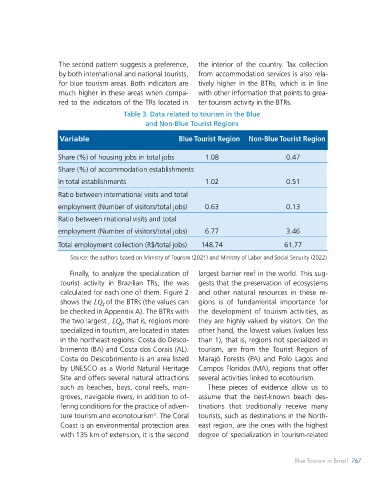
areas, natural parks, areas listed as natural   domestic product (GDP), the largest share   The second pattern suggests a preference,   the interior of the country. Tax collection
 heritage, small villages, and coastal metro-  in relation to the general total of Brazil is   by both international and national tourists,   from accommodation services is also rela-
 politan areas. The list of BTRs and their lo-  found in non-blue tourism areas. On the   for blue tourism areas. Both indicators are   tively  higher  in  the  BTRs,  which  is  in  line
 cations is included in Appendix A.  other hand, BTRs have average population   much higher in these areas when compa-  with other information that points to grea-
 In order to identify unique characteris-  density and average income (represented   red to the indicators of the TRs located in   ter tourism activity in the BTRs.
 tics of the tourism activity developed along   by GDP per capita), higher than non-blue   Table 3. Data related to tourism in the Blue
 the Brazilian coast, a comparison is made   areas. The relative higher population densi-  and Non-Blue Tourist Regions
 of the available information between the   ty is due to physical factors, as they are ar-
 BTRs (coastal) and the non-blue (non-coast-  eas delimited by the ocean and mountains,   Variable                                          Blue Tourist Region    Non-Blue Tourist Region
 al) TRs. To begin with, in Table 2 some so-  and to socioeconomic factors, as many
 cioeconomic data from both regions are   BTRs include metropolitan regions where   Share (%) of housing jobs in total jobs   1.08   0.47
 presented in aggregate form. From the   the concentration of people is higher. The   Share (%) of accommodation establishments
 data in the aforementioned Table, it can   presence of metropolitan regions can also   in total establishments   1.02   0.51
 be seen that in terms of population and   explain why the average income in the TRs
 wealth concentration (represented by gross   is relatively higher than in the non-blue TRs.  Ratio between international visits and total
                  employment (Number of visitors/total jobs)   0.63                   0.13
 Table 2. Socioeconomic data of the Blue and Non-Blue Tourism Regions, 2018
                  Ratio between rnational visits and total
 Variable   Blue Tourist Region     Non-Blue Tourist Region  employment (Number of visitors/total jobs)   6.77   3.46

 % in the Brazilian Population   18,11   59,36  Total employment collection (R$/total jobs)   148.74   61.77
 % in Brazilian GDP   19,48   66,56  Source: the authors based on Ministry of Tourism (2021) and Ministry of Labor and Social Security (2022)

 Population density (inhabitant/km²)   180,27   28,61
                      Finally, to analyze the specialization of   largest barrier reef in the world. This sug-
 Average per capita GDP (R$)   29.562,02   27.439,08  tourist activity in Brazilian TRs, the was   gests that the preservation of ecosystems
 Source: the authors based on IBGE (2021, 2022).  calculated for each one of them. Figure 2   and  other  natural  resources  in  these  re-
                   shows the LQ of the BTRs (the values  can   gions is of fundamental importance for

                               t
 Table  3  makes  a  comparison  between   non-blue regions. This may be indicative of   be checked in Appendix A). The BTRs with   the development of tourism activities, as
 blue  and  non-blue  tourism  regions  based   the greater importance of tourism to the   the two largest , LQ , that is, regions more   they are highly valued by visitors. On the
                                     t

 on the variables described in Table 1. Each   local economy in BTRs, when compared to   specialized in tourism, are located in states   other hand, the lowest values  (values  less

 variable was individually weighted to allow   non-blue TRs.  in the northeast regions: Costa do Desco-  than 1), that is, regions not specialized in
 a direct comparison between regions. Ba-  Regarding international and national   brimento (BA) and Costa dos Corais (AL).   tourism, are from the Tourist Region of
 sed on this information, we can see a pat-  visitors, the indicators used (total visits   Costa do Descobrimento is an area listed   Marajó  Forests  (PA)  and  Polo  Lagos  and
 tern distinguishing between blue and non-  estimated by total employment in the re-  by UNESCO as a World Natural Heritage   Campos Floridos (MA), regions that offer
 -blue TRs. Firstly, it is noted that the share   gion) point to two patterns. First, in both   Site and offers several natural attractions   several activities linked to ecotourism.
 of jobs in the accommodation sector in the   regions, national visits take precedence   such as beaches, bays, coral reefs, man-  These pieces of evidence allow us to
 total number of jobs and the share of the   over international ones. In other words,   groves, navigable rivers, in addition to of-  assume that the best-known beach des-
 number of accommodation establishmen-  Brazilian tourists are the majority of visitors   fering conditions for the practice of adven-  tinations that traditionally receive many
                                              3
 ts in the total establishments are relatively   and are probably the ones who most con-  ture tourism and econotourism . The Coral   tourists, such as destinations in the North-
 small in both regions, however, the values   tribute to the generation of income and   Coast is an environmental protection area   east region, are the ones with the highest
 in the blue regions are almost double the   employment linked to tourism in all TRs.   with 135 km of extension, it is the second    degree of specialization in tourism-related


 766   BLUE ECONOMY                                                                     Blue Tourism in Brazil 767

