


Page 579 - Economia Azul - versão: inglês
P. 579
The year 2015 was marked by a deep re-  Marine Manufacture (MMar) sector com-  Transport - when comparing the perfor-  Thus, the tourist finds a developed urban
 cession in the country; GDP fell by 3.5% in   pared to 2015 (Table 4). That is, the fall of   mance of that indicator between the years   infrastructure, especially a powerful tour-
 relation to the previous year. The behavior of   the MMar sector in the share of coastal and   2015 and 2018 (Graph 4).  ism and leisure sector with beautiful beach-
 GDP in 2017 and 2018 showed a slight pos-  marine GDP 2018 suggests the capture of   We can see that the sectorial pattern   es bathed by the Atlantic Ocean.
 itive evolution, suggesting a gradual recov-  the aforementioned negative variation, as it   of 2015 is partially repeated in 2018. The   Still with regard to the sectors that had
 ery of the economy, which did not sustain it-  emphasizes constructions related to the sea,   Marine Services sector continues with a   an intensified participation in the maritime
 self in the following years, being aggravated   among other economic segments. In contrast   strong participation (6.1%) and vigorous   and  coastal  economy,  it  is  worth  mention-
 by the Covid-19 pandemic in 2020.  to the industrial sector, there is the service   growth in the period (37% in the period   ing the Marine Energy sector (from 1.5% to
 According to official Brazilian data, in   sector, pointing to successive growths in the   2015-2018), as well as the concentration   3.6%) currently, primarily related to offshore
 2015 the national economic segment that   segments of transport and real estate activi-  (68.7%) in tertiary activities developed  in   oil and gas exploration resources. Comparing
 showed growth was the agricultural sector.   ties - in the same way, it is believed that the   the vicinity of the sea (growth of 23% in   national oil production between 2010 and

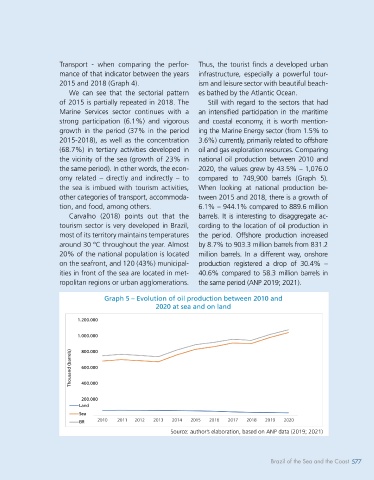
 In fact, IOMSea in 2015 showed that the   results shown in IOMSea, Table 4, year 2018,   the same period). In other words, the econ-  2020, the values  grew by 43.5% – 1,076.0
 marine and coastal economy was compa-  are capturing such findings, since the Marine   omy related – directly and indirectly – to   compared to  749,900  barrels (Graph 5).
 rable to the Brazilian agricultural sector   Services and Tertiary Adjacent to the Sea sec-  the  sea  is  imbued  with  tourism  activities,   When looking at national production be-
 (responsible for almost 20% of the nation-  tors present robust participations, as well as   other categories of transport, accommoda-  tween 2015 and 2018, there is a growth of
 al GDP) with actors incorporated down-  positive variations in the analyzed period.  tion, and food, among others.  6.1% – 944.1% compared to 889.6 million
 stream and upstream of their production   Although not very expressive, the increase   Carvalho (2018) points out that the   barrels.  It  is  interesting  to  disaggregate  ac-
 chains (CARVALHO; MORAES, 2021).  in the share of activities related to the sea in   tourism sector is very developed in Brazil,   cording to the location of oil production in
 Throughout 2018, among the nation-  the national GDP is important, as it dates   most of its territory maintains temperatures   the period. Offshore production increased
 al productive sectors, the industrial sector   back to a period of greater deterioration in   around 30 ºC throughout the year. Almost   by 8.7% to 903.3 million barrels from 831.2
 should be highlighted, with a drop in per-  economic activity and in the labor market.  20% of the national population is located   million  barrels.  In  a  different  way,  onshore
 formance. In it, the construction segment   In the decomposition of the GDP of the   on the seafront, and 120 (43%) municipal-  production registered a drop of 30.4% –
 recorded the highest negative variation   coastal and marine, it can be said that of the   ities in front of the sea are located in met-  40.6% compared to 58.3 million barrels in
 – the aforementioned result raises the hy-  9 sectors, only 2 registered a negative vari-  ropolitan regions or urban agglomerations.    the same period (ANP 2019; 2021).
 pothesis that the same is happening in the   ation - Marine Manufactures and Marine
                                Graph 5 – Evolution of oil production between 2010 and
 Graph 4 – Change in Coastal and marine GDP between the years 2015 and 2018  2020 at sea and on land
                      1.200.000
                        1.200.000
 Increase  Decrease  Total
                      1.000.000
                        1.000.000
  0,23
                         800.000
 1,94   0,21    0,00   0,10  800.000
  0,37
                         600.000
  -0,28               Thousand (barrels) mil (barris)  600.000
  -0,20                400.000
                         400.000
  0,72
                       200.000
                         200.000
                        Terra
                        Land
                        Mar 0
                        Sea
                                                               2016
                                                    2014
                                                          2015
                                                                     2017
                                                                                2019
                                                                                     2020
                                                                          2018
                                    2011
                              2010
                                         2012
                                               2013
 RMar  EMar  MMar  TMar  SMar  DMar  PAM  SAM  TAM  BR  2010        2011       2012        2013       2014       2015       2016       2017       2018       2019       2020
                        BR
                                                   Source: author’s elaboration, based on ANP data (2019; 2021)
 Source: author’s elaboration
 576   BLUE ECONOMY                                                              Brazil of the Sea and the Coast 577
                                                                                 Brazil of the Sea and the Coast
                                                                                                         577

