


Page 581 - Economia Azul - versão: inglês
P. 581
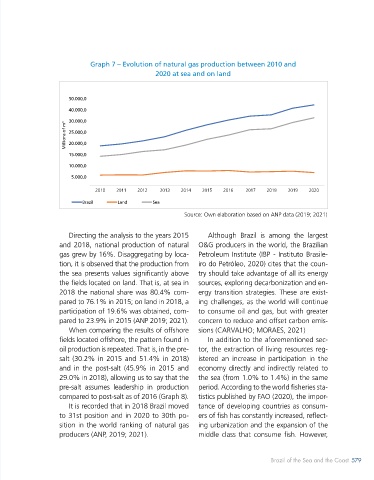
In Graph 5, it is possible to register that   In this case, we have the pre-salt with a par-  Graph 7 – Evolution of natural gas production between 2010 and
 in 2018, national oil production fell (1.3%)   ticipation rate of 55.2% in 2018 compared   2020 at sea and on land
 compared to the previous year, however, it is   to 31.5% in 2015 and in the post-salt the
 worth noting the considerable increase in oil   participation rate was 40.5% in 2018 com-
                     50.000,0
 production in the pre-salt layer between the   pared to 60% in 2015 (ANP, 2019).   50.000,0
                     40.000,0
 years mentioned (Graph 6). Thus, it is very   In light of this scenario, the magnitude    45.000,0
                      40.000,0
 important to point out the cut by produc-  of the increase in the pre-salt layer, from    35.000,0
                     30.000,0
 tion coming exclusively from the sea – focus   280.0 million barrels to 521.5 million bar-   30.000,0
                     25.000,0
 of IOMSea – in which the differences in the   rels (growth of 86.2%) between 2015 and   Millions of m 3 milhões de m 3   25.000,0
                     20.000,0
 national participation rate are pronounced.   2018, stands out (ANP, 2021).   20.000,0
                     15.000,0
                      15.000,0
                     10.000,0
                      10.000,0
                       5.000,0
                      5.000,0
                          -
                                                2013
                                    2011
                             2010
                                          2012
                                                       2014
                                                                   2016
                                                                          2017
                                                                                2018
                                                                                      2019
                                                             2015
                                                                                            2020
 Graph 6 – Evolution of oil production in the pre- and post-salt   2010         2011          2012           2013         2014         2015         2016          2017         2018         2019         2020
 layers between 2015 and 2018  Brasil  Terra  Mar
                         Brazil
                                              Sea
                                    Land

                                                        Source: Own elaboration based on ANP data (2019; 2021)
  600.000
 600.000
                     Directing the analysis to the years 2015   Although Brazil is among the largest
  500.000          and 2018, national production of natural   O&G producers in the world, the Brazilian
 500.000
                   gas grew by 16%. Disaggregating by loca-  Petroleum Institute (IBP - Instituto Brasile-
 Thousand barrels  mil barris   300.000  tion, it is observed that the production from   iro do Petróleo, 2020) cites that the coun-
  400.000
 400.000

                   the sea presents values  significantly above
                                                            try should take advantage of all its energy
 300.000
                   the fields located on land. That is, at sea in
  200.000
 200.000
                                                            ergy transition strategies. These are exist-
                   2018 the national share was 80.4% com-   sources, exploring decarbonization and en-
  100.000          pared to 76.1% in 2015; on land in 2018, a   ing challenges, as the world will continue
 100.000
                   participation of 19.6% was obtained, com-  to consume oil and gas, but with greater
  -                pared to 23.9% in 2015 (ANP 2019; 2021).  concern to reduce and offset carbon emis-
 2015  2016  2017  2018
 2015                                     2016                                      2017                                      2018
                     When comparing the results of offshore   sions (CARVALHO; MORAES, 2021)
 Pré-sal  Pós-sal
 Pre-salt
 Post-salt
                   fields located offshore, the pattern found in   In addition to the aforementioned sec-
 Source: author’s elaboration, based on ANP data (2021)  oil production is repeated. That is, in the pre-  tor, the extraction of living resources reg-
                   salt (30.2% in 2015 and 51.4% in 2018)   istered an increase in participation in the
                   and in the post-salt (45.9% in 2015 and   economy directly and indirectly related to
                   29.0% in 2018), allowing us to say that the   the sea (from 1.0% to 1.4%) in the same
                   pre-salt assumes leadership in production   period. According to the world fisheries sta-
 Brazil obtained the 10th position in the   Something similar occurred in the nation-
 ranking of the largest oil producing coun-  al production of natural gas between the   compared to post-salt as of 2016 (Graph 8).  tistics published by FAO (2020), the impor-
 tries; in 2018 and 2020 it rose to 9th place   analyzed period. Comparing the years 2010   It is recorded that in 2018 Brazil moved   tance of developing countries as consum-
 in the aforementioned world ranking (CBIE,   and 2020, the values   grew by 103% - 46.6   to 31st position and in 2020 to 30th po-  ers of fish has constantly increased, reflect-
 2020; ANP, 2019; 2021).  compared to 22.9 million m³ (Graph 7).  sition in the world ranking of natural gas   ing urbanization and the expansion of the
                   producers (ANP, 2019; 2021).             middle class that consume fish. However,
 578   BLUE ECONOMYBLUE ECONOMY                                                  Brazil of the Sea and the Coast 579
 578

