


Page 637 - Economia Azul - versão: inglês
P. 637
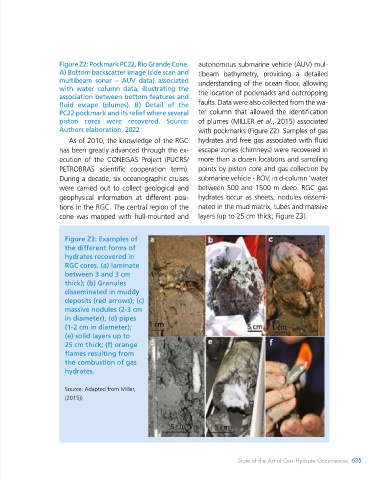
Figura Z2
                   Figure Z2: Pockmark PC22, Rio Grande Cone.   autonomous submarine vehicle (AUV) mul-
                   A) Bottom backscatter image (side scan and   tibeam bathymetry, providing a detailed
                   multibeam sonar –  AUV  data)  associated   understanding of the ocean floor, allowing
                   with water column data, illustrating the
                   association between bottom features and   the location of pockmarks and outcropping
                   fluid escape (plumes). B) Detail of the   faults. Data were also collected from the wa-
                   PC22 pockmark and its relief where several   ter  column  that  allowed  the  identification
                   piston cores were recovered. Source:     of plumes (MILLER et al., 2015) associated
                   Authors elaboration, 2022                with pockmarks (Figure Z2). Samples of gas
                     As of 2010, the knowledge of the RGC   hydrates and free gas associated with fluid
                   has been greatly advanced through the ex-  escape zones (chimneys) were recovered in
                   ecution of the CONEGAS Project (PUCRS/   more than a dozen locations and sampling
                   PETROBRAS scientific cooperation term).   points by piston core and gas collection by
                   During a decade, six oceanographic cruises   submarine vehicle - ROV, in d-column ‘water
                   were carried out to collect geological and   between 500 and 1500 m deep. RGC gas
                   geophysical information at different posi-  hydrates occur as sheets, nodules dissemi-
                   tions in the RGC. The central region of the   nated in the mud matrix, tubes and massive
                   cone was mapped with hull-mounted and    layers (up to 25 cm thick; Figure Z3).


                    Figure Z3: Examples of
                    the different forms of
                    hydrates recovered in
                    RGC cores. (a) laminate
                    between 3 and 3 cm
                    thick); (b) Granules
                    disseminated in muddy
                    deposits (red arrows); (c)
                    massive nodules (2-3 cm
                    in diameter); (d) pipes
                    (1-2 cm in diameter);
                    (e) solid layers up to
                    25 cm thick; (f) orange
                    flames resulting from
                    the combustion of gas
                    hydrates.

                    Source: Adapted from Miller,
                    (2015))


 Source: Authors elaboration (2022)


 634   ECONOMIA AZUL                                                   State of the Art of Gas Hydrate Occurrences  635
 634   BLUE ECONOMY

