


Page 633 - Economia Azul - versão: inglês
P. 633
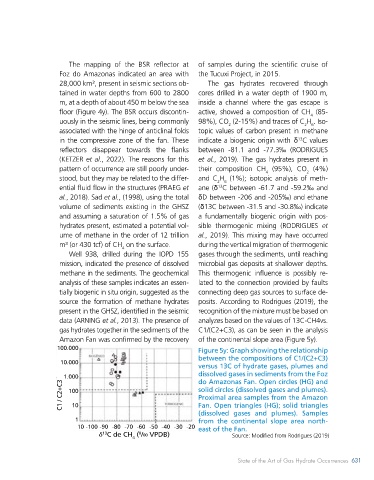
Figure 4y
 Figura y4           The mapping of the BSR reflector at    of samples during the scientific cruise of
                   Foz do Amazonas indicated an area with   the Tucuxi Project, in 2015.
                   28,000 km², present in seismic sections ob-  The gas hydrates recovered through
                   tained in water depths from 600 to 2800   cores drilled in a water depth of 1900 m,
                   m, at a depth of about 450 m below the sea   inside a channel where the gas escape is
                   floor (Figure 4y). The BSR occurs discontin-  active, showed a composition of CH  (85-
                                                                                             4
                   uously in the seismic lines, being commonly   98%), CO  (2-15%) and traces of C H . Iso-
                                                                     2                     2  6
                   associated with the hinge of anticlinal folds   topic values  of carbon present in methane

                                                                                         13
 5 o 0’0’’N        in the compressive zone of the fan. These   indicate a biogenic origin with δ C values
                                                            between -81.1 and -77.3‰ (RODRIGUES
                   reflectors disappear towards the flanks
                   (KETZER et al., 2022). The reasons for this   et  al.,  2019).  The  gas  hydrates  present  in
                   pattern of occurrence are still poorly under-  their composition CH  (95%), CO  (4%)
                                                                                4           2
                   stood, but they may be related to the differ-  and C H  (1%); isotopic analysis of meth-
                                                                 2  6
                   ential fluid flow in the structures (PRAEG et   ane (δ C between -61.7 and -59.2‰ and
                                                                 13
                   al., 2018). Sad et al., (1998), using the total   δD between -206 and -205‰) and ethane
                   volume of sediments existing in the GHSZ   (δ13C between -31.5 and -30.8‰) indicate
                   and assuming a saturation of 1.5% of gas   a fundamentally biogenic origin with pos-
                   hydrates present, estimated a potential vol-  sible thermogenic mixing (RODRIGUES  et
                   ume of methane in the order of 12 trillion   al., 2019). This mixing may have occurred
                   m³ (or 430 tcf) of CH  on the surface.   during the vertical migration of thermogenic
                                     4
                     Well  938,  drilled  during  the  IOPD  155   gases through the sediments, until reaching
 0 o 0’0’’         mission, indicated the presence of dissolved   microbial gas deposits at shallower depths.
                   methane in the sediments. The geochemical   This  thermogenic  influence  is  possibly  re-
                   analysis of these samples indicates an essen-  lated to the connection provided by faults
                   tially biogenic in situ origin, suggested as the   connecting deep gas sources to surface de-
                   source the formation of methane hydrates   posits. According to Rodrigues (2019), the
 Foz do Amazonas Fan  present in the GHSZ, identified in the seismic   recognition of the mixture must be based on

 BSR               data (ARNING et al., 2013). The presence of   analyzes based on the values  of 13C-CH4vs.
                   gas hydrates together in the sediments of the   C1/(C2+C3), as can be seen in the analysis
 50 0’0’’W  45 0’0’’W
 o
 o
                   Amazon Fan was confirmed by the recovery   of the continental slope area (Figure 5y).
 TWTT (s)         100.000
 BSR  Seabed  –1,5         BIOGÊNICO                        Figure 5y: Graph showing the relationship
                   10.000                                   between the compositions of C1/(C2+C3)
 BSR                                                        versus 13C of hydrate gases, plumes and
 –2                                                         dissolved gases in sediments from the Foz
                    1.000                                   do Amazonas Fan. Open circles (HG) and
                   C1 / C2+C3                               Proximal area samples from the Amazon
 –2,5                100                                    solid circles (dissolved gases and plumes).

                      10                        TERMOGÊNICO  Fan. Open triangles (HG); solid triangles
                                                            (dissolved gases and plumes). Samples
 Figure 4y: Map of the Foz do Amazo-  lines, coincident with the anticlinal   1  from the continental slope area north-
 nas Fan illustrating the BSR occurren-  folds, seismic line below (d-d’).   -110 -100 -90  -80  -70  -60  -50  -40  -30  -20  east of the Fan.
 ce  areas  mapped  on  the  2D  seismic   Source: Authors elaboration, 2022  δ C de CH  ( /00 VPDB)  Source: Modified from Rodrigues (2019)
                               13
                                          0
                                        4
 630   ECONOMIA AZUL                                                   State of the Art of Gas Hydrate Occurrences  631
 630   BLUE ECONOMY

