Page 642 - Economia Azul - versão: inglês
P. 642
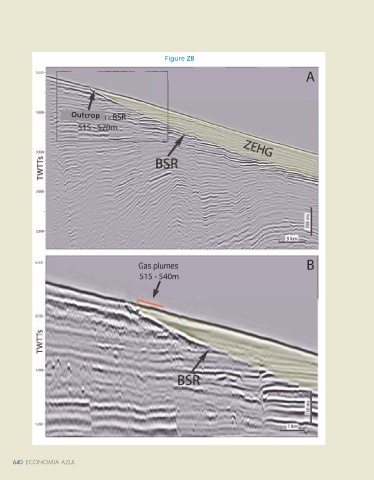
Figure Z8
            o.soo  �           ��            ===i-                                                                               communities (GIONGO  et al., 2016). In      This intersection of the BSR reflector
                                                                                            A                                    the chemosynthetic communities, micro-   with the seafloor has been observed in

                                                                                                                                 organisms that live externally attached   only a few other regions of the world (e.g.,
                                                                                                                                 (epibionts) to tubes of the Escarpia worm   Mauritania slope, DAVIES et al., 2015). The
                                                                                                                                 have been described (Figure Z7). This is a   rarity of such features is puzzling, as the
                                                                                                                                 group of methanotrophic bacteria, which   thinning of the gas hydrate stability zone re-
                      Outcrop
                                                                                                                                 indicates that these life forms are adapt-  lated to decreasing pressure (water depth)
                                                                                                                                 ed to the presence of methane, located   and increasing bottom water temperature
                                                                                                                                 near the gas seeps (MEDINA-SILVA et al.,   should naturally lead to BSR outcrops.
                                                                                                                                 2018 a and b).                           The position of the edge of the GHSZ on
                                                                                                                                    In addition to gas exudations asso-   the RGC seafloor, calculated from current
                                                                                                                                 ciated with the presence of faults and   groundwater temperature measurements,
                                                                                                                                 “pockmarks”, they also occur in the por-  is more distal to that of the BSR outcrop,
                                                                                                                                 tions where the stability zone thins in   indicating a thermodynamic imbalance be-
                                                                                                                                 the  proximal  region  of  the  RGC.  Ketzer   tween the hydrate system and the ground-
                                                                                                                                 et al. (2022) identify the presence of a   water. (KETZER et al., 2020). Bottom water
                                                                                                                                 singular phenomenon, where the GHSZ      warming to depths >500 m in the South
                                                                                                                                 thins towards the seafloor until outcrops,   Atlantic, which can be traced back at least
                                                                                                                                 characterizing an upwelling zone of the   to the 1970s (SCHMIDTKO and JOHNSON,
                                                                                                                                 BSR. This phenomenon occurs between      2012), provides strong evidence that this
                                                                                                                                 the isobaths of 515 and 520 m (KETZER    imbalance may be linked to contempo-
            o.soo                                                                           B                                    et al., 2020 – Figure Z8) where 394 gas   rary climate change (KETZER). et al., 2019;
                                          Gas plumes
                                              I                                                                                  up to 50 m in the water column. Margins   transfer from sediments to the ocean were
                                           S15-540m                                                                              plumes were detected reaching heights of   KETZER et al., 2020). The rates of methane
                                                                                                                                                                          estimated by Ketzer et al. (2020) between
                                                                                                                                 with well-defined BSR outcrops constitute
                                                                                                                                 unique  sites  to  investigate  interactions   31.3 and 144 MgCH /year (megagrams of
                                                                                                                                                                                             4
                                                                                                                                 between marine gas hydrate systems and   methane per year) in this region.
                                                                                                                                 climate change, as the edge of the GHSZ     Numerical modeling carried out for
                                                                                                                                 is the site most susceptible to gas hydrate   this area involving a scale of hundreds of
                                                                                                                                 dissociation driven by warming waters at   years confirmed the sensitivity of the hy-
                                                                                                                                 the ocean bottom (Ruppel, 2011).         drates to variations in background tem-
                                                                                                                                                                          perature, causing seasonality at the limit of
                                                                                                                                 Figure Z8: (A) Seismic profile showing   the GHSZ, which can significantly retreat
                                                                                                                                 the BSR outcrop zone in the Rio Grande   down the slope, depending on the rate of
                                                                                                                                 Cone; (B) Detail of (A) showing the BSR   increase in temperatures. This would result
                                                                                                                                 outcrop on the seafloor at 515-520 m     in complete dissociation of the hydrates
                                                                                                                                 water depth, the range of occurrence     and significant releases of methane to the
                                                                                                                                 of gas plumes and the current range of   ocean. Another phenomenon related to re-
                                                                                                                                 the gas hydrate stability zone (GHSZ).   leases of gas to the ocean is the gravity-in-

                                                                                                                                        Source: Modified from Ketzer et al., (2020)  duced collapse of depocenters down the


     640   BLUE ECONOMY                                                                                                                                                               State of the Art of Gas Hydrate Occurrences  641
     640   ECONOMIA AZUL
   637   638   639   640   641   642   643   644   645   646   647