


Page 473 - Economia Azul - versão: inglês
P. 473
to optimize routes and save fossil fuels,   information without making it confusing   signals or even satellite navigation, leads   cyber threats, with impacts that transcend
 which additionally leads to a reduction in   and overwhelming the user is generating   to the need to adopt measures of strict   the digital world. This  is because, when
 CO2 emissions from the merchant fleet.   important research in the search for deci-  cyber protection, equal to or greater than   controlling critical systems through com-
 Artificial intelligence solutions, embedded   sion support solutions with the use of ar-  those adopted on an internet-connected   puters, it is possible for an action initiat-
 in decision support and route planning   tificial intelligence and augmented reality   computer. At the same time that it allows   ed in the digital world to have concrete
 software, use long-term weather-ocean-  resources, which aim to improve maritime   great gains in the operation of ships, in-  effects in the real world, with an impact
 ographic forecasts to suggest important   situational awareness.  creasing efficiency and reducing the need   on the operation of the ship and on the
 route changes to ships. These changes aim   The Brazilian Navy is working inten-  for manpower, the digitization of systems   safety of the crew, passengers and the en-
 to avoid adverse situations of wind, current   sively on the specification and implemen-  makes room for the risks arising from     vironment (Armor Shield, 2021).
 or seakeeping (response to waves) and pro-  tation of the Amazônia Azul (Blue Ama-
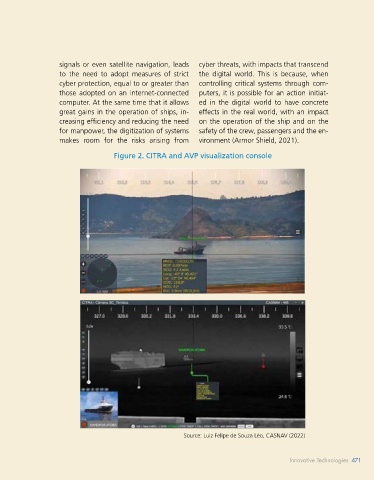
 vide the optimization of fuel consumption   zon) Management System (SisGAAz) that   Figure 2. CITRA and AVP visualization console
 in an ocean crossing.  will be able to monitor, with multiple data
 The monitoring of maritime and port   sources, the maritime space adjacent to
 traffic has undergone an important para-  the Brazilian coast, called Amazônia Azul
 digm shift since the establishment of sat-  (Blue Amazon). One of the first products
 ellite positioning systems that began to   developed  for  this  purpose  is  the  Aug-
 provide the navigator with his precise po-  mented Reality Tactical Image Console (CI-
 sition in real time, and this position began   TRA) developed by CASNAV. It integrates
 to be shared by radio with ground control   surveillance cameras, sensors such as AIS
 stations. Sharing position information be-  and ARPA Radar, located on land or on
 tween navigators helps to improve navi-  board, with artificial intelligence and aug-
 gation safety in regions of intense traffic   mented reality resources (LÉO, 2022). The
 and low visibility conditions. Today, more   result of this integration is the real-time
 than 30 years after the popularization of   presentation of high-definition images of
 GPS in the maritime environment, there   the fusion of sensor information with an
 are resources on board that automatically   intelligent synthetic layer that provides the
 share the position, heading, speed, status,   port operator with important data from
 and characteristics of vessels, such as the   the monitored targets, as can be seen in
 Automatic Identification System (AIS). Ad-  the images below. CITRA, in its Virtual As-
 vances in the data telemetry sector allow a   sistant Bridge (AVP) version, can also be
 wide range of information to be sent and   used on board a ship and offer the nav-
 received by vessels and exchanged with   igator a more accurate and harmonious
 shore control stations or even with the   tactical scenario, integrating data from
 common user over the internet.  multiple sources on a single platform, thus
 A recent technological challenge is to   improving safety at navigation.
 harmonize the amount of information   Although encouraging, the use of
 available in the environment of a mod-  computational resources in maritime ac-
 ern walkway compatible with the oper-  tivities that make use of external data
 ator’s cognitive capacity. The difficulty   for their processing, such as the use of
 found in balancing the  presentation  of    electronic nautical charts, receiving AIS   Source: Luiz Felipe de Souza Léo, CASNAV (2022)


 470   BLUE ECONOMY                                                                    Innovative Technologies  471
                                                                                       Innovative Technologies 471

