


Page 740 - Economia Azul - versão: inglês
P. 740
(generally made of polyamide or polyes-   unrolled) during the longline launch pro-
              ter) suspended by buoys and submerged     cess (UHRIN et al., 2020). It is most often                                    Figure 4. Passive fishing using drift line (above) and bottom line (below),
                                                                                                                                                           buoys and hooks highlighted
              by lead weights, maintaining neutral      used in oceanic areas but is also used in
              buoyancy, this apparatus is detached (or   Exclusive Economic Zones (FAO, 2022).

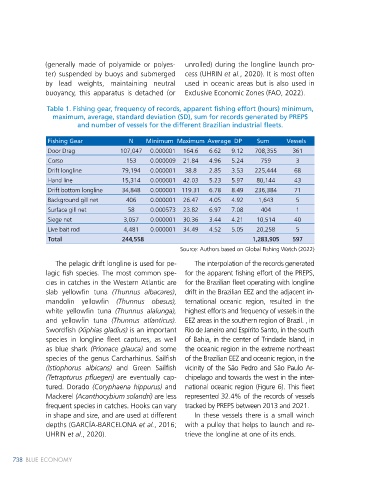
               Table 1. Fishing gear, frequency of records, apparent fishing effort (hours) minimum,
                 maximum, average, standard deviation (SD), sum for records generated by PREPS
                        and number of vessels for the different Brazilian industrial fleets.

               Fishing Gear            N    Mínimum  Maximum  Average  DP    Sum      Vessels
               Door Drag             107,047   0.000001  164.6   6.62   9.12   708,355   361
               Corso                  153    0.000009  21.84   4.96   5.24    759        3
               Drift longline        79,194   0.000001   38.8   2.85   3.53   225,444   68
               Hand line             15,314   0.000001  42.03   5.23   5.97   80,144    43
               Drift bottom longline   34,848   0.000001  119.31   6.78   8.49   236,384   71
               Background gill net    406    0.000001  26.47   4.05   4.92   1,643       5
               Surface gill net        58    0.000573  23.82   6.97   7.08    404        1
               Siege net              3,057   0.000001  30.36   3.44   4.21   10,514    40
               Live bait rod          4,481   0.000001  34.49   4.52   5.05   20,258     5

               Total                  244,558                               1,283,905   597
                                                      Source: Authors based on Global Fishing Watch (2022)

                 The pelagic drift longline is used for pe-  The interpolation of the records generated                                             Figure 5. Illustration of a longline drift vessel
               lagic fish species. The most common spe-  for the apparent fishing effort of the PREPS,
               cies in catches in the Western Atlantic are  for the Brazilian fleet operating with longline
               slab yellowfin tuna (Thunnus albacares),  drift in the Brazilian EEZ and the adjacent in-
               mandolin yellowfin  (Thunnus obesus),  ternational oceanic region, resulted in the
               white yellowfin tuna (Thunnus alalunga),  highest efforts and frequency of vessels in the
               and yellowfin tuna  (Thunnus atlanticus).  EEZ areas in the southern region of Brazil. , in
               Swordfish (Xiphias gladius) is an important  Rio de Janeiro and Espírito Santo, in the south
               species in longline fleet captures, as well  of Bahia, in the center of Trindade Island, in
               as blue shark (Prionace glauca) and some  the oceanic region in the extreme northeast
               species of the genus Carcharhinus. Sailfish  of the Brazilian EEZ and oceanic region, in the
               (Istiophorus albicans) and Green Sailfish  vicinity of the São Pedro and São Paulo Ar-
               (Tetrapturus pfluegeri)  are eventually cap-  chipelago and towards the west in the inter-
               tured. Dorado (Coryphaena hippurus) and  national oceanic region (Figure 6). This fleet
               Mackerel (Acanthocybium solandri) are less  represented 32.4% of the records of vessels
               frequent species in catches. Hooks can vary  tracked by PREPS between 2013 and 2021.
               in shape and size, and are used at different   In these vessels there is a small winch
               depths (GARCÍA-BARCELONA et al., 2016;  with a pulley that helps to launch and re-
               UHRIN et al., 2020).                     trieve the longline at one of its ends.                                                                                       Source: Cochrane & Garcia, 2009


     738   BLUE ECONOMY                                                                                                                                                        Fishing Exploitationin in the Brazilian Economic Zone  739
                                                                                                                                                                                 Fishing Exploitation in the Brazilian Economic Zone 739

