


Page 739 - Economia Azul - versão: inglês
P. 739
Other databases, known as online       that are also easily accessible, such as the
                   data repositories, aim at Open Science,   Global Fishing Watch.
 50 0’0 W     45 0’0 W    40 0’0 W    35 0’0 W    30 0’0 W    25 0’0 W    20 0’0 W
 o
 o
 o
 o
 o
 o
 o
 o
 o
 o
 o
 o
 o
 o
                   which are open and free data for re-        The possibilities of using these databases
                   searchers (LIN  et al., 2020). There are   should significantly contribute to the spatial
 10 0’0’’N  10 0’0’’N  many online repositories available today,   analysis of the areas of operation of the na-
 o
 o
                   many of them are focused on specific     tional fishing fleet, in time and space, tar-
                   areas, whether for biodiversity, ecology,   geting the captures of Brazilian marine ex-
 o
 5 0’0’’N  5 0’0’’N  oceanography, among other areas. There   tractive fisheries, as well as updating infor-
 o
                   is a quality control of this data for each   mation on these important fishing resources
 ASPSP
                   repository governed by licenses  and us-  for the fishing community of the artisanal
 0 0’0’’  0 0’0’’
 o
 o
                   age policies (LIN et al., 2020). The most   and industrial fleet in Brazil, constituting a
                   famous in the area of  biodiversity are the   landmark in the analysis of the spatial dis-

                   Ocean Biodiversity Information System    tribution of the fleets and contributing deci-
 5 0’0’’S  5 0’0’’S
 o
 o
                   (OBIS) and the Global Biodiversity Infor-  sively with subsidies for the spatial planning
                   mation Facility (GBIF), but there are others    and ordering of these fisheries.
 10 0’0’’S  10 0’0’’S
 o
 o
 Atlantic         2. Tracking national fishing vessels
 Ocean
 o
 15 0’0’’S  15 0’0’’S
 o
                     The data generated by the National     fleet were registered. The port trawl fleet
                   Program for Tracking Fishing Vessels by   represented 60.5% of the vessels, 11.9%
 Trindade          Satellite (PREPS), referring to the Brazilian   the bottom longline and 11.4% the pe-
 20 0’0’’N  20 0’0’’N
 o
 o
                   industrial and semi-industrial fleet with   lagic drift longlines (Table 1).
                   lengths of 15 meters or more, equipped     Next, information and general char-
 25 0’0’’S  25 0’0’’S  with trackers that record georeferenced   acteristics of the fleets that operate with
 o
 o
                   locations every hour, were shared with   different fishing equipment will be de-
                   the Global Fishing Watch platform. These   scribed, as well as the main resources cap-
 30 0’0’’N  30 0’0’’N
 o
 o
                   data present records between September   tured and the spatial distribution of these
                   5, 2013, and December 18, 2021. During   fleets, considering the records generated
                   this period, a total of 244,558 records   from September 2013 to December 2021.
 o
 35 0’0’’S  35 0’0’’S
 o
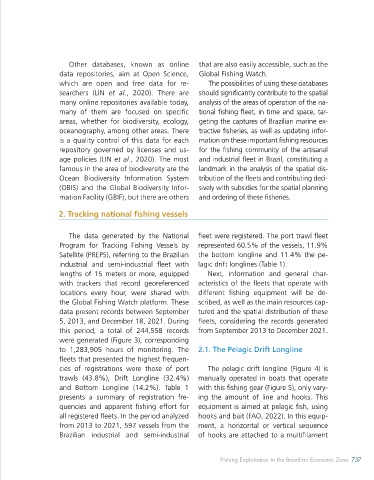
                   were generated (Figure 3), corresponding
 Exclusive Economic Zone (EEZ)
 Vessels           to 1,283,905 hours of monitoring. The    2.1. The Pelagic Drift Longline
 o
 40 0’0’’S  40 0’0’’S  fleets that presented the highest frequen-
 o
 o
 o
 o
 o
 o
 o
 50 0’0 W     45 0’0 W    40 0’0 W    35 0’0 W    30 0’0 W    25 0’0 W    20 0’0 W  cies of registrations were those of port   The pelagic drift longline (Figure 4) is
 o
 o
 o
 o
 o
 o
 o
 o
 0  312.5  625  1.250  1.875  2.500  3.125  trawls (43.8%), Drift Longline (32.4%)   manually operated in boats that operate
  Kilometers       and Bottom Longline (14.2%). Table 1     with this fishing gear (Figure 5), only vary-
 Source: Authors based on Global Fishing Watch (2022)  presents a summary of registration fre-  ing the amount of line and hooks. This
                   quencies and apparent fishing effort for   equipment is aimed at pelagic fish, using
 Figure 3. Map of the Brazilian coast and   itored vessels in the Brazilian industrial   all registered fleets. In the period analyzed   hooks and bait (FAO, 2022). In this equip-
 EEZ and the Southwest Atlantic Ocean,   fishing fleet, between September 2013   from 2013 to 2021, 597 vessels from the   ment, a horizontal or vertical sequence
 showing the spatial distribution of mon-  and December 2021.  Brazilian industrial and semi-industrial   of hooks are attached to a multifilament
 736   BLUE ECONOMY                                               Fishing Exploitation in the Brazilian Economic Zone 737
 736

