


Page 743 - Economia Azul - versão: inglês
P. 743
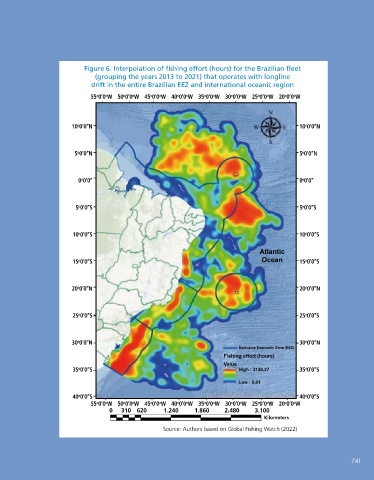
2.2. the bottom longline  The main species associated with these   Figure 6. Interpolation of fishing effort (hours) for the Brazilian fleet
 fisheries in southeastern and southern   (grouping the years 2013 to 2021) that operates with longline
 The Drift Line is not used in the cap-  Brazil are the potatofish (Lopholatilus vil-  drift in the entire Brazilian EEZ and international oceanic region
 ture  of  demersal  and  benthic  fish,  the  larii), the grouper (Epinephelus niveatus   55 0’0 W    50 0’0 W    45 0’0 W    40 0’0 W    35 0’0 W    30 0’0 W    25 0’0 W    20 0’0 W
                                                                o
                                                             o
                                                                        o
                                                                                o
                                                                                     o
                                                                     o
                                                                                        o
                                        o
                              o
                                      o
                                o
                                                     o
                                                        o
                                             o
                                                o
                                                                             o
 bottom line (Figure 4) is the technique  and Polyprion americanus) and the boni-
 used to capture these species with hooks  to (Pseudoper cisnumida). Species such as
 (FAO, 2022). This equipment follows the  the deep-sea hake (previously used almost   10 0’0’’N  10 0’0’’N
                        o
                                                                                           o
 same structure as an Espinhel, a longline  exclusively as bait), the catfish (Genidens
 drift with hooks  sequentially  connected  barbus), the croaker, the pink conger (Ge-
 to a main multifilament rope where the  nypterus brasiliensis) and the sweet-billed   5 0’0’’N  5 0’0’’N
                                                                                          o
                        o
 hooks are attached, using the same type  dogfish (Heptranchias perlo) are also ex-
 of vessel (Figure 5), and they also have the  ploited (VALENTIN and PEZZUTO, 2006).
 premise of attracting fish from baits at-  The Brazilian industrial and semi-industri-  0 0’0’’  0 0’0’’
                         o
                                                                                          o
 tached to the hooks (FADER et al., 2021).  al fleet that operates with bottom longline
 The difference is that the bottom Espinhel  operated between 2013 and 2021 predom-
 has  large  buoys  only  at  its  ends,  having  inantly in the southern regions and in the   5 0’0’’S  5 0’0’’S
                                                                                          o
                        o
 small buoys and lead throughout the main  states of São Paulo and Rio de Janeiro, in
 filament, making them always very close  the Southeast. The greatest fishing efforts
                                                                                           o
 or touching the bottom (FAO, 2022). The  are found in areas up to 100 km from the   10 0’0’’S  10 0’0’’S
                        o
 Bottom Longline is aimed at species of the  coast, which have depths of approximately
 Serranidae family (riggedgroupers and  100 m. From these areas, the fishing effort   Atlantic
                        o
                                                                                           o
 grouper), the elasmobranchs (Sharks and  is lower, although operations take place up   15 0’0’’S  Ocean  15 0’0’’S
 rays), the Lutjanidae family (red), the Ca-  to 2,000 m depth, at distances of approx-
 rangidae family (Xareús and Arabaianas)  imately 200 km from the coast (Figure 7).   o    o
 and Sparidae (Pargos) (ECHWIKHI  et al.  This fleet represented 32.4% of the records   20 0’0’’N  20 0’0’’N
 al., 2014; PINHO et al., 2020).   of vessels tracked by PREPS in the period.
                      25 0’0’’S                                                           25 0’0’’S
                        o
                                                                                           o
                      30 0’0’’N                                                           30 0’0’’N
                        o
                                                                                           o
                                                                        Exclusive Economic Zone (EEZ)
                                                                   Fishing effort (hours)
                                                                   Value
                      35 0’0’’S                                         High : 3138,27    35 0’0’’S
                                                                                           o
                        o
                                                                        Low : 0,01
                      40 0’0’’S                                                           40 0’0’’S
                                                                                           o
                        o
                                                                                        o
                                                                                     o
                                                                                o
                                                                             o
                                        o
                                             o
                                                o
                                      o
                            55 0’0 W    50 0’0 W    45 0’0 W    40 0’0 W    35 0’0 W    30 0’0 W    25 0’0 W    20 0’0 W
                              o
                                o
                                                             o
                                                                o
                                                                     o
                                                                        o
                                                     o
                                                        o
                                 0   310  620    1.240     1.860   2.480    3.100
                                                                                Kilometers
                                                 Source: Authors based on Global Fishing Watch (2022)
 740   BLUE ECONOMY                                               Fishing Exploitation in the Brazilian Economic Zone 741
                                                                                                         741

