


Page 745 - Economia Azul - versão: inglês
P. 745
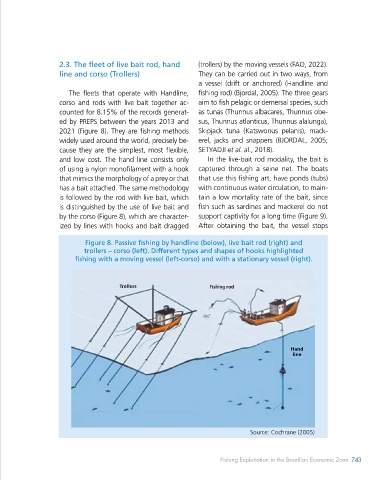
2.3. The fleet of live bait rod, hand    (trollers) by the moving vessels (FAO, 2022).
 Figure 7. Interpolation of fishing effort (hours) for the Brazilian fleet
 (grouped from 2013 to 2021) operating with longline in the southern and   line and corso (Trollers)  They can be carried out in two ways, from
 southeastern regions of the Brazilian EEZ                  a vessel (drift or anchored) (Handline and
                     The fleets that operate with Handline,   fishing rod) (Bjordal, 2005). The three gears
 50 0’0 W                                   45 0’0 W                                  40 0’0 W
 o
 o
 o
 o
 o
 o
                   corso and rods with live bait together ac-  aim to fish pelagic or demersal species, such
                   counted for 8.15% of the records generat-  as tunas (Thunnus albacares, Thunnus obe-
                   ed by PREPS between the years 2013 and   sus, Thunnus atlanticus, Thunnus alalunga),
                   2021 (Figure 8). They are fishing methods   Skipjack tuna (Katswonus pelanis), mack-
                   widely used around the world, precisely be-  erel, jacks and snappers (BJORDAL, 2005;
 20 0’0’’S  20 0’0’’S
 o
 o
                   cause they are the simplest, most flexible,   SETYADJI et al. al., 2018).
                   and  low cost. The hand  line  consists only   In the live-bait rod modality, the bait is
                   of using a nylon monofilament with a hook   captured  through  a  seine  net.  The  boats
                   that mimics the morphology of a prey or that   that use this fishing art, have ponds (tubs)
                   has a bait attached. The same methodology   with continuous water circulation, to main-
                   is followed by the rod with live bait, which   tain a low mortality rate of the bait, since
                   is distinguished by the use of live bait and   fish such as sardines and mackerel do not
 25 0’0’’S  25 0’0’’S  by the corso (Figure 8), which are character-  support captivity for a long time (Figure 9).
 o
 o
                   ized by lines with hooks and bait dragged   After obtaining the bait, the vessel stops
                          Figure 8. Passive fishing by handline (below), live bait rod (right) and
 Atlantic                 trollers – corso (left). Different types and shapes of hooks highlighted
 Ocean                 fishing with a moving vessel (left-corso) and with a stationary vessel (right).
                                   Trollers                   Fishing rod
 o
 30 0’0’’S  30 0’0’’S
 o
                                    Trollers                   Fishing rod
 Isobath 2000m
 Isobath_300m
 Isobath 100m
 Isobath 50m
 Exclusive Economic Zone (EEZ)
 o
 35 0’0’’S  Fishing Efforts (hours)  35 0’0’’S                                         Hand
 o
                                                                                        line
 Value
 High : 5420
 Low : 0,01

 50 0’0 W                                   45 0’0 W                                  40 0’0 W
 o
 o
 o
 o
 o
 o
 0  120  240  480  720  960  1.200
  Kilometers
 Source: Authors based on Global Fishing Watch (2022)                      Source: Cochrane (2005)
 742   BLUE ECONOMY                                               Fishing Exploitation in the Brazilian Economic Zone 743
 742

