


Page 749 - Economia Azul - versão: inglês
P. 749
300 meters. In this region, the fleet oper-  to pelagic species, mainly to yellowfin tuna
 Figure 11. Interpolation of fishing effort (hours) for the Brazilian fleet   ates to depths greater than 2,000 m, close   (Thunnus albacares), mackerel (Acanthocy-
 (grouped from 2013 to 2021) that operates with handline i
 n the Brazilian EEZ and the international oceanic region  to the outer limit of the Brazilian EEZ (Figure   bium solandri)  and kingfish (Elagatis bip-
                   11). In the surroundings of the Archipelago   inulattus. In the surroundings of the Ocean
 o
 55 0’0 W        50 0’0 W        45 0’0 W       40 0’0 W        35 0’0 W       30 0’0 W       25 0’0 W      of São Pedro and São Paulo (ASPSP) there   Banks  and adjacent areas, exploration is
 o
 o
 o
 o
 o
 o
 o
 o
 o
 o
 o
 o
 o
 o
 10 0’0’’N  10 0’0’’N
 o
                   is a considerable effort of the line fleet,   currently directed mainly for schools of tuna
                   which  starts  in  the  extreme  northeast  of   species  (Thunnus albacares and Thunnus
                   the coast of Rio Grande do Norte, as well   atlanticus), and for demersal species of the
 5 0’0’’N  5 0’0’’N  as in the surroundings of the Atol das Ro-  Lutjanidae family  (Lutanus jocu, Lutjanus
 o
 o
 ASPSP             cas, on the Island of Fernando de Noronha   analis, Lutjanus vivanus, Etelis oculatus), and
                   and in the Oceanic Banks of the Brazilian   groupers of the Serranidade family, of the

 0 0’0’’  0 0’0’’  North Chain. A small area of  operation was   genera Epinephelus and Mycteroperca.
 o
 o
                   identified in the extreme west of the Brazil-  2.4 The gill net
                   ian coast, on the coast of Amapá near the
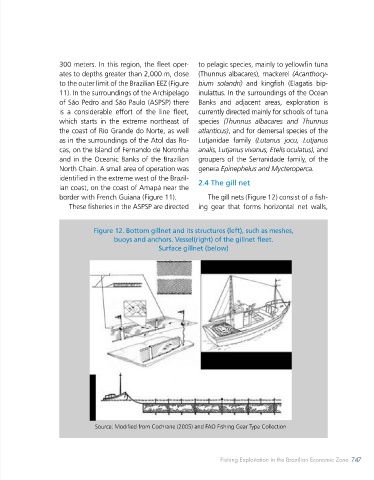
 5 0’0’’S  5 0’0’’S  border with French Guiana (Figure 11).    The gill nets (Figure 12) consist of a fish-
 o
 o
                     These fisheries in the ASPSP are directed   ing gear that forms horizontal net walls,
 10 0’0’’S  10 0’0’’S        Figure 12. Bottom gillnet and its structures (left), such as meshes,
 o
 o
                                   buoys and anchors. Vessel(right) of the gillnet fleet.
 Atlantic                                       Surface gillnet (below)
 Ocean
 15 0’0’’S  15 0’0’’S
 o
 o
 o
 20 0’0’’N  20 0’0’’N
 o
 25 0’0’’S  Isobath 2000m  25 0’0’’S
 o
 o
 Isobath_300m
 Isobath 100m
 Isobath 50m
 o
 30 0’0’’N  Exclusive Economic Zone (EEZ)  30 0’0’’N
 o
 Fishing Efforts (hours)
 Value
 High : 1039
 o
 o
 35 0’0’’S  Low : 0,01  35 0’0’’S
 55 0’0 W        50 0’0 W        45 0’0 W       40 0’0 W        35 0’0 W       30 0’0 W       25 0’0 W
 o
 o
 o
 o
 o
 o
 o
 o
 o
 o
 o
 o
 o
 o
 0  265  530  1.000  1.590  2.120  2.860
  Kilometers

 Source: Authors based on Global Fishing Watch (2022). (https://globalfishingwatch.org/)  Source: Modified from Cochrane (2005) and FAO Fishing Gear Type Collection
 746   BLUE ECONOMY                                               Fishing Exploitation in the Brazilian Economic Zone 747
 746   ECONOMIA AZUL

