


Page 750 - Economia Azul - versão: inglês
P. 750
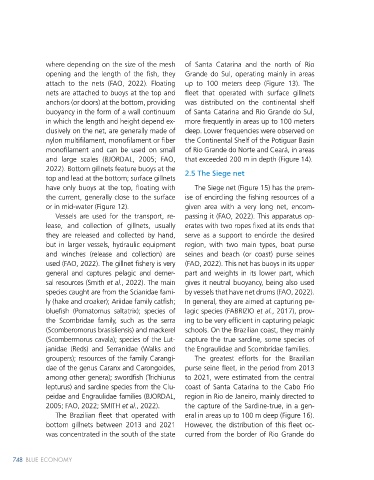
where depending on the size of the mesh of Santa Catarina and the north of Rio Figure 13. Interpolation of fishing effort (hours) for the Brazilian
opening and the length of the fish, they Grande do Sul, operating mainly in areas fleet (grouped from 2013 to 2021) operating with bottom
attach to the nets (FAO, 2022). Floating up to 100 meters deep (Figure 13). The gillnets in the Brazilian EEZ
nets are attached to buoys at the top and fleet that operated with surface gillnets 50 0’0 W 45 0’0 W
o
o
o
o
anchors (or doors) at the bottom, providing was distributed on the continental shelf
buoyancy in the form of a wall continuum of Santa Catarina and Rio Grande do Sul,
in which the length and height depend ex- more frequently in areas up to 100 meters
clusively on the net, are generally made of deep. Lower frequencies were observed on
nylon multifilament, monofilament or fiber the Continental Shelf of the Potiguar Basin 25 0’0’’S
o
monofilament and can be used on small of Rio Grande do Norte and Ceará, in areas
and large scales (BJORDAL, 2005; FAO, that exceeded 200 m in depth (Figure 14).
o
o
2022). Bottom gillnets feature buoys at the 2.5 The Siege net 25 0’0’’S 25 0’0’’S
top and lead at the bottom; surface gillnets
have only buoys at the top, floating with The Siege net (Figure 15) has the prem-
the current, generally close to the surface ise of encircling the fishing resources of a
or in mid-water (Figure 12). given area with a very long net, encom-
Vessels are used for the transport, re- passing it (FAO, 2022). This apparatus op-
lease, and collection of gillnets, usually erates with two ropes fixed at its ends that 30 0’0’’S
o
they are released and collected by hand, serve as a support to encircle the desired
but in larger vessels, hydraulic equipment region, with two main types, boat purse
o
o
and winches (release and collection) are seines and beach (or coast) purse seines 30 0’0’’S Atlantic 30 0’0’’S
used (FAO, 2022). The gillnet fishery is very (FAO, 2022). This net has buoys in its upper Ocean
general and captures pelagic and demer- part and weights in its lower part, which
sal resources (Smith et al., 2022). The main gives it neutral buoyancy, being also used
species caught are from the Scianidae fami- by vessels that have net drums (FAO, 2022).
ly (hake and croaker); Ariidae family catfish; In general, they are aimed at capturing pe-
bluefish (Pomatomus saltatrix); species of lagic species (FABRIZIO et al., 2017), prov-
the Scombridae family, such as the serra ing to be very efficient in capturing pelagic Isobath 200m 35 0’0’’S
o
(Scomberomorus brasisliensis) and mackerel schools. On the Brazilian coast, they mainly Isobath 100m
Isobath 50m
o
o
(Scombermorus cavala); species of the Lut- capture the true sardine, some species of 35 0’0’’S Exclusive Economic Zone (EEZ) 35 0’0’’S
janidae (Reds) and Serranidae (Walks and the Engraulidae and Scombridae families. Fishing Efforts (hours)
groupers); resources of the family Carangi- The greatest efforts for the Brazilian Value High : 37,4
dae of the genus Caranx and Carongoides, purse seine fleet, in the period from 2013
among other genera); swordfish (Trichiurus to 2021, were estimated from the central Low : 0,01
lepturus) and sardine species from the Clu- coast of Santa Catarina to the Cabo Frio
peidae and Engraulidae families (BJORDAL, region in Rio de Janeiro, mainly directed to 50 0’0 W 45 0’0 W
o
o
o
o
2005; FAO, 2022; SMITH et al., 2022). the capture of the Sardine-true, in a gen-
The Brazilian fleet that operated with eral in areas up to 100 m deep (Figure 16). 0 90 160 360 540 720 900
Kilometers
bottom gillnets between 2013 and 2021 However, the distribution of this fleet oc-
was concentrated in the south of the state curred from the border of Rio Grande do Source: Authors based on Global Fishing Watch (2022)
748 BLUE ECONOMY Fishing Exploitation in the Brazilian Economic Zone 749
749

