


Page 702 - Economia Azul - versão: inglês
P. 702
demand decreases of more than 70%. During   for icebreakers and natural gas carriers due                           intrinsically related to the country’s econom-  credit objects are included as likely to be
              this period, the Russian shipbuilding sector,   to their exploration objectives in the Arctic re-                  ic cycles. Thus, according to Barat, Campos   covered by the financing offered.
              which is also dominated by state-owned    gion. Currently one of the largest companies                             Neto and Paula (2014), in the period from   The FMM is an accounting fund that relies
              companies, deserves to be highlighted. Con-  in the country is the United Shipbuilding Cor-                        1880 to 1930, the development of port infra-  on resources from the following sources: (i)
              trary to the global downward trend, the   poration (USC), created in 2007 and owned                                structure was closely related to the country’s   percentage on the collection of the Additional
              country’s shipyards have seen an increase in   by the government. The sector is dependent                          export efforts. However, at that time, there   Freight for the Renewal of the Merchant Ma-
              their production due to government demand   on the military demands of the State (Idem).                           was no policy dedicated to the naval industry.  rine (AFRMM); (ii) budget allocations in the
                                                                                                                                    According  to  D’Avila and  Bridi  (2017),   General Budget of the Union; (iii) amounts
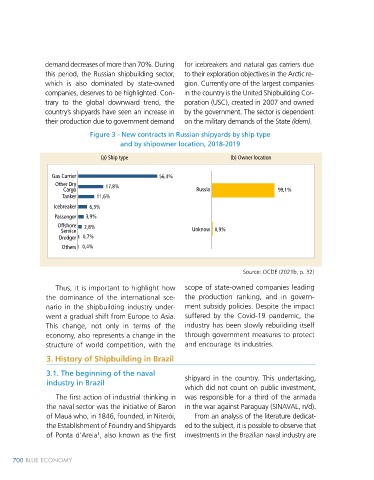
                            Figure 3 - New contracts in Russian shipyards by ship type
                                     and by shipowner location, 2018-2019                                                        it was only in the 1950s that the naval in-  and amounts allocated by law, product of
                                                                                                                                 dustry began to receive government atten-  the return on financing operations granted;
                               (a) Ship type                         (b) Owner location                                          tion, with its inclusion in the Goals Plan.   (iv) other income from financial investments .
                                                                                                                                                                                                               2
                                                                                                                                 And, only at the end of the 1960s, specific   It is currently managed by the Ministry of In-
                Gas Carrier                     56,4%                                                                            actions began to exist aimed at this indus-  frastructure and the Board of Directors of the
                 Other Dry      17,8%                                                                                            try, as stated by Amaral, Gomide and Pires
                    Cargo                                  Russia                  99,1%                                                                                  Merchant Marine Fund. During the period of
                   Tanker     11,6%                                                                                              (2014); D’Avila and Bridi (2017); and Sina-  existence of the FMM, it underwent several
                 Icebreaker  6,3%                                                                                                val (n/d), with the Shipbuilding Emergency   modifications, the last one occurring with the
                 Passenger  3,9%                                                                                                 Plan (1969/1970) and the Shipbuilding Pro-  approval of Law 13,401, of 01/07/2022, also
                  Offshore  2,8%                                                                                                 grams (1970 to 1980). As defined in Pires,   known as BR do Mar.
                   Service                                Unknow 0,9%
                  Dredger  0,7%                                                                                                  Gomide and Amaral (2014a, p. 188-189)    3.3. The shipping industry in the
                   Others  0,4%                                                                                                      “[...] the naval industry comprises the   1970s
                                                                                                                                     activity of manufacturing vessels and
                                                                                                                                     water transport vehicles in general,    During the 1970s, Brazil was relatively
                                                                         Source: OCDE (2021b, p. 32)                                                                      successful in the performance of its naval
                                                                                                                                     ranging from maritime support vessels,
                 Thus, it is important to highlight how   scope of state-owned companies leading                                     port, oil tankers, bulk carriers, contain-  industry, serving 4% of the world market,
                                                                                                                                                                          according  to  Amaral,  Gomide  and  Pires
               the dominance of the international sce-  the production ranking, and in govern-                                       er carriers and river convoys to the   (2014), in addition to employing around
               nario in the shipbuilding industry under-  ment subsidy policies. Despite the impact                                  construction of shipyards, platforms   40,000 people. This industry was based
               went a gradual shift from Europe to Asia.   suffered by the Covid-19 pandemic, the                                    and drilling rigs for offshore oil produc-  on foreign technology: Japanese, Dutch,
               This change, not only in terms of the    industry has been slowly rebuilding itself                                   tion, in addition to the entire ship parts   German and English, but it had a high per-
               economy, also represents a change in the   through government measures to protect                                     supply network”.                     centage of nationalization, approaching
               structure of world competition, with the   and encourage its industries.                                                                                   60%. Thus, what characterizes this period
                                                                                                                                 3.2. The Merchant Marine Fund (FMM)
               3. History of Shipbuilding in Brazil                                                                                                                       of production success are the internation-
                                                                                                                                    In 1958, the Merchant Marine Fund -   al orders, when Brazil came to occupy the
               3.1. The beginning of the naval          shipyard  in  the country.  This undertaking,                            FMM was created, through Law 3,381.      second place in the world orders.
               industry in Brazil
                                                        which did not count on public investment,                                The initiative addresses the financing of   However, with the world economic crisis
                  The first action of industrial thinking in   was responsible for a third of the armada                         various activities related to the naval in-  of 1980, the market lost strength and not
               the naval sector was the initiative of Baron   in the war against Paraguay (SINAVAL, n/d).                        dustry, such as the construction and acqui-  even the government’s efforts with the Sec-
               of Mauá who, in 1846, founded, in Niterói,   From an analysis of the literature dedicat-                          sition of vessels and shipyards. According   ond Shipbuilding Program of 1981 were
               the Establishment of Foundry and Shipyards   ed to the subject, it is possible to observe that                    to the development of the industry, the   able to maintain the country’s production
               of Ponta d’Areia , also known as the first   investments in the Brazilian naval industry are                      fund’s regulations are modified, and new   (D’AVILA; BRIDI, 2017; PIRES; GOMIDE;
                              1

     700  BLUE ECONOMY                                                                                                                                                                               Brazilian Naval Industry 701

