


Page 705 - Economia Azul - versão: inglês
P. 705
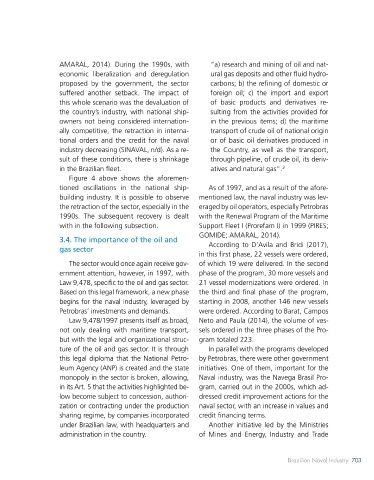
Table 1 – Merchant Marine Fund  AMARAL, 2014). During the 1990s, with   “a) research and mining of oil and nat-
                   economic liberalization and deregulation    ural gas deposits and other fluid hydro-
 Year     Number of completed projects                                 Onlending of financing   proposed by  the government, the sector   carbons; b) the refining of domestic or
            Vessels            Shipyards                             resources to the naval industry   suffered another setback. The impact of   foreign oil; c) the import and export
                                    (in billions)
                   this whole scenario was the devaluation of   of basic products and derivatives re-
 2007  33  0  1.10  the country’s industry, with national ship-  sulting from the activities provided for
 2008  51  1  1.30                                             in the previous items; d) the maritime
 2009  36  0  2.30  owners not being considered internation-
 2010  40  1  2.60  ally competitive, the retraction in interna-  transport of crude oil of national origin
 2011  60  2  2.60  tional orders and the credit for the naval   or of basic oil derivatives produced in
 2012  30  0  4.10  industry decreasing (SINAVAL, n/d). As a re-  the Country, as well as the transport,
 2013  76  4  4.50
 2014  89  2  4.00  sult of these conditions, there is shrinkage   through pipeline, of crude oil, its deriv-
 2015  70  2  4.90  in the Brazilian fleet.                    atives and natural gas”. 3
 2016  119  0  2.80  Figure 4 above shows the aforemen-
 2017  82  2  2.30  tioned oscillations in the national ship-  As of 1997, and as a result of the afore-
 2018  54  0  2.60
 2019  53  0  2.00  building industry. It is possible to observe   mentioned law, the naval industry was lev-
 2020  92  1  0.35  the retraction of the sector, especially in the   eraged by oil operators, especially Petrobras
 2021  46  0  0.21  1990s. The subsequent recovery is dealt   with the Renewal Program of the Maritime
 Total  931  15  37.67  with in the following subsection.   Support Fleet I (Prorefam I) in 1999 (PIRES;
 Source: Own elaboration, based on the Ministry of Integration’s website 3  GOMIDE; AMARAL, 2014).
 Figure 4 – Evolution of the number of employees and the volume   3.4. The importance of the oil and   According to D’Avila and Bridi (2017),
 of production in the Brazilian naval industry 1960-2009  gas sector  in this first phase, 22 vessels were ordered,
                     The sector would once again receive gov-  of which 19 were delivered. In the second
 3,5  49,0
                   ernment attention, however, in 1997, with   phase of the program, 30 more vessels and
                   Law 9,478, specific to the oil and gas sector.   21 vessel modernizations were ordered. In
 3,0  42,0
                   Based on this legal framework, a new phase   the third and final phase of the program,
 Production (in millions of TPB’s)  2,0  28,0 Employees (in thousands)  not only dealing with maritime transport,   Neto and Paula (2014), the volume of ves-
                                                            starting in 2008, another 146 new vessels
                   begins for the naval industry, leveraged by
 35,0
 2,5
                   Petrobras’ investments and demands.
                                                            were ordered. According to Barat, Campos
                     Law 9,478/1997 presents itself as broad,
                                                            sels ordered in the three phases of the Pro-
 21,0
 1,5
                                                            gram totaled 223.
                   but with the legal and organizational struc-
                   ture of the oil and gas sector. It is through
                                                               In parallel with the programs developed
 14,0
 1,0
                   this legal diploma that the National Petro-
                   leum Agency (ANP) is created and the state
                                                            initiatives. One of them, important for the
 7,0
 0,5
                                                            Naval industry, was the Navega Brasil Pro-
                   monopoly in the sector is broken, allowing,   by Petrobras, there were other government
 0,0  0,0          in its Art. 5 that the activities highlighted be-  gram, carried out in the 2000s, which ad-
 1960  1961  1965  1970  1971  1974  1975  1976  1978  1979  1980  1981  1985  1990  1996  1997  1998  2000  2001  2002  2003  2004  2005  2006  2007  2008  2009  low become subject to concession, authori-  dressed credit improvement actions for the

 Fase              zation or contracting under the production   naval sector, with an increase in values  and
                   sharing regime, by companies incorporated   credit financing terms.
 Contracted TPBs  TPBs delivered  Employees
                   under Brazilian law, with headquarters and   Another initiative led by the Ministries
 Source: BARAT; FIELDS NETO; PAULA, 2014, p.64  administration in the country.  of Mines and Energy, Industry and Trade
 702  BLUE ECONOMY                                                                    Brazilian Naval Industry 703

