


Page 685 - Economia Azul - versão: inglês
P. 685
there is a constant stability, that is, there   1.57 – 2019 – 11th position), in which we   – 45 MTEU (million TEUS) in 2020; Singapo-  value.  This  has  a  direct  relationship  with
 was no growth in this international share   notice a sharp decay. On the other hand,   re (37 MTEU); Ningbo-Zhoushan (32 MTEU);   the industry. The main containerized lo-
 when compared between the beginning   we check the case of Japan (2.80 – 2000 –   Shezhen (26 MTEU); Rotterdam (15 MTEU).  ads in maritime transport are presented by
 and end of the series, mainly in products   1st position – 2.49 – 2019 – 1st position),   It is clearly observed that the 4 main ports   Port Economics, Management and Policy
 with higher added value, which demand a   South Korea (1.25 – 2000 – 20th position   presented in the world are directly related to   (2021), as follows:
 specific infrastructure for cargo handling,   – 2.05 – 2019 – 4th position), as well as   their level of complexity, and the first nine  .   Miscellaneous manufactures include
 such as container terminals.  China (0.44 – 2000 – 39th position – 1.35   in the world are concentrated in Asia, and   items  made  of  plastic  (e.g.,  bags),  toys,
 In this way, we can identify the degree   – 2019 – 16th position), Singapore (1.55 –   as demonstrated in the previous section,   sporting goods, or office supplies;
 of economic complexity from the loads we   2000 – 11th position – 2.00 – 2019 – 5th   the region that expanded its ICE. Rotterdam  .  Electrical machines, including electri-
 export and move in the country. Thus, eco-  position) and Vietnam (0.59 – 2000 – 93rd   is  the  only  European  port  in  force  among   cally powered machines such as electrical
 nomic development requires the accumula-  position – 0.05 – 2019 – 56th position),   the first in the world, in the tenth position.   cables, appliances, batteries and integra-
 tion of productive knowledge and its use in   showing that some countries have increa-  When we analyze the case of Brazil, we see   ted circuits;
 increasingly complex sectors. The Harvard   sed their production complexity in the last   that in the same period the terminals that  . Vegetables and fruits make up an im-
 Growth Lab country rankings assess a coun-  few years. This shows that port logistics   had the greatest growth in exports were   portant segment of transport by refrige-
 try’s current state of productive knowledge   development has a strong correlation with   those connected to ores and vegetable solid   rated containers. This sector has seen re-
 using the Economic Complexity Index (ECI).   the degree of global economic complexity.  bulk. The port of Santos, which is the largest   markable growth with more reliable cold
 Countries improve their ECI by increasing   public port in Brazil, is in the 45th position   chain logistics;
 the number and complexity of products they   1.6 Economic complexity reflects on   in terms of global movements totaling 2.6  .  Textiles and made-up items include
 successfully export, that is, higher techno-  container transport  million units (4.23 million TEU), according to   yarn, woven fibers, blankets, sheets, cur-
 logy products represent a higher degree of   the Port of Santos 2020 yearbook.  tains and rugs.
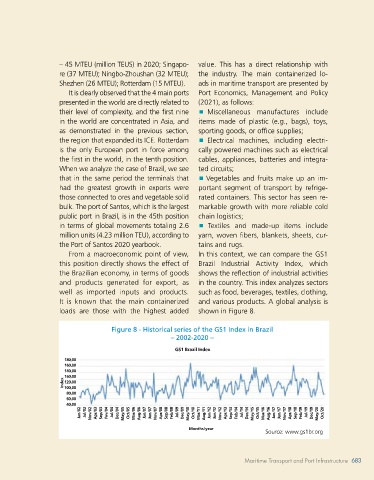
 ECI, which represents greater added value.  The movement of containers can be   From a macroeconomic point of view,   In this context, we can compare the GS1
 In 2000, the Brazilian ICE was 0.86   used as a thermometer to evaluate the eco-  this position directly shows the effect of   Brazil Industrial Activity Index, which
 (26th position) and in 2019 it was 0.10   nomy of a country, considering the nature   the Brazilian economy, in terms of goods   shows the reflection of industrial activities
 (53rd position). In other words, these data,   of the main loads that are usually on bo-  and products generated for export, as   in the country. This index analyzes sectors
 when compared with Figure 7, show that   ard these boxes. The recent example of this   well as imported inputs and products.   such as food, beverages, textiles, clothing,
 due to the greater participation in the glo-  phenomenon occurred with Covid-19. For   It  is  known  that  the  main  containerized   and various products. A global analysis is
 bal market share of products such as com-  a few months the global economy went   loads  are  those with the highest added   shown in Figure 8.
 modities  (agricultural  and  mineral),  the   into a process of stagnation, but when it
 country has been reducing its complexity in   resumed, all the reflection was based on   Figure 8 - Historical series of the GS1 Index in Brazil
 terms of production for export. This means   the shortage of containers, queues of ships   – 2002-2020 –
 that cargo that is shipped in large volumes   in ports and congestion. This was a positi-  GS1 Brazil Index
 at Brazilian ports has less production com-  ve sign of economic recovery in the world’s   180,00
 plexity compared to cargo from other cou-  largest economies. To validate our state-  160,00
                    140,00
 ntries with a higher degree of industrializa-  ment, it is enough to carry out a compari-  160,00
 tion and technological value added to the   son of the main global container terminals   Index  120,00
                    100,00
 exported products. This phenomenon is not   in recent years, and the container is a cargo   80,00
                     60,00
 only Brazilian, but it also occurs with other   that generally transports products with hi-  40,00
 countries such as Argentina (0.14 – 2000   gher added value, which consequently has   Jan/02  Jul/02  Nov/02  Apr/03  Sep/03  Fev/04  Jul/04  Dec/04  May/05  Oct/05  Mar/06  Aug/06  Jan/07  Jun/07  Nov/07  Apr/08  Sep/08  Feb/08  Jul/09  Dec/09  May/10  Oct/10  Mar/11  Aug/11  Jan/12  Jun/12  Nov/12  Apr/13  Sep/13  Feb/14  Jul/14  Dec/14  May/15  Oct/15  Mar/16  Aug/16  Jan/17  Jun/17  Nov/17  Apr/18  Sep/18  Feb/19  Jul/19  Dec/19  M
 – 54th position – 0.24 – 2019 – 73rd), the   a correlation with the ICE of the countries.   Months/year
 United States (1.99 – 2000 – 6th position –   The main container handling port is Shanghai   Source: www.gs1br.org


                                                                                                         683
                                                                         Maritime Transport and Port Infrastructure
 682   BLUE ECONOMY                                                      Maritime Transport and Port Infrastructure 683

