


Page 689 - Economia Azul - versão: inglês
P. 689
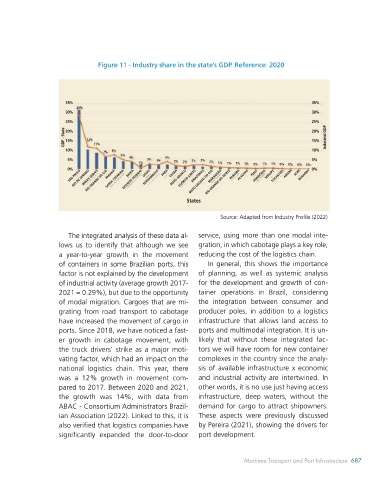
Notably, the port of Santos is the largest   the national economic development hub in   Figure 11 - Industry share in the state’s GDP. Reference: 2020
 container hub complex in the country. This   the Southeast region.
 is mainly justified by the fact that the state   In this sense, it is also possible to ob-
 of São Paulo is the largest national GDP,   serve the economic relationship of the in-
 and is the hub of the largest number of   dustry in the state of São Paulo in terms   35%   35%
                        29%
 companies, showing the influence of the   of the collection of social security contri-  30%  30%
 industrialization x containerization relation-  butions (CSS) as an element that gener-  25%  25%
 ship. Allied to this, the transport infrastruc-  ates taxes arising from industrial activity   20%  20%
 ture of the state of São Paulo also allows   (Figure 10). For a better understanding of   GDP - State  15%  12% 11%  15%  Industrial GDP
 capturing  cargo  in  several  states  that are   these  economic  relationships  versus  the   10%  7%  8%  10%
 in its hinterland. The container terminals at   infrastructure available for handling con-  5%  5%  4%  3%  4%  2%  2%  5%
                                          1%        2%  2%     2%  1%  1%  1%  1%  0%  1%  1%  0%  0%  0%  0%
 the port of Santos are directly integrated   tainers, we related the CSS to the num-  0%  BAHIA  GOIÁS  PARÁ  CEARÁ  PIAUÍ  ACRE
                                                          AMAZONAS
                           RIO GRANDE DO SUL
                                 SANTA CATARINA
                                                              RIO GRANDE DO NORTE
                                                      ESPÍRITO SANTO
                       RIO DE JANEIRO
 with the provision of a logistics infrastruc-  ber of terminals available in each state of   SÃO PAULO  MINAS GERAIS  PARANÁ  DISTRITO FEDERAL  PERNAMBUCO  MATO GROSSO  MATO GROSSO DO SUL MARANHÃO  PARAÍBA ALAGOAS  RONDÔNIA  SERGIPE TOCANTINS  AMAPÁ  RORAIMA 0%
 ture, in addition to being concentrated in   the federation.

                                                        States
 Figure 10 - Social Security Contribution Collection Ranking (CSS) of the   Source: Adapted from Industry Profile (2022)
 States Industry – 2017 data x number of container terminals
                     The integrated analysis of these data al-  service, using more than one modal inte-
                  lows  us  to  identify  that  although  we  see   gration, in which cabotage plays a key role,
 R$ 35.000,00  5  a year-to-year growth in the movement     reducing the cost of the logistics chain.
 R$ 30.000,00
 4                of containers in some Brazilian ports, this   In general, this shows the importance
 R$ 25.000,00
 3 Number of Container Terminals  factor is not explained by the development   of planning, as well as systemic analysis
 R$ 20.000,00     of industrial activity (average growth 2017-  for the development and growth of con-
 R$ 15.000,00  2  2021 = 0.29%), but due to the opportunity   tainer operations in Brazil, considering
 R$ 10.000,00
 1                of modal migration. Cargoes that are mi-  the integration between consumer and
 R$ 5.000,00
                  grating from road transport to cabotage   producer poles, in addition to a logistics
 R$ 0,00  0
 RIO GRANDE DO NORTE
 SANTA CATARINA
 GOIÁS
 PARANÁ
 SÃO PAULO  MINAS GERAIS RIO GRANDE DO SUL  BAHIA  PERNAMBUCO ESPÍRITO SANTO  PARÁ AMAZONAS MATO GROSSO DO SUL  MARANHÃO PARAÍBA  SERGIPE ALAGOAS RONDÔNIA  PIAUÍ TOCANTINS  ACRE  AMAPÁ RORAIMA  have increased the movement of cargo in   infrastructure that allows land access to
 RIO DE JANEIRO
 CEARÁ
 MATO GROSSO
 DISTRITO FEDERAL
                                                            ports and multimodal integration. It is un-
                  ports. Since 2018, we have noticed a fast-
                                                            tors we will have room for new container
                  the truck drivers’ strike as a major moti-
 States           er growth in cabotage movement, with      likely that without these integrated fac-
                  vating factor, which had an impact on the   complexes in the country since the analy-
 Source: Adapted from Industry Profile (2022)  national logistics chain. This year, there   sis of available infrastructure x economic
                  was a 12%  growth  in movement com-       and industrial activity are intertwined. In
                  pared to 2017. Between 2020 and 2021,     other words, it is no use just having access
                  the growth was 14%, with data from        infrastructure,  deep  waters,  without  the
 Therefore, we clearly note that the   containerized cargo. Additionally, we   ABAC - Consortium Administrators Brazil-  demand for cargo to attract shipowners.
 states with the highest contribution   relate the states in terms of share of   ian Association (2022). Linked to this, it is   These aspects were previously discussed
 are those that also have the high-  national GDP x industrial GDP of the   also verified that logistics companies have   by Pereira (2021), showing the drivers for
 est number of terminals for handling   respective states (Figure 11).  significantly expanded the door-to-door   port development.

 686   BLUE ECONOMYBLUE ECONOMY                                          Maritime Transport and Port Infrastructure  687
 686

