


Page 617 - Economia Azul - versão: inglês
P. 617
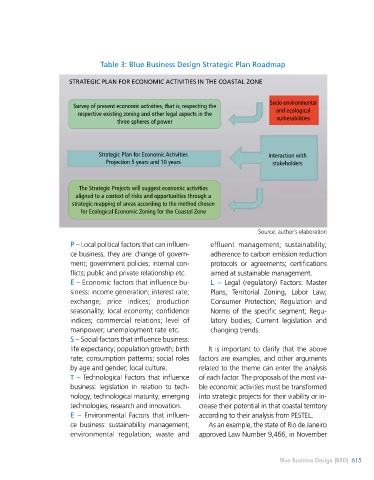
Table 2: Ecological-Economic Zoning Model  Table 3: Blue Business Design Strategic Plan Roadmap


 a.  Mangrove in its entirety  Areas of   a.  Traditional and artisanal   STRATEGIC PLAN FOR ECONOMIC ACTIVITIES IN THE COASTAL ZONE
 b.  Atlantic Forest  Intensive     fishing
 Areas of   c.  Riparian Forest. Minimum    Economic Use   b.  Ecotourism and responsible
 Protection     preservation range of 50 (fifty)    (AUEI))    tourism  Survey of present economic activities, that is, respecting the   Socio-environmental
 c.  Primary contact sports.
 and     meters, starting from themost    respective existing zoning and other legal aspects in the   and ecological
 Conservation     seasonal bed, measured      These are areas associated with   three spheres of power  vulnerabilities
 (APC)    horizontally  ecosystems that have been
 d.  Sandbanks, Dunes, and Beaches  suffering strong degradation in
 e.  Rocky Shores.  the coastal zone.
 Areas of Potential   a.  Coastal ecosystems adjacent
 Environmental     to the urban area  Strategic Plan for Economic Activities    Interaction with
 Exclusive   a.  Nautical leisure areas and repairs  Risk (APRA)  b.  Ecosystems pressured by     Projection 5 years and 10 years
 Economic   b.  Ports and Shipyards  non-compatible economic                      stakeholders
 Use Areas   c.  Oil  activities.
 d.   Tourism
 (AUEE)
 e.   Industrial Fishing
                        The Strategic Projects will suggest economic activities
 Urbanized Areas   These are the urban centers   aligned to a context of risks and opportunities through a
 and Urban   located in the Coastal Zone (CZ)   strategic mapping of areas according to the method chosen
 Expansion (AUEU)  and other municipal seats.  for Ecological Economic Zoning for the Coastal Zone


 Areas of Protection and Conservation (APC); Note: these areas must be related to the classification   Source: author’s elaboration
 by CONAMA nº 357, which establishes class 1 for these activities for saline and brackish waters.
 Exclusive economic use areas (AUEE); Note: these areas must be related to the classification by   P – Local political factors that can influen-  effluent management; sustainability;
 CONAMA nº 357, which establishes class 2 for saline and brackish waters for these activities.  ce business, they are: change of govern-  adherence to carbon emission reduction
 Areas of Intensive Economic Use (AUEI); Note: these areas must be related to the classification by   ment; government policies; internal con-  protocols or agreements; certifications
 CONAMA nº 357, which establishes class 1 for these activities for saline and brackish waters.  flicts; public and private relationship etc.  aimed at sustainable management.
 Source: Barros (2007)  E – Economic factors that influence bu-  L  –  Legal  (regulatory)  Factors:  Master
                      siness: income generation; interest rate;   Plans, Territorial Zoning, Labor Law;
 4 - Strategic plan for economic activities compatible with the coastal  exchange; price indices; production   Consumer Protection; Regulation and
 and adjacent oceanic zones  seasonality; local economy; confidence   Norms of the specific segment; Regu-
                      indices; commercial relations; level of   latory bodies; Current legislation and
 A strategic plan should align its focus   systematizing and making programs com-  manpower; unemployment rate etc.  changing trends.
 on future actions that generate value for   patible with objectives and goals, seeking   S – Social factors that influence business:
 the  territory,  allowing  the  reconciliation   to optimize projects where the products   life expectancy; population growth; birth   It is important to clarify that the above
 of economic development goals and the   of the entire planning will be generated.   rate; consumption patterns; social roles   factors are examples, and other arguments
 minimization of social inequalities, allied   Strategic Projects (Blue Business Design)   by age and gender; local culture.  related to the theme can enter the analysis
 to the conservation of natural spaces. In   must follow the script below (Table 3):  T – Technological Factors that influence   of each factor. The proposals of the most via-
 order to establish a strategic plan, coastal   Strategic projects, aligned in economic   business: legislation in relation to tech-  ble economic activities must be transformed
 municipalities must establish their Munici-  activities, will be proposed from the im-  nology; technological maturity; emerging   into strategic projects for their viability or in-
 pal Coastal Management Plan, observing   pacts caused by the factors of the acronym   technologies; research and innovation.  crease their potential in that coastal territory
 the norms and guidelines of the National   PESTEL, they are: POLITICAL, ECONOMIC,   E –  Environmental Factors that influen-  according to their analysis from PESTEL.
 Coastal Management Plan, as well as its   SOCIAL, TECHNOLOGICAL, ENVIRON-  ce business: sustainability management;   As an example, the state of Rio de Janeiro
 Master Plan. The plan is responsible for   MENTAL AND LEGAL, exemplified below:  environmental regulation; waste and    approved Law Number 9,466, in November


 614   BLUE ECONOMY                                                                 Blue Business Design (BBD)   615

