


Page 612 - Economia Azul - versão: inglês
P. 612
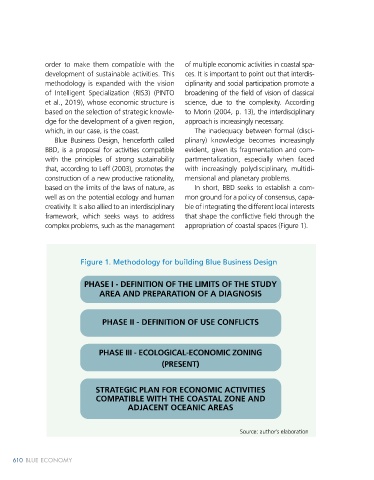
order to make them compatible with the    of multiple economic activities in coastal spa-                          3.1.1. Phase I - Definition of the       provisions for the protection and conserva-
              development of sustainable activities. This   ces. It is important to point out that interdis-                     study area and preparation of the        tion of adjacent coastal and ocean resources?
              methodology is expanded with the vision   ciplinarity and social participation promote a                           diagnosis                                .   How is compliance with these legal re-
              of Intelligent Specialization (RIS3) (PINTO   broadening of the field of vision of classical                          The first phase of the BBD suggests: (1)   quirements verified by the actors involved?
              et al., 2019), whose economic structure is   science, due to the complexity. According                             the definition of the study area of the coas-
              based on the selection of strategic knowle-  to Morin (2004, p. 13), the interdisciplinary                         tal and adjacent oceanic zone; (2) the elabo-  .   Who are the social actors involved and
              dge for the development of a given region,   approach is increasingly necessary.                                   ration of a physical, biological, socio-spatial,   responsible for the problems in the area of
              which, in our case, is the coast.            The inadequacy between formal (disci-                                 socioeconomic diagnosis; (3) survey of legal   study? What are their interests, limitations,
                 Blue  Business  Design,  henceforth  called   plinary) knowledge becomes increasingly                           aspects; (4) Strategic Plan from BBD.    and potential?
              BBD, is a proposal for activities compatible   evident, given its fragmentation and com-                              A very relevant issue will be the prior   3.1.2. Phase II - Definition of use
              with the principles of strong sustainability   partmentalization, especially when faced                            definition of the study area, that is, a ge-  conflicts
              that, according to Leff (2003), promotes the   with increasingly polydisciplinary, multidi-                        ographic space where the baseline studies
              construction of a new productive rationality,   mensional and planetary problems.                                  will be carried out, an area that will be the   Conflicts of uses are, in fact, “conflicts
              based on the limits of the laws of nature, as   In short, BBD seeks to establish a com-                            object of primary or secondary data collec-  generated” by the incompatibility between
              well as on the potential ecology and human   mon ground for a policy of consensus, capa-                           tion. Baseline studies are the pillars in the   cultural values of different human groups,
              creativity. It is also allied to an interdisciplinary   ble of integrating the different local interests           process of elaborating a BBD, and around   which, when establishing contact, exert dif-
              framework,  which seeks  ways  to address   that shape the conflictive field through the                           them the organization of fieldwork and   ferent relations of use of the territory, which
              complex problems, such as the management   appropriation of coastal spaces (Figure 1).                                                                      can have disintegrating effects on their cul-
                                                                                                                                 information gathering revolves, as well as   tures (AZEVEDO, 1977). Conflicts related to
                                                                                                                                 the structuring of the diagnosis itself. The   traditional populations in the coastal zone ul-
                                                                                                                                 results of the base studies show an analysis   timately led to the absorption of new values

                         Figure 1. Methodology for building Blue Business Design                                                 of the current situation of the study area   brought by a new culture, a new relationship
                                                                                                                                 made through surveys of the components   with the environment and the abandonment
                                                                                                                                 of the physical, biological, socio-spatial,
                          PHASE I - DEFINITION OF THE LIMITS OF THE STUDY                                                        socioeconomic environment, their environ-  of their group of origin. This phenomenon is
                              AREA AND PREPARATION OF A DIAGNOSIS                                                                mental risks, and the survey of legal requi-  often observed with fishermen and small far-

                                                                                                                                 rements, contemplating their interactions.  mers, who abandon their traditional activity
                                                                                                                                                                          for summer support jobs such as: houseke-
                                                                                                                                    The diagnosis of the study area should
                               PHASE II - DEFINITION OF USE CONFLICTS                                                            answer the key questions listed below, and   epers, bricklayers, construction workers etc.,
                                                                                                                                 they are:                                with fishing and agriculture becoming their
                                                                                                                                                                          second occupation (CALSJ, 2000).
                                                                                                                                 .   What are the characteristics of the     Environmental conflicts are understood
                              PHASE III - ECOLOGICAL-ECONOMIC ZONING                                                             territory, landscape, economic activities,   to be those involving social groups with
                                                 (PRESENT)                                                                       population profile, legal aspects, and local   different modes of appropriation, use and

                                                                                                                                 ecosystems?                              meaning of the territory, having their origin
                             STRATEGIC PLAN FOR ECONOMIC ACTIVITIES                                                              .   How  important  is  the  study  area  to   when at least one of the groups has its way
                             COMPATIBLE WITH THE COASTAL ZONE AND                                                                stakeholders? And what are the goods,    of life threatened. Appropriation will take
                                       ADJACENT OCEANIC AREAS                                                                    services and uses associated with these   place through undesirable impacts – trans-

                                                                                                                                 ecosystems/urban spaces?                 mitted by soil, air, water, or living systems
                                                                                                                                                                          resulting from the exercise of practices by
                                                                        Source: author’s elaboration                             .   Are there adequate/effective legal   other groups (ACSELRAD, 2004).


     610   BLUE ECONOMY                                                                                                                                                                           Blue Business Design (BBD)   611

