


Page 492 - Economia Azul - versão: inglês
P. 492
economic activity essentially based on the in-  between academia and the government,
               terdependence of actors in the spheres of sci-  a reflection of the filing of patents under                                             Figure 4: Expanded Triple Helix Model
               ence, market, and State, respectively. Private   joint ownership between funding agencies                                                 applied to Marine Biotechnology
               enterprise depends on academic knowledge   and universities. Collaboration between ac-
               and innovation funding to produce goods   ademia and industry remains incipient, mak-
               and services. Universities and institutes car-  ing the pattern of collaboration not what
               ry out research using public and private re-  was expected in the Triple Helix model.
               sources. In turn, governments, agencies, and    One of the instruments normally used to
               committees formulate ST&I policies and are   bring the parties together within the acade-                                        Innovation                                Offer
               responsible for the regulatory structure, activ-  my-industry-government model is the estab-                                                           Industry
               ities that need to be in tune with companies   lishment of Technological Poles, which are en-
               and academia to be effective.            vironments conducive to interaction between
                 Understanding  biotechnology  involves   public institutions, private companies, and
               understanding this complex of interdepen-  the scientific community. These Hubs serve as
               dencies, so the three spheres can be used   environments for cooperation between the                                                               Government
               as an analytical resource. The basic idea   entrepreneurial initiative and the academic                                                                                Academy
               suggests that biotechnological innovation is   community, aiming to strengthen the capac-
               only possible when new knowledge is direct-  ity for innovation, generation of wealth and
               ed to meet the demands of socioeconomic   the well-being of society. Furthermore, these
               development, which are then analyzed,    environments have high potential to bridge
               managed, and commercialized by private   the gap between the generation of scientific
               entities and companies. In this way, there is   knowledge and socioeconomic development
               the stimulus of public policies aimed at co-  (the Innovation paradigm).                                                                         Demand
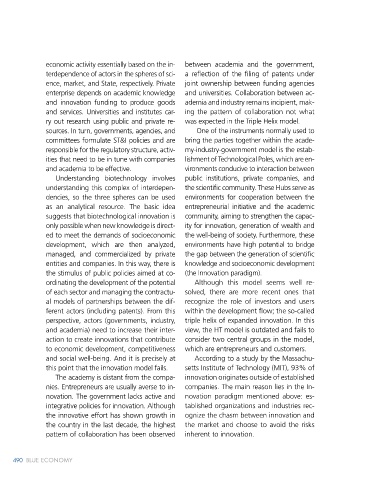
               ordinating the development of the potential   Although this  model seems well re-
               of each sector and managing the contractu-  solved, there are more recent ones that                                                                                Source: Own Elaboration (2022)
               al models of partnerships between the dif-  recognize the role of investors and users
               ferent actors (including patents). From this   within the development flow; the so-called
               perspective, actors (governments, industry,   triple helix of expanded innovation. In this                        4. Biotechnology in companies
               and academia) need to increase their inter-  view, the HT model is outdated and fails to
               action to create innovations that contribute   consider two central groups in the model,                             The term “Biotechnology” encom-       in molecular biology and the association of
               to economic development, competitiveness   which are entrepreneurs and customers.                                 passes several technologies employed in   Embrapa (Brazilian Agricultural Research
               and social well-being. And it is precisely at   According to a study by the Massachu-                             research and industry, ranging from the   Corporation) with some universities in the
               this point that the innovation model fails.  setts Institute of Technology (MIT), 93% of                          production of enzymes by genetically     State of São Paulo for the development of
                 The academy is distant from the compa-  innovation originates outside of established                            modified bacteria to therapies using stem   genetic engineering programs in animals,
               nies. Entrepreneurs are usually averse to in-  companies. The main reason lies in the In-                         cells. Biotechnology itself, in Brazil, began   biotechnology was little gradually consoli-
               novation. The government lacks active and   novation paradigm mentioned above: es-                                around 1930,  when the  Agronomic Insti-  dating itself on the national scene.
               integrative policies for innovation. Although   tablished organizations and industries rec-                       tute of Campinas (IAC) began to develop     Although the country is essentially agri-
               the innovative effort has shown growth in   ognize the chasm between innovation and                               research for the genetic improvement of   cultural, only 10% of biotechnology com-
               the country in the last decade, the highest   the market and choose to avoid the risks                            coffee, corn and other species. Gradually,   panies are focused on agriculture. About
               pattern of collaboration has been observed   inherent to innovation.                                              with the emergence of graduate programs   40% work in human health and 5% in


                                                                                                                                                                                          Development of Marine Biotechnology 491
     490   BLUE ECONOMY                                                                                                                                                                   Development of Marine Biotechnology 491

