


Page 448 - Economia Azul - versão: inglês
P. 448
compromised coastal ecosystems and the   than 3,000 tons of oil residues collected
                                                                                                                                economy of the affected regions.         along approximately 2,900 km of coastline
                                                                                                                                   The ability to monitor and forecast the   (SOARES et al., 2022), smaller oil spills oc-
                                                                                                                                movement of vessels and oil slicks at sea has   cur with great frequency. During the peri-
                                                                                                                                a direct impact on the ability to deter oil spills   od from December 31, 2021, to February
                                                                                                                                at sea by ships and oil exploration platforms   10, 2022, IBAMA identified the occurrence
                                                                                                                                in the Amazônia Azul (Blue Amazon). To   of three contributions of oleaginous resi-
                                                                                                                                strengthen this capacity, the National Fund   dues on the beaches of Paraíba and Ceará
                                                                                                                                for Scientific and Technological Development   and an orphan oil slick at sea, which did
                                                                                                                                (FNDCT) approved funding in 2022 for the   not reach the Coast. In order to exemplify
                                                                                                                                establishment of a System for the Detection,   the future operation of SisMOM, the case of
                                                                                                                                Forecast and Monitoring of Oil Spills at Sea   the appearance of oil slicks on the coast of
                                                                                                                                (SisMOM). The system will have the partici-  Paraíba between 12/31/2021 and 1/1/2022
                                                                                                                                pation of INPE, IBAMA, UFBA, UFPR, UFSB,   was analyzed. For this exercise, an experi-
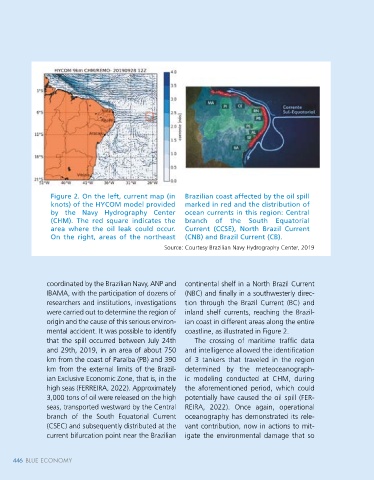
                Figure 2. On the left, current map (in   Brazilian coast affected by the oil spill                              UFES, UFMA, UFRJ, IOUSP, IEAv, VISIONA,   mental SisMOM situation room was set
                knots) of the HYCOM model provided      marked in red and the distribution of                                   UFPA, SIMEPAR, EPAGRI, UnB, UFRGS, UFPE,   up, with the participation of scientists and
                by the Navy Hydrography Center          ocean currents in this region: Central                                  UFPI, UFAL, PUC-Rio; in addition to the Navy’s   technicians from INPE, IBAMA, UFBA, UFPR,
                (CHM). The red square indicates the     branch of the South  Equatorial
                area where the oil leak could occur.    Current (CCSE), North Brazil Current                                    DGDNTM, CPTMRJ, CASNAV, CHM, COM-        UFSB, COMPAAz, CHM and IEAPM.
                On  the right, areas of  the northeast   (CNB) and Brazil Current (CB).                                         PAAz, DGePM, IEAPM and IPqM.                Figure 3 shows the dates and locations
                                                                                                                                   SisMOM is responsible for carrying out   of oil residue observations, the reverse
                                                  Source: Courtesy Brazilian Navy Hydrography Center, 2019
                                                                                                                                a feasibility study on the development of a   defeat of Lagrangian tracers launched at
                                                                                                                                constellation of microsatellites, controlled   touchdown locations and dates, and the
                                                                                                                                by Brazil, capable of acquiring real-time op-  positions of oil tankers or tugs whose de-
               coordinated by the Brazilian Navy, ANP and   continental shelf in a North Brazil Current                         tical and synthetic aperture radar images of   feats crossed the defeat of Lagrangian
               IBAMA, with the participation of dozens of   (NBC) and finally in a southwesterly direc-                         specific areas of the ocean, along major ship   tracers, indicated by the colors of both. De-
               researchers and institutions, investigations   tion  through  the  Brazil  Current  (BC)  and                    routs or oil exploration platform positions.  monstratively, OSCAR model integrations
               were carried out to determine the region of   inland shelf currents, reaching the Brazil-                           For the identification of false positives of   were performed for a hypothetical spill at
               origin and the cause of this serious environ-  ian coast in different areas along the entire                     oil slicks in satellite images, observed and   the position of the ship furthest from shore
               mental accident. It was possible to identify   coastline, as illustrated in Figure 2.                            predicted meteoceanographic fields, ob-  (shown by the westernmost light green dot
               that the spill occurred between July 24th   The crossing of maritime traffic data                                tained from the composition of satellite data   in the central panel of Figure 3), the results
               and 29th, 2019, in an area of about 750   and intelligence allowed the identification                            and forecasts of coupled ocean-atmosphere   of which are shown on the right in Figure
               km from the coast of Paraíba (PB) and 390   of 3 tankers that traveled in the region                             models and access to data from the Auto-  3. The  ocean  currents  used both  for  the
               km from the external limits of the Brazil-  determined by the meteoceanograph-                                   matic Identification System – Vessel AIS. The   calculation of the reverse trajectories with
               ian Exclusive Economic Zone, that is, in the   ic modeling conducted at CHM, during                              offshore oil slick drift detection and predic-  the plot model and for the oil dispersion

               high seas  (FERREIRA, 2022). Approximately   the aforementioned period, which could                              tion system is integrated through the use of   were obtained  from  the European  oper-
               3,000 tons of oil were released on the high   potentially have caused the oil spill (FER-                        artificial intelligence tools, for the detection   ating system CMEMS/Mercator. The wind
               seas, transported westward by the Central   REIRA, 2022). Once again, operational                                of anomalous ship displacement behaviors   fields used were from ERA5. In time, the
               branch of the South Equatorial Current   oceanography has demonstrated its rele-                                 and identification of oil slicks at sea.  experiment was later redone using CHM/
               (CSEC) and subsequently distributed at the   vant contribution, now in actions to mit-                              While the 2019 offshore oil spill event is   REMO HYCOM current fields and CHM
               current bifurcation point near the Brazilian   igate the environmental damage that so                            unique in magnitude and extent, with more   COSMOS model winds.


     446   BLUE ECONOMIY                                                                                                                                                                        From Observation to Data Use  447
     446   BLUE ECONOMY

