


Page 414 - Economia Azul - versão: inglês
P. 414
4. Acidification and loss of biodiversity
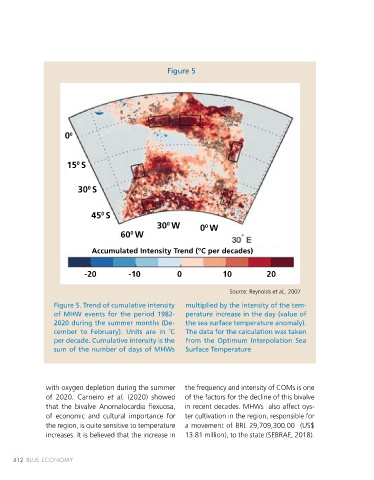
                                                   Figure 5
                                                                                                                                    Acidification is caused by the increase in   region of the east-southeast platform where
                                                                                                                                 the absorption of atmospheric CO by the   they are found. banks of rhodoliths (red cal-
                                                                                                                                 ocean, causing changes in the chemistry of   careous algae) are made (Figure 6).
                                                                                                                                 seawater, namely: i) decrease in water pH,   Overall, almost all major coral reef sys-
                                                                                                                                 caused by the reaction of dissolved CO2   tems (shallow and deep) are vulnerable to
                                                                                                                                 with water, ii) decrease in the availability of   climate change with regional differences in
                    0 0
                                                                                                                                 carbonate ions [CO3(2-)] and the calcium   their sensitivities and projected global loss-
                                                                                                                                 carbonate saturation index (Ω). Carbonate   es reaching over 70% even under the min-
                                                                                                                                 ions are essential for marine organisms that   imum global warming scenario (Represen-
                     15 S                                                                                                        produce calcium carbonate structures in   tative Concentration Pathway 2.6 W/m2,
                        0
                                                                                                                                 the form of aragonite and calcite (CaCO3),   or RCP2.6, BINDOFF et al., 2019). Warm-
                        30 S                                                                                                     such as corals, bivalve and gastropod mol-  ing oceans, acidification, rising sea levels
                           0
                                                                                                                                 lusks, calcareous macroalgae, in addition   and intensifying storms impede greater
                                                                                                                                 to certain primary planktonic producers,   resilience of reefs globally and increase
                            45 S                                                                                                 such as coccolithophorids (DONEY  et al.,   their destruction. Shallow coral reefs that
                               0
                                               30 W         0 W                                                                  2009). According to the latest global car-  are not degraded by other impacts, such
                                                  0
                                                              0
                                     60 W                                                                                        bon balance (FRIEDLINGSTEIN et al., 2021),   as extensive bottom trawling and nutrient
                                        0
                                                                                                                                 the oceanic CO2 sink captured an average   enrichment, can provide an important ref-
                            Accumulated Intensity Trend (ºC per decades)                                                         of 26% of global CO2 emissions into the   uge for reefs degraded by climate change.
                                                                                                                                 atmosphere in the decade 2011-2020, and   The loss of deepwater coral reef habitat is
                           -20         -10           0                10          20                                             in the year 2021, it is estimated that has   virtually certain, considering the projection
                                                                                                                                 assimilated about 2.9 GtC a-1.           of increasing ocean acidification (BINDOFF
                                                                     Source: Reynolds et al., 2007                                  According to the IPCC’s Sixth Climate   et al., 2019). In addition to ocean acidifi-
                                                                                                                                 Assessment Report (AR6 – WGI and WGII),   cation and warming, ecosystem fragmen-
                 Figure 5. Trend of cumulative intensity   multiplied by the intensity of the tem-
                 of MHW events for the period 1982-     perature increase in the day (value of                                   it is virtually certain that ocean acidification   tation and pollution in coastal regions are
                 2020 during the summer months (De-     the sea surface temperature anomaly).                                    will continue to occur under all CO2 emis-  other major threats to marine ecosystems
                 cember to February). Units are in ˚C   The data for the calculation was taken                                   sion scenarios (IPCC, 2021; 2022) through-  across the planet (IPCC, 2022).
                 per decade. Cumulative intensity is the   from the Optimum Interpolation Sea                                    out the 21st century. However, the acidifica-  Regarding the effects of acidification,
                 sum of the number of days of MHWs      Surface Temperature                                                      tion rate will be due to the amount of CO2   coastal regions can respond to excess CO2
                                                                                                                                 emitted in future years. It can be stated with   dissolved in seawater in a heterogeneous
                                                                                                                                 high reliability that climate change, includ-  way, since other processes, such as eutro-
                                                                                                                                 ing acidification, has already caused chang-  phication, can amplify or partially mitigate
               with oxygen depletion during the summer   the frequency and intensity of COMs is one                              es in coastal and oceanic ecosystems (IPCC,   the effect of acidification, notably through
               of  2020.  Carneiro  et  al.  (2020)  showed   of the factors for the decline of this bivalve                     2022). Among the most vulnerable Brazilian   increased primary production. location
               that  the  bivalve  Anomalocardia  flexuosa,   in recent decades. MHWs  also affect oys-                          ecosystems, according to the 2016 assess-  (CAI et al., 2011; COTOVICZ et al., 2022).
               of economic and cultural importance for   ter cultivation in the region, responsible for                          ment carried out by the Brazilian Research   However, the potential aspect of mitiga-
               the region, is quite sensitive to temperature   a movement of BRL 29,709,300.00  (US$                             Network on Ocean Acidification – BrOA    tion through eutrophication must be care-
               increases. It is believed that the increase in   13.81 million), to the state (SEBRAE, 2018).                     (KERR et al., 2016), are coral reefs and the   fully examined, as the natural variability of


     412  BLUE ECONOMY                                                                                                                                                                     Ocean and Climate: New Challenges  413

