


Page 416 - Economia Azul - versão: inglês
P. 416
coastal  ecosystems leads to different  re-  eling  results  estimate  that  the  trend  be-                         Despite the efforts of the BrOA network,   al., 2007; TANHUA et al., 2021), be initiated
               gional responses (COTOVICZ et al., 2022).  tween 1991 and 2011 of acidification and                               the capacity for observation and data analysis   as a state strategy, aligned with the Devel-
                 We still do not have enough observa-   increasing CO2 fugacity (f CO2, a proxy for                              of Brazilian marine ecosystems remains below   opment Goal Sustainable 14 – Life on Water
               tions to infer about ocean acidification   the amount of CO2 in the ocean) at the sea                             the desired level when considering the extent   from the 2030 Agenda and the United Na-
               trends in coastal and oceanic regions of   surface was -0.0016 ± 0.0003 pH units at                               and heterogeneity of the Amazônia Azul   tions Decade of Ocean Science. Only in this
               Brazil (KERR et al., 2016; COTOVICZ et al.,   -1 and 1.81 ± 0.32 µatm CO2 a-1, accord-                            (Blue Amazon). It is essential that a nation-  way will it be possible to design public poli-
               2022). In the tropical Atlantic Ocean, mod-  ing to Lauvset et al. (2015).                                        al program, aligned with the best practices   cies for the adaptation and mitigation of the
                                                                                                                                 of data analysis and transparency employed   effects of ocean acidification on the country’s
                                                                                                                                 by the international community (DICKSON et   various marine ecosystems.
                                                   Figure 6
                 0
                10 N                                                                                                             5. Sea level rise: the case of the metropolitan region of Recife
                                                                                                                                    The latest reports by the Intergovern-  sandy beaches and wetlands. Such an im-
                                                                                                                                 mental Panel  on Climate Change con-     pact, although felt globally, depends on local
                 EQ                                                                                                              clude that the planet is unequivocally ex-  peculiarities; therefore, it happens unevenly
                                                                                                                                 periencing rapid warming, and this is due   across countries, regions, communities, and
                                                                                                                                 in part to human activities (IPCC, 2021).   individuals as a result of different levels of

                10 S                                                                                                             Consequently, global mean sea levels will   exposure and vulnerability. Furthermore, the
                  0
                                                                                                                                 continue to rise over centuries to millennia   adaptation of coastal regions naturally rep-
                                                                                                                                 under all emission scenarios. Sea level rise   resents a greater challenge for developing
                                                                                                                                 will accelerate further under high emis-  countries than for  more developed coun-
                  0
                20 S
                                                                                                                                 sions  (e.g., RCP8.5).  These changes  are   tries, for mainly economic reasons.
                                                                                                                                 projected to result in disruptive direct and   In Brazil, sea level trends for different
                                                                                                                                 indirect impacts on coastal ecosystems and   places are different. For Recife, specifically,
                  0
                30 S
                                                                                                                                 the livelihoods and infrastructure used by   Harari  et al. (2008) pointed to a sea lev-
                                                                                                                                 tens of millions of people in the low-lying   el rise of about 5.6 mm/year. Despite this
                                                                                                                                 coastal zone (considered elevation <10 m   gap, some studies have been dedicated to
                  0
                40 S
                                                           0
                                                                    0
                                                                                     0
                                                                             0
                        0
                       50 W               40 W              30 W              20 W               10 W              50 W               40 W              30 W             above mean sea level). According to this   coastal forecasts for future sea level sce-
                                 0
                                                  0
                                          0
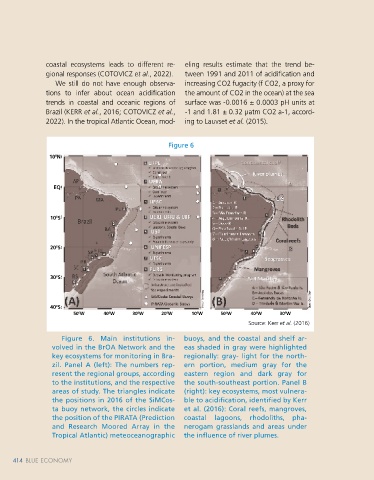
                                                                          Source: Kerr et al. (2016)                             and other studies (NEVES and MUEHE,      narios, such as Alfredini et al. (2008), who
                                                                                                                                 1995; THIELER and HAMMAR-Klose, 1999;    describe islands and urban areas as the
                   Figure 6. Main institutions in-     buoys, and the coastal and shelf ar-                                      ALFREDINI  et al., 2008; SNOUSSI  et al.,   most vulnerable to flooding in the medium
                volved in the BrOA Network and the     eas shaded in gray were highlighted                                       2008; VARGAS et al., 2008), the level rise   and long term. Another study, prepared by
                key ecosystems for monitoring in Bra-  regionally: gray- light for the north-                                    scenarios of the sea for the near future are   Marengo et al. (2007) on a national scale,
                zil. Panel A (left): The numbers rep-  ern  portion,  medium  gray for the                                       of great concern. Recent results indicate an   pointed out Pernambuco as one of the
                resent the regional groups, according   eastern region and dark gray for                                         acceleration in the rate of  sea  level  rise.   most affected states by sea level rise. The
                to the institutions, and the respective   the south-southeast portion. Panel B
                areas of study. The triangles indicate   (right): key ecosystems, most vulnera-                                  This acceleration in the rate at which sea   same conclusion is demonstrated by two
                the positions in 2016 of the SiMCos-   ble to acidification, identified by Kerr                                  levels rise not only increases the possibili-  other studies: Neves et al. (2007) and Naca-
                ta buoy network, the circles indicate   et al. (2016): Coral reefs, mangroves,                                   ty of intensified impacts – such as coastal   rati  (2008). According  to these  authors,
                the position of the PIRATA (Prediction   coastal lagoons, rhodoliths,  pha-                                      erosion, habitat loss and saline intrusion   both natural causes and characteristics of
                and Research Moored Array in the       nerogam grasslands and areas under                                        into coastal aquifers and rivers – but can   occupation  of urban space contribute  to
                Tropical Atlantic) meteoceanographic   the influence of river plumes.                                            also result in complete suppression of    the high vulnerability of the area. In fact,


     414  BLUE ECONOMY                                                                                                                                                                     Ocean and Climate: New Challenges  415
     414   BLUE ECONOMY

