


Page 81 - RAC_CIAW_ a_I_n_01_2021.pdf
P. 81
the possibility of tampering by an attack. Hence, these   that  meet good  QoS levels.  Moreover, the computa-
            lighter devices don’t possess the same computational   tional power of a server can be improved more easily
            resources as the system servers. This is why the perfor-  to support a bigger network with a larger number of
            mance analysis is bold on the sensing nodes.      sensing nodes.
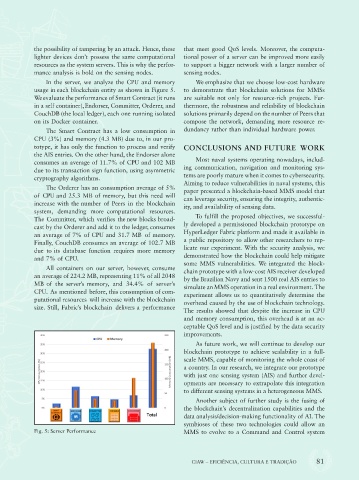
                In the  server, we analyze the  CPU and memory    We emphasize that we choose low-cost hardware
            usage in each blockchain entity as shown in Figure 5.   to demonstrate that blockchain solutions for MMSs
            We evaluate the performance of Smart Contract (it runs   are suitable not only for resource-rich projects. Fur-
            in a self container), Endorser, Committer, Orderer, and   thermore, the robustness and reliability of blockchain
            CouchDB (the local ledger), each one running isolated   solutions primarily depend on the number of Peers that
            on its Docker container.                          compose the network, demanding more resource  re-
                The Smart Contract has a low consumption in   dundancy rather than individual hardware power.
            CPU (3%) and memory (4.3 MB) due to, in our pro-
            totype, it has only the function to process and verify   CONCLUSIONS AND FUTURE  WORK
            the AIS entries. On the other hand, the Endorser alone
            consumes an average of 11.7% of CPU and 102 MB        Most naval systems operating nowadays, includ-
            due to its transaction sign function, using asymmetric   ing communication, navigation and monitoring sys-
            cryptography algorithms.                          tems are poorly mature when it comes to cybersecurity.
                                                              Aiming to reduce vulnerabilities in naval systems, this
                The Orderer has an consumption average of 5%   paper presented a blockchain-based MMS model that
            of  CPU and 25.3 MB of memory, but this need will   can leverage security, ensuring the integrity, authentic-
            increase with the number of Peers in  the blockchain   ity, and availability of sensing data.
            system,  demanding more  computational resources.
            The Committer, which verifies the new blocks broad-   To fulfill the proposed objectives, we successful-
            cast by the Orderer and add it to the ledger, consumes   ly developed a permissioned blockchain prototype on
            an average of 7% of CPU and 31.7 MB  of memory.   HyperLedger Fabric platform and made it available in
            Finally, CouchDB consumes an average of 102.7 MB   a public repository to allow other researchers to rep-
            due to its database function requires more memory   licate our experiment. With the security analysis, we
            and 7% of CPU.                                    demonstrated how the blockchain could help mitigate
                                                              some  MMS  vulnerabilities.  We integrated  the  block-
                All containers on our server, however, consume   chain prototype with a low-cost AIS receiver developed
            an average of 224.2 MB, representing 11% of all 2048   by the Brazilian Navy and sent 1500 real AIS entries to
            MB of  the  server’s  memory,  and 34.4% of server’s   simulate an MMS operation in a real environment. The
            CPU. As mentioned before, this consumption of com-  experiment allows us to quantitatively determine the
            putational resources  will increase with the blockchain   overhead caused by the use of blockchain technology.
            size. Still, Fabric’s blockchain  delivers a performance
                                                              The results showed that despite the increase in CPU
                                                              and memory consumption, this overhead is at an ac-
                                                              ceptable QoS level and is justified by the data security
                                                              improvements.
                                                                  As future work, we will continue to develop our
                                                              blockchain prototype to achieve scalability in a full-
                                                              scale MMS, capable of monitoring the whole coast of
                                                              a country. In our research, we integrate our prototype
                                                              with just one sensing system (AIS) and further devel-
                                                              opments are necessary to extrapolate this integration
                                                              to different sensing systems in a heterogeneous MMS.
                                                                  Another subject of further study is the fusing of
                                                              the blockchain’s decentralization capabilities and the
                                                              data analysis/decision-making functionality of AI. The
                                                              symbioses  of these  two technologies  could allow an
            Fig. 5: Server Performance                        MMS to evolve to a Command and Control system


                                                                 CIAW – EFICIÊNCIA, CULTURA E TRADIÇÃO    81

