


Page 80 - RAC_CIAW_ a_I_n_01_2021.pdf
P. 80
running isolated in its container.                asymmetric cryptography. Figure 4a shows CPU and
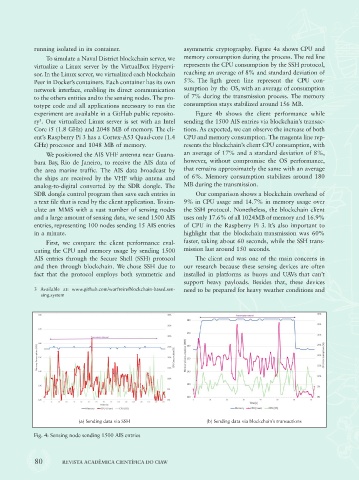
                To simulate a Naval District blockchain server, we   memory consumption during the process. The red line
            virtualize a Linux server by the VirtualBox Hypervi-  represents the CPU consumption by the SSH protocol,
            sor. In the Linux server, we virtualized each blockchain   reaching an average of 8% and standard deviation of
            Peer in Docker’s containers. Each container has its own   5%.  The  ligth green  line represent  the CPU  con-
            network interface, enabling its direct communication   sumption  by  the  OS, with an average of consumption
            to the others entities and to the sensing nodes. The pro-  of 7% during the transmission process. The memory
            totype code and all applications necessary to run the   consumption stays stabilized around 156 MB.
            experiment are available in a GitHub public reposito-  Figure 4b shows the client performance while
              3
            ry . Our virtualized Linux server is set with an Intel   sending the 1500 AIS entries via blockchain’s transac-
            Core i5 (1.8 GHz) and 2048 MB of memory. The cli-  tions. As expected, we can observe the increase of both
            ent’s Raspberry Pi 3 has a Cortex-A53 Quad-core (1.4   CPU and memory consumption. The magenta line rep-
            GHz) processor and 1048 MB of memory.             resents the blockchain’s client CPU consumption, with
                We positioned the AIS VHF antenna near Guana-  an average of 17% and a standard deviation of 8%,
            bara Bay, Rio de Janeiro, to receive the AIS data of   however, without compromise the OS performance,
            the area marine traffic. The AIS data broadcast by   that remains approximately the same with an average
            the  ships are  received  by the  VHF whip  antena and   of 6%. Memory consumption stabilizes around 180
            analog-to-digital converted by the  SDR dongle. The   MB during the transmission.
            SDR dongle control program then save each entries in   Our comparison shows a blockchain overhead of
            a text file that is read by the client application. To sim-  9% in CPU usage and 14.7% in memory usage over
            ulate an MMS with a vast number of sensing nodes   the SSH protocol. Nonetheless, the blockchain client
            and a large amount of sensing data, we send 1500 AIS   uses only 17.6% of all 1024MB of memory and 16.9%
            entries, representing 100 nodes sending 15 AIS entries   of CPU in the Raspberry Pi 3. It’s also important to
            in a minute.                                      highlight  that  the  blockchain transmission  was  60%
                First, we compare the client performance eval-  faster, taking about 60 seconds, while the SSH trans-
            uating the CPU and memory usage by sending 1500   mission last around 150 seconds.
            AIS entries through the Secure Shell (SSH) protocol   The client end was one of the main concerns in
            and then through blockchain. We chose SSH due to   our research because these sensing devices are often
            fact that the protocol employs both symmetric and   installed in platforms as buoys and UAVs that can’t
                                                              support heavy  payloads. Besides that, these devices
            3  Available  at:  www.github.com/warfreire/blockchain-based.sen-  need to be prepared for heavy weather conditions and
               sing.system


                           (a) Sending data via SSH                   (b) Sending data via blockchain’s transactions

            Fig. 4: Sensing node sending 1500 AIS entries


             80       REVISTA ACADÊMICA CIENTÍFICA DO CIAW

