


Page 85 - RAC_CIAW_ a_I_n_01_2021.pdf
P. 85
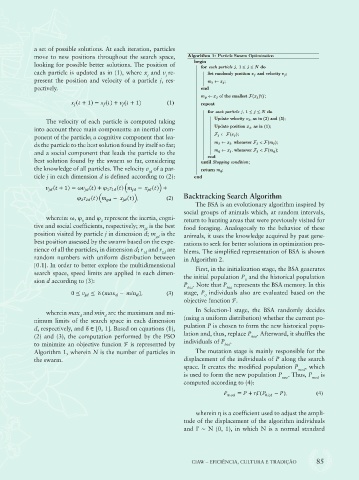
a set of possible solutions. At each iteration, particles
            move to new positions throughout the search space,
            looking for possible better solutions. The position of
            each particle is updated as in (1), where x  and v re-
                                                        j
                                                  j
            present the position and velocity of a particle j, res-
            pectively.


                The velocity of each particle is computed taking
            into account three main components: an inertial com-
            ponent of the particle; a cognitive component that lea-
            ds the particle to the best solution found by itself so far;
            and a social component that leads the particle to the
            best solution found by the swarm so far, considering
            the knowledge of all particles. The velocity v  of a par-
                                                  jd
            ticle j in each dimension d is defined according to (2):


                                                              Backtracking Search Algorithm
                                                                  The BSA is an evolutionary algorithm inspired by
                                                              social groups of animals which, at random intervals,
                wherein: ω, φ  and φ  represent the inertia, cogni-  return to hunting areas that were previously visited for
                            1     2
            tive and social coefficients, respectively; m  is the best   food foraging. Analogously  to the behavior  of  these
                                                 jd
            position visited by particle j in dimension d; m  is the   animals, it uses the knowledge acquired by past gene-
                                                     gd
            best position assessed by the swarm based on the expe-  rations to seek for better solutions in optimization pro-
            rience of all the particles, in dimension d; r  and r  are   blems. The simplified representation of BSA is shown
                                                       2d
                                                1d
            random numbers with uniform distribution between   in Algorithm 2.
            [0.1]. In order to better explore the multidimensional   First, in the initialization stage, the BSA generates
            search space, speed limits are applied in each dimen-  the initial population P  and the historical population
            sion d according to (3):                                              0
                                                              P . Note that P  represents the BSA memory. In this
                                                               hist         hist
                                                              stage, P  individuals also are evaluated based on the
                                                                     0
                                                              objective function ℱ.
                wherein max  and min  are the maximum and mi-     In  Selection-I  stage,  the  BSA  randomly  decides
                                    d
                           d
            nimum  limits  of  the  search  space  in  each  dimension   (using a uniform distribution) whether the current po-
            d, respectively, and δ ∈ [0, 1]. Based on equations (1),   pulation P is chosen to form the new historical popu-
            (2) and (3), the computation performed by the PSO   lation and, thus, replace P . Afterward, it shuffles the
                                                                                    hist
            to minimize an objective funcion ℱ is represented by   individuals of P .
                                                                            hist
            Algorithm 1, wherein N is the number of particles in   The mutation stage is mainly responsible for the
            the swarm.                                        displacement of the individuals of P along the search
                                                              space. It creates the modified population P  , which
                                                                                                    mod
                                                              is used to form the new population P new . Thus, P mod  is
                                                              computed according to (4):


                                                                  wherein η is a coefficient used to adjust the ampli-
                                                              tude of the displacement of the algorithm individuals
                                                              and Γ ∼ N (0, 1), in which N is a normal standard


                                                                 CIAW – EFICIÊNCIA, CULTURA E TRADIÇÃO    85

