


Page 86 - RAC_CIAW_ a_I_n_01_2021.pdf
P. 86
distribution. Therefore, P mod  results from the displace-
            ment of the individuals of P in the directions defined
            by the vector (P  − P ). The crossover stage creates
                           hist
            P new . To do so, it randomly combines the individuals of
            P    and P following a uniform distribution.
              mod
                Finally, the Selection-II stage creates the final ver-
            sion of the BSA population in a given iteration. First,
            it evaluates the individuals of P   based on the objec-
                                        new
            tive function ℱ. Then, it selects the elements of P
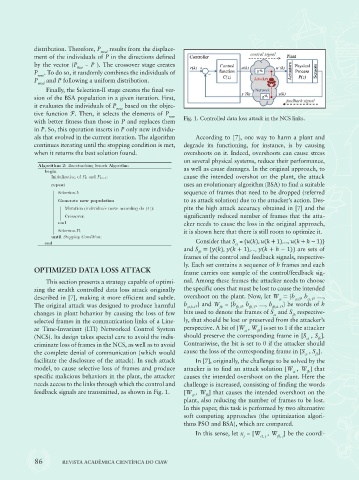
                                                         new  Fig. 1. Controlled data loss attack in the NCS links.
            with better fitness than those in P and replaces them
            in P. So, this operation inserts in P only new individu-
            als that evolved in the current iteration. The algorithm   According to [7], one way to harm a plant and
            continues iterating until the stopping condition is met,   degrade its functioning, for instance, is by causing
            when it returns the best solution found.          overshoots on it. Indeed, overshoots can cause stress
                                                              on several physical systems, reduce their performance,
                                                              as well as cause damages. In the original approach, to
                                                              cause the intended overshot on the plant, the attack
                                                              uses an evolutionary algorithm (BSA) to find a suitable
                                                              sequence of frames that need to be dropped (referred
                                                              to as attack solution) due to the attacker’s action. Des-
                                                              pite the high attack accuracy obtained in [7] and the
                                                              significantly reduced number of frames that the atta-
                                                              cker needs to cause the loss in the original approach,
                                                              it is shown here that there is still room to optimize it.
                                                                  Consider that S  = {  (  ),    (   +  1), …,    (   +  ℎ  − 1)}
                                                                               ct
                                                              and S  = {  (  ),    (   +  1), …,    (   +  ℎ  − 1)} are sets of
                                                                   fb
                                                              frames of the control and feedback signals, respective-
                                                              ly. Each set contains a sequence of h frames and each
            OPTIMIZED DATA LOSS ATTACK                        frame carries one sample of the control/feedback sig-

                This section presents a strategy capable of optimi-  nal. Among these frames the attacker needs to choose
            zing the stealth controlled data loss attack originally   the specific ones that must be lost to cause the intended
            described in [7], making it more efficient and subtle.   overshoot on the plant. Now, let W  = {b , b , …,
                                                                                                       ct,1
                                                                                                   ct,0
                                                                                             ct
            The original attack was designed to produce harmful   b ct,h-1 ,} and W  = {b , b , …, b fb,h-1 ,} be words of h
                                                                                    fb,1
                                                                          fb
                                                                               fb,0
            changes in plant behavior by causing the loss of few   bits used to denote the frames of S  and S  respective-
                                                                                            ct
                                                                                                  fb
            selected frames in the communication links of a Line-  ly, that should be lost or preserved from the attacker’s
            ar Time-Invariant (LTI) Networked Control System   perspective. A bit of [W , W ] is set to 1 if the attacker
                                                                                  ct
                                                                                      fb
            (NCS). Its design takes special care to avoid the indis-  should preserve the corresponding frame in [S  , S ].
                                                                                                          fb
                                                                                                       ct
            criminate loss of frames in the NCS, as well as to avoid   Contrariwise, the bit is set to 0 if the attacker should
            the complete denial of communication (which would   cause the loss of the corresponding frame in [S  , S ].
                                                                                                      ct
                                                                                                          fb
            facilitate the disclosure of the attack). In such attack   In [7], originally, the challenge to be solved by the
            model, to cause selective loss of frames and produce   attacker is to find an attack solution [W , W ] that
                                                                                                  ct
                                                                                                       fb
            specific malicious behaviors in the plant, the attacker   causes the intended overshoot on the plant. Here the
            needs access to the links through which the control and   challenge is increased, consisting of finding the words
            feedback signals are transmitted, as shown in Fig. 1.  [W , W ] that causes the intended overshoot on the
                                                                 ct   fb
                                                              plant, also reducing the number of frames to be lost.
                                                              In this paper, this task is performed by two alternative
                                                              soft computing approaches (the optimization algori-
                                                              thms PSO and BSA), which are compared.
                                                                  In this sense, let x  = [W  , W  ] be the coordi-
                                                                                  j    ct, j   fb, j
             86       REVISTA ACADÊMICA CIENTÍFICA DO CIAW

