


Page 78 - RAC_CIAW_ a_I_n_01_2021.pdf
P. 78
ty, and availability. In this system, buoys and UAVs be-  through a  text file  containing NMEA  entries.  Each
            have as blockchain clients, possessing their respective   NMEA string is sent, as a blockchain transaction, by
            cryptographic  credentials.  The  Fabric’s  Membership   the  client to  an endorsing  peer  in the  respective ND
            Service Provider (MSP) manages the keys and charac-  and processed by the smart contract.
            terizes the blockchain’s permissioned nature. The cli-
            ents are equipped with a low-cost AIS receiver devel-
            oped by the Brazilian Navy, compound by a VHF whip
            antenna, an SDR (Software Defined Radio) frequency
            demodulating dongle, and a Raspberry Pi 3. Figure 1
            illustrates the Blockchain-based MMS topology.


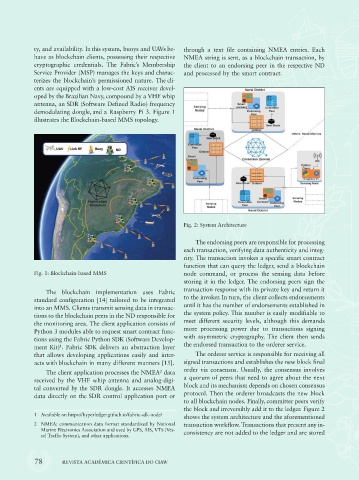
                                                              Fig. 2: System Architecture

                                                                  The endorsing peers are responsible for processing
                                                              each transaction, verifying data authenticity and integ-
                                                              rity. The transaction invokes a specific smart contract
                                                              function that can query the ledger, send a blockchain
            Fig. 1: Blockchain-based MMS                      node command, or process the  sensing  data  before
                                                              storing it in the ledger. The endorsing peers sign  the

                The blockchain implementation uses Fabric     transaction response with its private key and return it
            standard configuration [14] tailored to be integrated   to the invoker. In turn, the client collects endorsements
            into an MMS. Clients transmit sensing data in transac-  until it has the number of endorsements established in
            tions to the blockchain peers in the ND responsible for   the system policy. This number is easily modifiable to
            the monitoring area. The client application consists of   meet  different security  levels,  although  this  demands
            Python 3 modules able to request smart contract func-  more processing power  due to transactions signing
            tions using the Fabric Python SDK (Software Develop-  with asymmetric cryptography. The client then sends
            ment Kit) . Fabric SDK delivers an abstraction layer   the endorsed transaction to the orderer service.
                     1
            that allows developing applications easily and inter-  The orderer service is responsible for receiving all
            acts with blockchain in many different manners [15].  signed transactions and establishes the new block final
                                                      2
                The client application processes the NMEA  data   order  via  consensus.  Usually,  the  consensus  involves
            received by the VHF whip antenna and analog-digi-  a quorum of peers that need to agree about the next
            tal converted by the SDR dongle. It accesses NMEA   block and its mechanism depends on chosen consensus
            data directly on the SDR control application port or   protocol. Then the orderer broadcasts the new block
                                                              to all blockchain nodes. Finally, committer peers verify
                                                              the block and irreversibly add it to the ledger. Figure 2
            1   Available on https://hyperledger.github.io/fabric-sdk-node/  shows the system architecture and the aforementioned
            2   NMEA: communication data format standardized by National   transaction workflow. Transactions that present any in-
               Marine Electronics Association and used by GPS, AIS, VTS (Ves-  consistency are not added to the ledger and are stored
               sel Traffic System), and other applications.


             78       REVISTA ACADÊMICA CIENTÍFICA DO CIAW

