


Page 73 - RAC_CIAW_ a_I_n_01_2021.pdf
P. 73
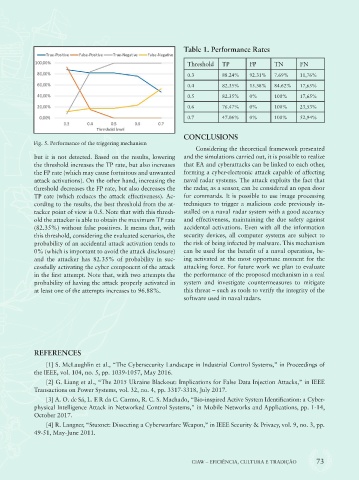
Table 1. Performance Rates

                                                               Threshold   TP       FP      TN      FN

                                                               0.3         88.24%   92.31%  7.69%   11,76%
                                                               0.4         82.35%   15.38%  84.62%  17,65%
                                                               0.5         82.35%   0%      100%    17,65%

                                                               0.6         76.47%   0%      100%    23,53%
                                                               0.7         47.06%   0%      100%    52,94%

                                                              CONCLUSIONS
            Fig. 5. Performance of the triggering mechanism
                                                                  Considering the theoretical framework presented
            but it is not detected. Based on the results, lowering   and the simulations carried out, it is possible to realize
            the threshold increases the TP rate, but also increases   that EA and cyberattacks can be linked to each other,
            the FP rate (which may cause fortuitous and unwanted   forming a cyber-electronic attack capable of affecting
            attack activations). On the other hand, increasing the   naval radar systems. The attack exploits the fact that
            threshold decreases the FP rate, but also decreases the   the radar, as a sensor, can be considered an open door
            TP rate (which reduces the attack effectiveness). Ac-  for commands. It is possible to use image processing
            cording to the results, the best threshold from the at-  techniques to trigger a malicious code previously in-
            tacker point of view is 0.5. Note that with this thresh-  stalled on a naval  radar system with a good accuracy
            old the attacker is able to obtain the maximum TP rate   and effectiveness, maintaining the due safety against
            (82.35%) without false positives. It means that, with   accidental activations. Even with all the information
            this threshold, considering the evaluated scenarios, the   security  devices, all computer  systems  are subject  to
            probability of an accidental attack activation tends to   the risk of being infected by malware. This mechanism
            0% (which is important to avoid the attack disclosure)   can be used for the benefit of a naval operation, be-
            and the attacker has 82.35% of  probability in suc-  ing activated at the most opportune moment for the
            cessfully activating the cyber component of the attack   attacking force. For future work we plan to evaluate
            in the first attempt. Note that, with two attempts the   the performance of the proposed mechanism in a real
            probability of having the attack properly activated in   system and investigate countermeasures to mitigate
            at least one of the attempts increases to 96.88%.  this threat – such as tools to verify the integrity of the
                                                              software used in naval radars.


            REFERENCES

                [1] S. McLaughlin et al., “The Cybersecurity Landscape in Industrial Control Systems,” in Proceedings of
            the IEEE, vol. 104, no. 5, pp. 1039-1057, May 2016.
                [2] G. Liang et al., “The 2015 Ukraine Blackout: Implications for False Data Injection Attacks,” in IEEE
            Transactions on Power Systems, vol. 32, no. 4, pp. 3317-3318, July 2017.
                [3] A. O. de Sá, L. F. R da C. Carmo, R. C. S. Machado, “Bio-inspired Active System Identification: a Cyber-
            physical Intelligence Attack in Networked Control Systems,” in Mobile Networks and Applications, pp. 1-14,
            October 2017.
                [4] R. Langner, “Stuxnet: Dissecting a Cyberwarfare Weapon,” in IEEE Security & Privacy, vol. 9, no. 3, pp.
            49-51, May-June 2011.


                                                                 CIAW – EFICIÊNCIA, CULTURA E TRADIÇÃO    73

