


Page 70 - RAC_CIAW_ a_I_n_01_2021.pdf
P. 70
cording to [9], a cyber- electronic attack is an offen-  cyber-electronic attack.
            sive where Electronic Warfare (EW) actions seek not
            only to manipulate the tactical information obtained   MECHANISM FOR CYBER-ELECTRONIC
            through the electromagnetic spectrum (as in the tradi-  ATTACK
            tional EW), but also to manipulate the computational
            process of the target system.                         In the cyber-electronic attack addressed in this
                In [11], the authors present an EA technique able   work, it is assumed that the electromagnetic spectrum
            to forge multiple false targets, with different ranges,   is used by the attacker to send a sequence of forged
            within the radar detection range. The purpose of their   pulses to the radar receiver, as in [11], which is coded
            technique is to produce multiple fabricated targets and,   in time/range to represent a command to the cyber
            thus, make the radar operator unable to distinguish   mechanism hosted in the radar. Once the command is
            between the real target and the false targets. Note that   acknowledged, the cyber component of the attack can
            in their case, the target detection information is manip-  start to manipulate the radar computational process
            ulated, but the radar computational process continues   to perform malicious actions, such as reset the system,
            to run normally. To make such EA able to manipulate   stop to update the Plan Position Indicator (PPI), or even
            the computational process, it would be necessary to   record and replay scenarios. The focus of this work is
            have in the radar system a mechanism prepared to ac-  not on the generation of the forged radar echoes (an
            knowledge the false information produced by the EA   action in the EW domain represented in Figure 1), nei-
            as a command to trigger the malicious cyber mecha-  ther in the details about the manipulation of the radar
            nism responsible for manipulating the system behavior.  computational process (an action in the CW domain
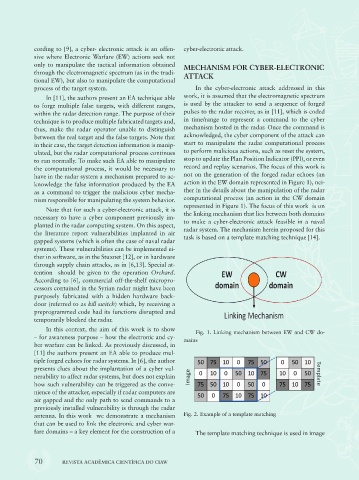
                Note that for such a cyber-electronic attack, it is   represented in Figure 1). The focus of this work  is on
            necessary to have a cyber component previously im-  the linking mechanism that lies between both domains
            planted in the radar computing system. On this aspect,   to make a cyber-electronic attack feasible in a naval
            the  literature  report  vulnerabilities  implanted  in  air   radar system. The mechanism herein proposed for this
            gapped systems (which is often the case of naval radar   task is based on a template matching technique [14].
            systems). These vulnerabilities can be implemented ei-
            ther in software, as in the Stuxnet [12], or in hardware
            through supply chain attacks, as in [6,13]. Special at-
            tention  should be given to the operation  Orchard.
            According to [6], commercial off-the-shelf micropro-
            cessors contained in the Syrian radar might have been
            purposely  fabricated  with  a  hidden  hardware  back-
            door (referred to as kill switch) which, by receiving a
            preprogrammed code had its functions disrupted and
            temporarily blocked the radar.
                In this context, the aim of this work is to show   Fig. 1. Linking mechanism between EW and CW do-
            – for awareness purpose – how the electronic and cy-  mains
            ber warfare can be linked. As previously discussed, in
            [11] the authors present an EA able to produce mul-
            tiple forged echoes for radar systems. In [6], the author
            presents clues about the implantation of a cyber vul-
            nerability to affect radar systems, but does not explain
            how such vulnerability can be triggered as the conve-
            nience of the attacker, especially if radar computers are
            air gapped and the only path to send commands to a
            previously installed vulnerability is through the radar
            antenna. In this work  we demonstrate a mechanism   Fig. 2. Example of a template matching
            that can be used to link the electronic and cyber war-
            fare domains – a key element for the construction of a   The template matching technique is used in image


             70       REVISTA ACADÊMICA CIENTÍFICA DO CIAW

