


Page 71 - RAC_CIAW_ a_I_n_01_2021.pdf
P. 71
processing to find small parts of an image that cor-  the template matching mechanism for cyber-electronic
            respond to a model (template) image. To do so, it is   attack was implemented and simulated in Python.
            defined a template to be searched in a main image. The   It is assumed that the cyber component of the at-
            main image in analysis and the template are divided in   tack (the malware) is already installed in the radar,
            pixels, as shown in Figure 2. Then the template is moved   given that the exploitation mechanisms to install it in
            over the main image, in a search process throughout   the radar computational system is out of the scope of
            all the main image’s area. For each position assumed   this paper. Also, considering that the implementation
            by the template in this scanning process over the main   of the EA component of the attack is not in the scope
            image, a similarity index is computed. The similarity   of this paper, it is assumed that the remote command (a
            index quantifies the similitude between the template   sequence of false echoes) is generated and transmitted
            and the piece of the main image being compared. If   through a Digital Radio Frequency Memory (DRFM)
            the index is higher than a previously defined threshold,   technique  [11]. The  command is  received  and pro-
            then the template image is considered to be detected   cessed by the radar, and displayed as an image in the
            in the main image. This exhaustive search operation   PPI screen, such as any other received echoes (false or
            demands a considerable computational cost, propor-  not).
            tional to the sizes of the images. On the other hand, it   In the simulations herein presented, the Python
            provides a high degree of effectiveness in searching for   code scans the graphical interface (the PPI) produced
            patterns in images [14].
                                                              by the radar simulator in order to identify the attack
                Note that the degree of similarity between the   commands received from the EA component of the of-
            template and a piece of the main image is established   fensive. To evaluate the effectiveness of the proposed
            by comparing intensity values of each of their pixels.   mechanism, in this work, the chosen attack command
            Among the available methods to compute the similar-  consists of a sequence of five false echoes, which pro-
            ity coefficient, there are: the Sum of Absolute Differ-  duces a sequence of five points displayed in the direc-
            ences (SAD), the Sum of Squared Differences (SSD),   tion where the DRFM transmitter is. Once this pattern
            and normalized cross correlation. In  this paper,  the   is detected, it can be used to trigger a malicious action
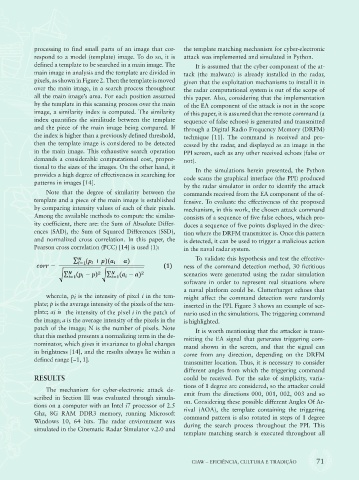
            Pearson cross correlation (PCC) [14] is used (1):  in the naval radar system.

                                                                  To validate this hypothesis and test the effective-
                                                              ness of the command detection method, 30 fictitious
                                                              scenarios were generated using the radar simulation
                                                              software in order to represent real situations where
                                                              a naval platform could be. Clutter/target echoes that
                wherein, pi is the intensity of pixel i in the tem-  might affect the command detection were randomly
            plate; p is the average intensity of the pixels of the tem-  inserted in the PPI. Figure 3 shows an example of sce-
            plate; ai is  the intensity of the pixel i in the patch of   nario used in the simulations. The triggering command
            the image; a is the average intensity of the pixels in the   is highlighted.
            patch of the image; N is the number of pixels. Note   It is worth mentioning that the attacker is trans-
            that this method presents a normalizing term in the de-  mitting the EA signal that generates triggering com-
            nominator, which gives it invariance to global changes   mand shown in the screen, and that the signal can
            in brightness [14], and the results always lie within a   come from any direction, depending on the DRFM
            defined range [−1, 1].                            transmitter location. Thus, it is necessary to consider
                                                              different angles from which the triggering command
            RESULTS                                           could be received. For the sake of  simplicity, varia-
                                                              tions of 1 degree are considered, so the attacker could
                The mechanism for cyber-electronic attack de-
            scribed in Section III was evaluated through simula-  emit from the directions 000, 001, 002, 003 and so
            tions on a computer with an Intel i7 processor of 2.5   on. Considering these possible different Angles Of Ar-
            Ghz, 8G RAM DDR3 memory, running Microsoft        rival (AOA), the template containing the triggering
            Windows 10, 64 bits. The radar environment was    command pattern is also rotated in steps of 1 degree
            simulated in the Cinematic Radar Simulator v.2.0 and   during the search process throughout the PPI. This
                                                              template matching search is executed throughout all


                                                                 CIAW – EFICIÊNCIA, CULTURA E TRADIÇÃO    71

