


Page 79 - RAC_CIAW_ a_I_n_01_2021.pdf
P. 79
to further auditions. All data into the ledger become   server, resulting in a Single Point of Failure (SPF). It
            immutable, and no mechanism can modify it.        is vulnerable to the second scenario due to the serv-
                                                              er database accept modifications on stored data. It is
            Security Analysis                                 also vulnerable to the third scenario due to its lack of
                                                              Fault Tolerance mechanisms. Finally, it is vulnerable
                This section presents a security analysis compar-  to the last scenario due to its lack of authentication on
            ing a conventional MMS (with centralized and de-  UAV-Operator communications.
            centralized databases) and a blockchain-based MMS     The decentralized database MMS differs from the
            regarding the attack model described in Section III-B.   centralized one just in the first attack scenario due to
            Table I summarizes the analysis result, labeling with a   its distributed data storage. If an attacker successfully
            red lock if the system is vulnerable to the attack and   break in a single ND, data would be safe in the other
            with a green lock if the system is resilient to the attack,   servers. However, in the other three scenarios, the de-
            also presenting the main reason for the success or fail-  centralized MMS would perform like the centralized
            ure of the system security in each scenario.
                                                              one.
                                                                  The blockchain-based MMS is resilient against
            TABLE I: Security Analysis                        all four  attack scenarios. It resists the first scenario
                                                              attack due to its Distributed Ledger Technology store
                                                              the sensing data in different nodes, unsettling the SPF.
                                                              It resists the second scenario because all data added
                                                              to the ledger becomes immutable and the attacker no
                                                              longer can modify stored data. It resists the collusion
                                                              attack if the attacker corrupts less than 1/3 or 1/2 (de-
                                                              pending on the consensus protocol) of all blockchain
                                                              nodes due to the Fault Tolerance mechanism of the
                                                              consensus protocol. And finally, it also resists the last
                                                              attack scenario, securing UAV-Operator  communica-
                                                              tions through asymmetric cryptography and the MSP
                                                              key management.


                                                              EXPERIMENT AND  RESULTS
                Firstly, we analyze the conventional centralized
            database MMS. It is vulnerable to the first attack sce-  In this section, we quantitatively analyze the pro-
            nario due to the storage of sensing data in only one   cessing overhead caused by the blockchain technolo-
                                                              gy through an experiment integrating our blockchain
                                                                                        prototype with the Bra-
                                                                                        zilian Navy low-cost AIS
                                                                                        system. To do so, we
                                                                                        evaluate the prototype
                                                                                        operation since data
                                                                                        acquisition on sensing
                                                                                        nodes  until its insertion
                                                                                        on the blockchain’s ledg-
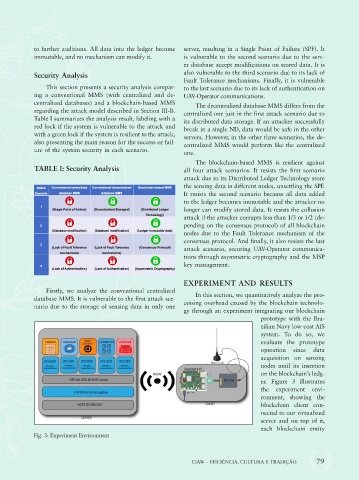
                                                                                        er. Figure 3 illustrates
                                                                                        the experiment envi-
                                                                                        ronment, showing the
                                                                                        blockchain client con-
                                                                                        nected to our virtualized
                                                                                        server and on top of it,
                                                                                        each blockchain entity
            Fig. 3: Experiment Environment


                                                                 CIAW – EFICIÊNCIA, CULTURA E TRADIÇÃO    79

