


Page 49 - Economia Azul - versão: inglês
P. 49
technical agenda, distant from the human   More recently, the 2010s have seen an in-
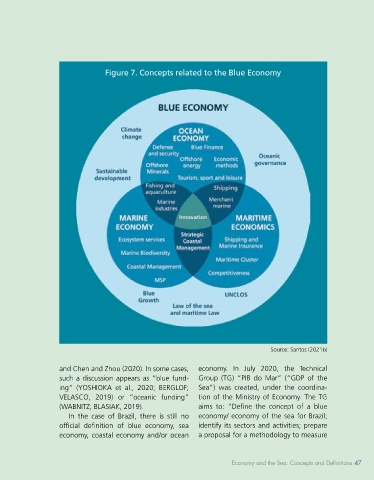
 and social sciences. In the first decade of   crease in themes, actors and their frequency.   Figure 7. Concepts related to the Blue Economy
 the 2000s,  discussions  on ship  design,   Unlike previous temporal analyses, it is diffi-
 shipbuilding, cargo and ports transport and   cult to identify the discussion (and its nature)
 harbors led the debate. In the second de-  that drives the period, as different terms indi-
 cade of the 2000s, the agenda expanded,   cate different issues and agendas. However,
 as it considers international cooperation,   it is possible to argue that the 2010s is the
 maritime policy, societies and institutions.   period that comprises the discussion from
 While still very focused on the USA, issues   the governance approach, highlighting its
 related to Asia are progressively increasing.  relevance in the following issues:

 . Economic: economic growth, compe-  offshore oil, marine resources, environ-
 titiveness and trade;  mental management and environmen-
 . Policies: public policies, marine policy,   tal protection;
 spatial planning, ecosystem management,  .Climate change and pollution: control of
 decision making, integrated approach, co-  emissions, plankton, eutrophication and
 astal zone management and project ma-  marine pollution; and
 nagement;  . Actors and institutions: China, European
 . Sustainability in the exploitation  of  Union (EU), the USA, Australia, Canada, Pa-
 marine resources: fishing, aquaculture,  cific Ocean, Baltic Sea and Law of the Sea.

 3. Main concepts and definitions


 Based mainly on the results of the pre-  3.1. Economy of the Sea
 vious  subsection, this section  presents  a
 more detailed conceptual discussion based   In the 1970s and 1980s, the concepts
 on the results of the bibliometric analysis is   of economy of the sea (GESSNER, 1971)
 presented, contextualizing it from the cen-  and sea economy (ANTIA, 1989; DOLM-
 tral debates in the specialized literature. In   IERSKI; NITKA, 1976) led  the  discussion.
 relation to Figure 5, it is possible to draw   More recently, the concept has been used
 several conclusions, which even motivated   to methodologically and quantitatively   Source: Santos (2021b)
 the research and justified some of the guid-  analyze the case of Brazil (SANTOS, 2019;
 ing questions of this chapter.  2020, 2021a, 2021b, 2022; ALERJ, 2021;   and Chen and Zhou (2020). In some cases,   economy. In July 2020, the Technical
 Figure 7  summarizes  the main  themes   REGAZZI et al., 2021; SANTOS; CARVAL-  such a discussion appears as “blue fund-  Group (TG) “PIB do Mar” (“GDP of the
 related to each of these concepts, which,   HO, 2020a; 2020b; PwC, 2019; CARVAL-  ing” (YOSHIOKA et  al., 2020; BERGLOF;   Sea”) was created, under the coordina-
 again, should not be understood as syn-  HO, 2018). Although it does not appear   VELASCO,  2019)  or  “oceanic  funding”   tion of the Ministry of Economy. The TG
 onyms. It focuses on the four most com-  as a key term in Figure 6, the increase in   (WABNITZ; BLASIAK, 2019).  aims to: “Define the concept of a blue
 monly used concepts, namely: blue econo-  recent publications on the interface be-  In  the  case of  Brazil, there  is  still  no   economy/ economy of the sea for Brazil;
 my, sea ocean economy, maritime econom-  tween financialization and seas and ocean   official definition of blue economy, sea   identify its sectors and activities; prepare
 ics and marine economy.  issues is notable, as in An and Li (2020)   economy, coastal economy and/or ocean   a proposal for a methodology to measure


 46  BLUE ECONOMY                                                     Economy and the Sea: Concepts and Definitions  47
                                                                                                          47
                                                                      Economy and the Sea: Concepts and Definitions

