


Page 47 - Economia Azul - versão: inglês
P. 47
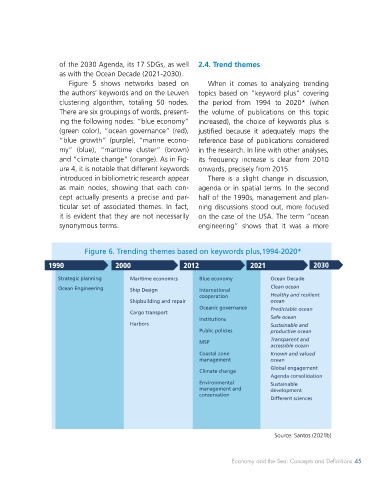
Figure 5. Networks based on authors’ keywords, 1959-2020*  of the 2030 Agenda, its 17 SDGs, as well   2.4. Trend themes
                   as with the Ocean Decade (2021-2030).
 law of the sea      Figure 5 shows networks based  on         When it comes to analyzing trending
 biodiversity      the authors’ keywords and on the Leuven   topics based on ”keyword plus” covering
 marine protected areas
                   clustering algorithm, totaling 50 nodes.   the period from 1994 to 2020* (when
 ecosystem-based management
 policy            There are six groupings of words, present-  the  volume  of  publications  on  this  topic
 ecosystem approach
                   ing the following nodes: “blue economy”   increased), the choice of keywords plus is
 ocean
 mediterranean sea  fisheries management  (green color), “ocean governance” (red),   justified  because  it  adequately  maps  the
 high seas
 climate change    “blue growth” (purple), “marine econo-   reference base of publications considered
 conservation
 ocean governance  my”  (blue),  “maritime  cluster”  (brown)   in the research. In line with other analyses,
 marine spatial planning  unclos  and “climate change” (orange). As in Fig-  its frequency increase is clear from 2010
 governance        ure 4, it is notable that different keywords   onwards, precisely from 2015.
 ecosystem services  fisheries  marine conservation
 marine  oceans governance  introduced in bibliometric research appear   There is a slight change in discussion,
 aquaculture  marine governance  coastal management  as main nodes, showing that each con-  agenda or in spatial terms. In the second
 blue growth  blue economy  cept actually presents a precise and par-  half of the 1990s, management and plan-

 sustainability    ticular set of associated themes. In fact,   ning discussions stood out, more focused
 maritime security  it is evident that they are not necessarily   on the case of the USA. The term “ocean
 sustainable development
                   synonymous terms.                        engineering” shows that it was a more
 maritime spatial planning  marine policy
 oceans
 south africa
 sustainable development goals  european union  china  Figure 6. Trending themes based on keywords plus,1994-2020*
 maritime economy  indian ocean
 ocean economy  1990               2000                2012                2021               2030

                  Strategic planning   Maritime economics   Blue economy         Ocean Decade
 innovation  marine economy  Ocean Engineering  Ship Design  International       Clean ocean
                                                            cooperation          Healthy and resilient
                                       Shipbuilding and repair                   ocean
 maritime  shipping
                                                            Oceanic governance   Predictable ocean
 development                           Cargo transport
 maritime cluster                                           Institutions         Safe ocean
                                       Harbors                                   Sustainable and
 maritime economics
 competitiveness                                            Public policies      productive ocean
 marine industry
                                                            MSP                  Transparent and
 strategic management                                                            accessible ocean
                                                            Coastal zone         Known and valued
 Source: Santos (2021a, 2022)                               management           ocean
 The exponential growth of the term   as aquaculture (720.0%), blue growth   Climate change  Global engagement
 “ocean governance” stands out, especially   (569.2%), marine economy (485.7%) and   Environmental   Agenda consolidation
 in the period 1999-2018. However, since   sustainable  development  (440.0%).  There   management and   Sustainable
                                                                                 development
 2015 (and especially from 2018 onwards),   should be a close relationship with the in-  conservation  Different sciences
 the term “blue economy” has become the   creasing frequency of “climate change”,
 most frequently used term. In the period   “sustainable development”, “sustainability”,
 2016-2020*, the frequency of the term   “marine spatial  planning”,  “aquaculture”
 blue economy increases (871.4%), as well   and “fishing” with the implementation   Source: Santos (2021b)


 44  BLUE ECONOMY                                                     Economy and the Sea: Concepts and Definitions  45

