


Page 654 - Economia Azul - versão: inglês
P. 654
outer sides of the dam is due to changes   al., 2018), oscillating hydrofoils (MA et al.,                          2.3  Thermal Gradient Conversion         at the mouth of a river. There are two
              in the tidal regime.                      2017; WANG et al., 2017; FILIPPAS et al.,                                                                         methods to generate electricity from the
                 The kinetic energy of tidal and ocean   2018), and effect turbines Venturi (CHAUD-                                 Ocean thermal energy conversion       salinity gradient: pressure retarded osmo-
              currents can be extracted with hydroki-   HARI  et al., 2013). The currents passing                                (OTEC) is a technology that uses the wa-  sis (PRO) (ALTAEE et al., 2017; Idem, 2019)
              netic turbines, which have similarities with   through the hydrofoils generate lift force,                         ter temperature difference between the   and reverse electrodialysis (RED) (TUFA
              wind turbines, however, operate under-    which drives the movement of the hydrau-                                 sea surface and great depths (about 1000   et al., 2018; AVCI et al., 2018). The PRO
              water. Due to the greater density of water   lic system to generate electricity. Venturi                           m) for heating, cooling, electricity genera-  method is based on semipermeable mem-
              compared to air, turbine blades for tidal   effect  turbines  take advantage  of the  ki-                          tion or desalination purposes. The feasibil-  branes that allow only water molecules
              or ocean currents are smaller and move    netic energy of the current, amplifying the                              ity of the technology requires a minimum   to pass through. In this approach, water
              more slowly than wind turbines. The main   current velocity due to the reduction of the                            temperature differential of around 20 °C.   flows from a dilute solution (freshwater) to
              difference  between tidal and ocean cur-  flow cross-section (MOFOR  et al., 2014).                                In the closed cycle, warm water from the   a concentrated solution (seawater), raising
              rents is that the former has bidirectional   In addition to these types of converters,                             upper layers is used to vaporize a working   the pressure of the saltwater, which drives
              flows in contrast to ocean currents which   there are ducted channels (KHAN  et al.,                               fluid, ammonia, for example, which drives   a turbine, producing electricity. The RED
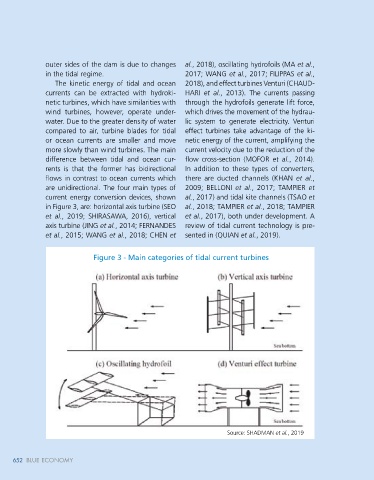
              are unidirectional. The four main types of   2009; BELLONI  et al., 2017; TAMPIER  et                              an electrical generator. The resulting steam   method is based on the transport of ions
              current energy conversion devices, shown   al., 2017) and tidal kite channels (TSAO et                             is then condensed by cold water, which is   (salt) through membranes. Two fluids of
              in Figure 3, are: horizontal axis turbine (SEO   al., 2018; TAMPIER et al., 2018; TAMPIER                          lifted, by means of hydraulic pumps, from   different salinities (fresh water and salt wa-
              et al., 2019; SHIRASAWA, 2016), vertical   et al., 2017), both under development. A                                the ocean floor and subsequently discard-  ter) pass through a series of specific mem-
              axis turbine (JING et al., 2014; FERNANDES   review of tidal current technology is pre-                            ed. Some studies on closed-cycle OTEC can   branes. The chemical potential difference
              et al., 2015; WANG et al., 2018; CHEN et   sented in (QUIAN et al., 2019).                                         be found in the references (FAIZAL et al.,   between the membranes results in an elec-
                                                                                                                                 2013; AYDIN   et al., 2014; YANG  et al.,   trical voltage. The brackish water is then

                             Figure 3 - Main categories of tidal current turbines                                                2014). Open-cycle technology uses heated   discharged into the sea. In addition, some
                                                                                                                                 water from the upper layers of the ocean   hybrid processes such as electricity produc-
                                                                                                                                 as the working fluid. The main benefit of   tion from thermal energy using a closed-
                                                                                                                                 the open cycle process is that it can pro-  loop RED heat engine, low-energy desali-
                                                                                                                                 duce both electricity and desalinated water.   nation integrating RED with desalination
                                                                                                                                 The hybrid cycle combines closed and open   facilities, and the use of microbial RED cells
                                                                                                                                 cycle technologies. In this process, heated   with improved energy performance have
                                                                                                                                 surface water is rapidly evaporated in or-  been proposed for extracting energy from
                                                                                                                                 der to vaporize ammonia from the working   the salinity gradient (TUFA et al., 2018; MEI
                                                                                                                                 fluid in a closed cycle, driving a turbine to   et al., 2018).
                                                                                                                                 produce electricity. Then the steam is con-  2.5 Offshore wind turbines
                                                                                                                                 densed by a heat exchanger, producing de-
                                                                                                                                 salinated water (OCTAVIANI et al., 2016).   There are two main types of founda-
                                                                                                                                 Such a cycle can generate electricity and   tions for offshore wind turbines, fixed with
                                                                                                                                 drinking water simultaneously.           a support on the sea floor and floating.
                                                                                                                                                                          Fixed foundation concepts are suitable
                                                                                                                                 2.4 Salinity Gradient Conversion
                                                                                                                                                                          for depths up to 60 m. However, for wa-
                                                                                                                                    The salinity gradient takes advantage of   ter-blades greater than 40 m, these struc-
                                                                                                                                 the energy that can be generated by mixing   tures suffer large hydrodynamic loads,
                                                                    Source: SHADMAN et al., 2019                                 fresh water with salt water, for example,   which leads to an increase in cost, due to


     652   BLUE ECONOMYBLUE ECONOMY                                                                                                                                                            Renewable Energy in the Ocean 653
     652

