


Page 653 - Economia Azul - versão: inglês
P. 653
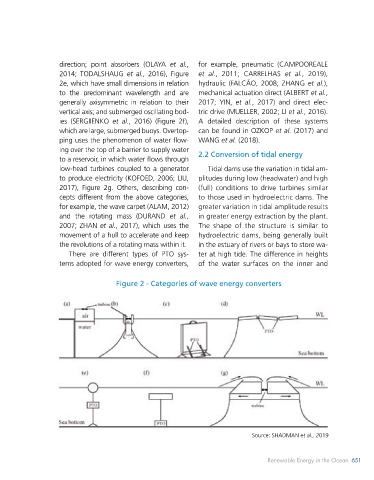
Despite decades of efforts to harness the  at Lake Sihwa, South Korea, since 2011.   direction; point absorbers (OLAYA  et al.,   for example, pneumatic (CAMPOOREALE
 energy, its global potential is still very little ex-  Advanced  marine  generation  projects,  tidal   2014; TODALSHAUG  et al., 2016), Figure   et  al.,  2011;  CARRELHAS  et  al.,  2019),
 plored (REN21, 2018). Over the last decade,  current power plants ranging from 10 kW to   2e, which have small dimensions in relation   hydraulic (FALCÃO, 2008; ZHANG  et al.),
 ocean energy sources have grown significant-  1 MW, have been deployed primarily in the   to the predominant wavelength and are   mechanical actuation direct (ALBERT et al.,
 ly. Since 2010, many devices have been de-  UK, Canada, Australia, and China. However,   generally axisymmetric in relation to  their   2017; YIN,  et al., 2017) and direct elec-
 ployed around the world to capture energy  these demonstration projects remain costly   vertical axis; and submerged oscillating bod-  tric drive (MUELLER, 2002; LI et al., 2016).
 from waves, currents and tidal ranges, and  and have not yet achieved the economies of   ies  (SERGIIENKO  et  al.,  2016)  (Figure  2f),   A detailed description of these systems
 thermal and salinity gradients. Globally, this  scale necessary for significant cost reductions   which are large, submerged buoys. Overtop-  can be found in OZKOP et al. (2017) and
 growth has more than doubled, from 244  (IEA, 2021). Ocean renewable energy tech-  ping uses the phenomenon of water flow-  WANG et al. (2018).
 MW in 2009 to 526.8 MW in 2021 (IRENA,  nologies are still in the conceptual, R&D, or   ing over the top of a barrier to supply water   2.2 Conversion of tidal energy
 2021). However, more than 90% of this op-  demonstration prototype stages. In the case   to a reservoir, in which water flows through
 erational capacity is represented by two tidal  of waves and tidal currents, based on current   low-head turbines coupled to a generator   Tidal dams use the variation in tidal am-
 dams, which have been operating commer-  developments, global commercial application   to produce electricity (KOFOED, 2006; LIU,   plitudes during low (headwater) and high
 cially, at La Rance, France, since 1966, and  is expected in the medium term.  2017), Figure 2g. Others, describing con-  (full) conditions to drive turbines similar
                   cepts different from the above categories,   to those used in hydroelectric dams. The
 2. Concepts and technologies  for example, the wave carpet (ALAM, 2012)   greater variation in tidal amplitude results
                   and the rotating mass (DURAND  et al.,   in greater energy extraction by the plant.
 2.1 Wave power converters
                   2007; ZHAN et al., 2017), which uses the   The shape of the structure is similar to
 Currently, there are a large number of   oscillating body, and overtopping. The Os-  movement of a hull to accelerate and keep   hydroelectric dams, being generally built
 concepts and patents on the use of wave   cillating Water Column (OWC) compress-  the revolutions of a rotating mass within it.  in the estuary of rivers or bays to store wa-
 energy. The wave energy conversion pro-  es and decompresses the air in a chamber,   There are different types of PTO sys-  ter at high tide. The difference in heights
 cess can be divided into three main steps:   from the elevation of the wave, to drive a   tems adopted for wave energy converters,   of the water surfaces on the inner and
 the primary conversion step, the second-  turbine coupled to a generator, producing
 ary conversion step, and the tertiary con-  electricity. Depending on the installation   Figure 2 - Categories of wave energy converters
 version step (E.R., 2019). In the primary   location, OWC devices can be installed on
 conversion stage, the wave converter cap-  the coast (HEATH, 2012; FERNANDES  et
 tures the kinetic energy of waves through   al., 2018). Figure 2a, or floating, Figure 2b
 interactions between the converter and   (BULL et al., 2016; FALCÃO et al., 2016).
 the wave, for example, float oscillation, air   Oscillating bodies use wave motion to ex-
 flow or water flow. The secondary stage   cite two bodies of a converter, so that the
 converts the energy of body movement   relative motion between the bodies, with
 into electricity through the electrical gen-  the aid of a generator, produces electric-
 erator (power take-off – PTO). In the tertia-  ity.  According to dimension and orienta-
 ry stage, the characteristics of the energy   tion, these systems can also be classified as
 produced are adapted to the requirements   terminators  (DIAS et al. 2017), Figure 2c,
 of the network with a power electronic   positioned with large horizontal extensions
 interface.  Based  on  the  working  princi-  perpendicular to the wave propagation di-
 ples of the wave converter’s primary and   rection; attenuators (YEMM, 2012; ZHENG,
 secondary conversion stages, the classifi-  2017) (Figure 2d), with a large horizontal
 cation includes oscillating water column,   extension parallel to the wave propagation    Source: SHADMAN et al., 2019


 650   BLUE ECONOMY                                                             Renewable Energy in the Ocean 651

