


Page 202 - Economia Azul - versão: inglês
P. 202
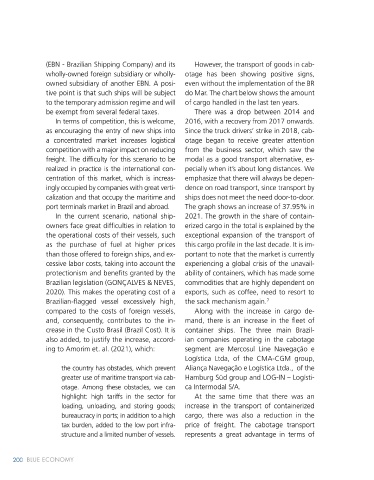
(EBN - Brazilian Shipping Company) and its   However, the transport of goods in cab-                                          Graph 1. Total cargo transported in cabotage (in tons)
               wholly-owned foreign subsidiary or wholly-   otage has been showing positive signs,
               owned subsidiary of another EBN. A posi-  even without the implementation of the BR                                900.000
               tive point is that such ships will be subject   do Mar. The chart below shows the amount                           800.000                                                               782787
               to the temporary admission regime and will   of cargo handled in the last ten years.
               be exempt from several federal taxes.       There  was  a  drop  between  2014  and                                700.000
                 In terms of competition, this is welcome,   2016, with a recovery from 2017 onwards.
               as encouraging the entry of new ships into   Since the truck drivers’ strike in 2018, cab-                         600.000        534928                                   538858  567431
               a concentrated market increases logistical   otage began to receive greater attention                              500.000               496212              486841  502733
               competition with a major impact on reducing   from the business sector, which saw the                                      424470               424375
               freight. The difficulty for this scenario to be   modal as a good transport alternative, es-                       400.000                             375829
               realized in practice is the international con-  pecially when it’s about long distances. We                        300.000
               centration of this market, which is increas-  emphasize that there will always be depen-
               ingly occupied by companies with great verti-  dence on road transport, since transport by                         200.000
               calization and that occupy the maritime and   ships does not meet the need door-to-door.
               port terminals market in Brazil and abroad.  The graph shows an increase of 37.95% in                              100.000
                 In the current scenario, national ship-  2021. The growth in the share of contain-                                    0
               owners face great difficulties in relation to   erized cargo in the total is explained by the                               2012   2013   2014   2015   2016   2017   2018   2019  2020   2021
               the operational costs of their vessels, such   exceptional expansion of the transport of
               as the purchase of fuel at higher prices   this cargo profile in the last decade. It is im-                                                                                      Source: ANTAQ (2022)
               than those offered to foreign ships, and ex-  portant to note that the market is currently
               cessive labor costs, taking into account the   experiencing a global crisis of the unavail-                                       Graph 2. Number of ships in Brazilian cabotage
               protectionism and benefits granted by the   ability of containers, which has made some                             25
               Brazilian legislation (GONÇALVES & NEVES,   commodities that are highly dependent on                                                                                        22
               2020). This makes the operating cost of a   exports, such as coffee, need to resort to                                                                                              21
               Brazilian-flagged vessel excessively high,   the sack mechanism again. 7                                           20                                         20     20                    20
               compared to the costs of foreign vessels,   Along with the increase in cargo de-
               and, consequently, contributes to the  in-  mand, there is an increase in the fleet of                                          16      16     15     16
               crease in the Custo Brasil (Brazil Cost). It is   container ships. The three main Brazil-                          15
               also added, to justify the increase, accord-  ian companies operating in the cabotage                                    13
               ing to Amorim et. al. (2021), which:     segment are Mercosul Line Navegação e
                                                        Logística Ltda, of the CMA-CGM group,                                     10
                   the country has obstacles, which prevent   Aliança Navegação e Logística Ltda.,  of the
                   greater use of maritime transport via cab-  Hamburg Süd group and LOG-IN – Logísti-
                   otage.  Among  these  obstacles,  we  can   ca Intermodal S/A.                                                  5
                   highlight: high tariffs in the sector for   At the same time that there was an
                   loading, unloading,  and  storing goods;   increase in the transport of containerized
                   bureaucracy in ports; in addition to a high   cargo, there was also a reduction in the                          0   2012    2013   2014   2015    2016   2017   2018    2019   2020   2021
                   tax burden, added to the low port infra-  price of freight. The cabotage transport
                   structure and a limited number of vessels.  represents a great advantage in terms of                                                                                         Source: ANTAQ (2022)


                                                                                                                                                                                                                        201
     200   BLUE ECONOMY                                                                                                                                                            Ocean Governance as a Communication Vector 201
                                                                                                                                                                                   Ocean Governance as a Communication Vector

