


Page 673 - Economia Azul - versão: inglês
P. 673
of the naval industry allowed ship size to  of the United Nations Conference on Trade   in the routes where they could operate. An   FPSO. In 2010, it was sent for recycling in Al-
 increase, and new, more efficient alterna-  and Development (UNCTAD) show the in-  example of this was the ship Knock Nevis,   ang, India, ending the cycle of the largest oil
 tives were found to conduct transportation  ternational participation of regions in the   with 458 m in length, 67 m of beam and 24   tanker in the world (MARINE INSIGHT, 2021).
 during each period of human progress.  maritime market. In terms of shipments, the   m of draft and 564,763 DWT, initially operat-  Also in this context, from the 2000s
 From sailing to the steam engine to in-  distribution is as follows: Africa 7%; Ameri-  ing between the Middle East and the United   onwards, the maritime sector began to
 ternal combustion engines, countless trans-  cas 22%; Asia 41%; Europe 16%; Oceania   States. In 1986 during the Iraq war it suffered   again experience a significant increase in
 formations have occurred in the design of  14%. This means that these are the flows   an attack and was seriously damaged. It re-  the size of container ships. Figure 1 shows
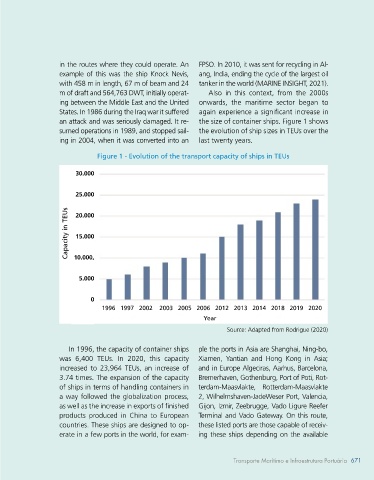
 vessels and in the materials used in their  from these regions with cargo shipments for   sumed operations in 1989, and stopped sail-  the evolution of ship sizes in TEUs over the
 construction. In 2021, there were around  export. In unloading (import) we have: Afri-  ing in 2004, when it was converted into an   last twenty years.
 99,800 merchant ships registered in the  ca 5%; Americas 13%; Asia 62%; Europe
 world. These ships are divided into the fol-  19%; Oceania 1%. This balance of supply   Figure 1 - Evolution of the transport capacity of ships in TEUs
 lowing proportions: 11% oil tankers; 12%  and demand for international maritime   30.000
 bulk carriers; 19% general post; 5% con-  transport refers to the period of 2019, in
 tainer; 51% other miscellaneous types, ac-  which 11.76 billion tons were exported and
 cording to the total classification based on  11.083 billion tons were imported.  25.000
 UNCTADSTAT (2021) data. Annually, around   It is clear that the flow of exports from
 800 ships are sent for demolition a year, in  countries, for example, the Americans, in-  20.000
 pre- Covid-19 conditions. Until 2020, there  cluding Brazil, is greater than imports, as
 were about 2,779 orders for the construc-  Brazil is a country that exports commodities   Capacity in TEUs  15.000
 tion of new ships in countries that are not  in large quantities. On the other hand, it is
 members of the OECD (WP6), with China  observed that Asia, and more specifically Chi-  10.000,
 as the main protagonist, with about 70.7%  na, is a major importer. Therefore, there is an
 of the orders for new construction, in which  inversion in relation to the flow of cargo, that   5.000
 most of the new construction contracts are  is, many imported cargoes are processed in
 for bulk carriers (DANIEL et al., 2021).  Asian territory, to be later consumed internal-
 The density of maritime transport is con-  ly and then shipped for export. This dynamics   0
 centrated in the Northern Hemisphere due  of maritime transport in terms of supply and   1996   1997   2002     2003   2005   2006   2012   2013   2014   2018   2019   2020
 to the economic issues of these nations,  demand is what governs its activity.  Year
 that is, the wealth of the world in terms                          Source: Adapted from Rodrigue (2020)
 of the value of transported goods. There is  1.2 Economy of scale
 intense maritime transport on the Asia-Eu-  In 1996, the capacity of container ships   ple the ports in Asia are Shanghai, Ning-bo,
 rope axis (Eurasia), which shows the impor-  The maritime transport sector is going   was 6,400 TEUs. In 2020, this capacity   Xiamen, Yantian and Hong Kong in Asia;
 tance of this flow for the global economic  through a crucial moment to reduce the   increased  to  23,964  TEUs,  an  increase  of   and in Europe Algeciras, Aarhus, Barcelona,
 matrix. On the Pacific Ocean side, there is  unit costs of the ton transported onboard   3.74 times. The expansion of the capacity   Bremerhaven, Gothenburg, Port of Poti, Rot-
 also an Asia-North America (west coast)  ships. When we compare the evolution of   of ships in terms of handling containers in   terdam-Maasvlakte, Rotterdam-Maasvlakte
 flow, as well as Europe-North America on  ship sizes, it is noted that in 1980 there was   a way followed the globalization process,   2, Wilhelmshaven-JadeWeser Port, Valencia,
 its east coast, concentrating the transport  a movement towards the construction of   as well as the increase in exports of finished   Gijon, Izmir, Zeebrugge, Vado Ligure Reefer
 flow of high value-added cargo.  large oil tankers for cargo handling. How-  products produced in China to European   Terminal and Vado Gateway. On this route,
 Sirimanne et al. (2021), published in the  ever, the growth of these ships brought a   countries. These ships are designed to op-  these listed ports are those capable of receiv-
 Review of Maritime Transportation (2021)  problem to the ports since they were limited    erate in a few ports in the world, for exam-  ing these ships depending on the available


                                                                         Maritime Transport and Port Infrastructure 671
 670   BLUE ECONOMY                                                   Transporte Marítimo e Infraestrutura Portuária  671

