


Page 626 - Economia Azul - versão: inglês
P. 626
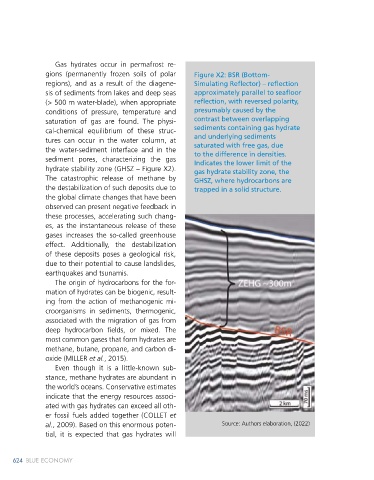
Gas  hydrates occur  in  permafrost re-                                                                         progressively replace natural gas (GRAULS,   estimates based on these seismic data have
              gions (permanently frozen soils of polar    Figure X2: BSR (Bottom-                                                2001), which could foster a new ener-    sparked interest in the area (estimated at
              regions), and as a result of the diagene-   Simulating Reflector) – reflection                                     gy revolution. According to Kvenvolden   780 tcf) (SAD et al. 1998).
              sis of sediments from lakes and deep seas   approximately parallel to seafloor                                     (1993), 1 m³ of methane gas hydrate con-    The  confirmation of  the  existence  of
              (> 500 m water-blade), when appropriate     reflection, with reversed polarity,                                    tains 164 m³ of methane and 0.8 m³ of    gas hydrates in Brazilian territory (Pelotas
              conditions of pressure, temperature and     presumably caused by the                                               water when brought to the surface (STP).   Basin) only occurred with the develop-
              saturation of gas are found. The physi-     contrast between overlapping                                           This number he calls the hydrate expansion   ment of the “CONEGAS Project: Origin,
              cal-chemical equilibrium of these struc-    sediments containing gas hydrate                                       factor. On the other hand, Sloan (2003)   occurrence and characterization of gas
              tures can occur in the water column, at     and underlying sediments                                               states that if each cavity is filled with a gas   hydrate deposits in the Rio Grande Cone,
                                                          saturated with free gas, due
              the water-sediment interface and in the     to the difference in densities.                                        molecule, 1 m³ of hydrate contains 180 m³   Pelotas Basin”, (MILLER et al., 2015). Lat-
              sediment pores, characterizing the gas      Indicates the lower limit of the                                       (Surface-Treating Pressure, STP) of meth-  er, in 2015, an oceanic mission to the Foz
              hydrate stability zone (GHSZ – Figure X2).   gas hydrate stability zone, the                                       ane. The conclusion is that hydrate-bearing   do Amazonas basin confirmed the occur-
              The catastrophic release of methane by      GHSZ, where hydrocarbons are                                           reservoirs contain more methane per m³   rence of this resource in the area (KETZER
              the destabilization of such deposits due to   trapped in a solid structure.                                        when compared to the volume of free gas   et al, 2018). Such projects were devel-
              the global climate changes that have been                                                                          in the same space (KVENVOLDEN, 1993).    oped by the team from the Institute of
              observed can present negative feedback in                                                                             In Brazil, detailed studies on gas hy-  Petroleum and Natural Resources at PU-
              these processes, accelerating such chang-                                                                          drates are still incipient, despite their enor-  CRS over a decade. These discoveries in

              es, as the instantaneous release of these                                                                          mous potential given the large area of  Bra-  Brazilian territory have raised the need
              gases increases the so-called greenhouse                                                                           zilian ocean basins. The existence of gas   for  additional  research  to  promote  the
              effect. Additionally, the destabilization                                                                          hydrate deposits in the country was, until   understanding of its forms of occurrence
              of these deposits poses a geological risk,                                                                         the beginning of this century, only based   and the future use of this resource in oth-
              due to their potential to cause landslides,                                                                        on evidence or indirect markers, such as   er sedimentary basins, in addition to the
              earthquakes and tsunamis.                                                                                          the presence of the so-called BSR (Bottom   known ones, the Pelotas and Foz do Am-
                 The origin of hydrocarbons for the for-                                                                         Simulating Reflector) in seismic sections   azonas basins (Figure X3).
              mation of hydrates can be biogenic, result-                                                                        (FONTANA, 1989; FONTANA; MUSSUME-           In addition to their importance as an en-
              ing from the action  of methanogenic  mi-                                                                          CI, 1994; SAD et al., 1997 and 1998). This   ergy resource, studies of gas hydrates also
              croorganisms  in  sediments,  thermogenic,                                                                         marker consists of a seismic reflector par-  provide important information about the
              associated with the migration of gas from                                                                          allel to the seafloor (Figure X2), normally   Earth’s carbon cycle and climate change.
              deep hydrocarbon fields, or mixed. The                                                                             between 200 and 700 m depth, caused      Small changes in ocean water temperature
              most common gases that form hydrates are                                                                           by the abrupt change in acoustic imped-  conditions can, for example, cause the dis-
              methane, butane, propane, and carbon di-                                                                           ance at the base of the gas hydrate stabil-  sociation and release of large amounts of
              oxide (MILLER et al., 2015).                                                                                       ity zone (GHSZ) in the sedimentary mass,   methane and carbon dioxide into the at-
                 Even though it is a little-known sub-                                                                           depending on the existence of a zone with   mosphere. The massive destabilization of
              stance, methane hydrates are abundant in                                                                           gas hydrates above and a zone with free   the gas hydrate system in a given region
              the world’s oceans. Conservative estimates                                                                         gas below this reflector in the sediments   can also trigger large mass wasting events
              indicate that the energy resources associ-                                                                         (MACKAY et al., 1994). In the Rio Grande   with potential impact on subsea instal-
              ated with gas hydrates can exceed all oth-                                                                         Cone (RGC), in a thick sedimentary se-   lations, such as oil platforms and subsea
              er fossil fuels added together (COLLET et                                                                          quence deposited during the Neogene, the   communication cables, or even major ca-
              al., 2009). Based on this enormous poten-            Source: Authors elaboration, (2022)                           presence of BSR was continuously identi-  tastrophes in coastal areas such as of tsu-
              tial, it is expected that gas hydrates will                                                                        fied in seismic surveys. Significant volume   namis (MIENERT et al., 2010).


     624   BLUE ECONOMY                                                                                                                                                               State of the Art of Gas Hydrate Occurrences  625

