


Page 545 - Economia Azul - versão: inglês
P. 545
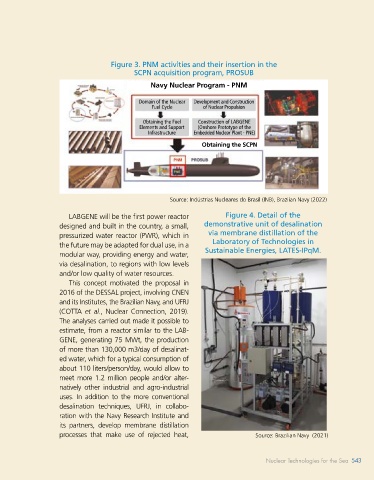
In the quest to master the nuclear fuel   magnetic levitation, which finally led to the   Figure 3. PNM activities and their insertion in the
 cycle, it was necessary to develop a technol-  production of nuclear fuel pellets. Figure 2   SCPN acquisition program, PROSUB
 ogy for obtaining and isotopic enrichment   below illustrates the stages of the cycle, and   Navy Nuclear Program - PNM
 of uranium hexafluoride with centrifuges   the prospecting, mining and processing part
 entirely built in Brazil. The enrichment took   is fully in charge of the company Indústrias   Domain of the Nuclear   Development and Construction
                                              Fuel Cycle
                                                             of Nuclear Propulsion
 place through ultracentrifugation obtained   Nucleares do Brasil – INB, a partner of MB in
 by the successful Brazilian technology of   the field of the nuclear fuel cycle.  Obtaining the Fuel   Construction of LABGENE
                                          Elements and Support   (Onshore Prototype of the
 Figure 2. Scheme of the complete nuclear fuel cycle   Infrastructure  Embedded Nuclear Plant - PNE)
 developed by PNM and INB                                    Obtaining the SCPN


 NAVY NUCLEAR PROGRAM
 PROGRAMA NUCLEAR DA MARINHA
 COMPLETE FUEL CYCLE
 CICLO COMPLETO DO COMBUSTÍVEL
 NATIONAL TECHNOLOGY
 PROSPECTION, MINING AND   T E C N OL OG I A   N A C I ON A L  Source: Indústrias Nucleares do Brasil (INB), Braziian Navy (2022)
 PROSPECÇÃO, MINERAÇÃO E
 IMPROVEMENT  CONVERSÃO
 BENEFICIAMENTO
 CONVERSION
 >>  >>
                     LABGENE will be the first power reactor        Figure 4. Detail of the
 ENRICHMENT        designed and built in the country, a small,   demonstrative unit of desalination
 ENRIQUECIMENTO
                   pressurized water reactor (PWR), which in   via membrane distillation of the
 >>
 DEPOSIT                                                        Laboratory of Technologies in
 DEPÓSITO
 >>                the future may be adapted for dual use, in a
 NUCLEAR SUBMARINE  modular way, providing energy and water,   Sustainable Energies, LATES-IPqM.
 SUBMARINO NUCLEAR
 >>  >>  >>        via desalination, to regions with low levels
                   and/or low quality of water resources.
 ELECTRIC            This concept motivated the proposal in
 GERAÇÃO
 POWER   >>  >>
 DE ENERGIA
 GENERATION        2016 of the DESSAL project, involving CNEN
 ELÉTRICA
 RECONVERSION AND   and its Institutes, the Brazilian Navy, and UFRJ
 RECONVERSÃO E FABRICAÇÃO
 MANUFACTURE OF THE
 DO ELEMENTO COMBUSTÍVEL
 FUEL ELEMENT      (COTTA  et al., Nuclear Connection, 2019).
 Source: Brazilian Navy (2019)   The analyses carried out made it possible to
                   estimate, from a reactor similar to the LAB-
 The technology of enrichment by ultra-  naval propulsion plant, at the Laboratory   GENE, generating 75 MWt, the production
 centrifugation employing magnetic levitation  for the Generation of Nucleoelectric En-  of more than 130,000 m3/day of desalinat-
 allowed the construction of nine cascades of  ergy - LABGENE, a crucial development to   ed water, which for a typical consumption of
 ultracentrifuges that today equip the INB. A  reach the embedded nuclear plant (PNE),   about 110 liters/person/day, would allow to
 further 30 cascades are expected to be deliv-  to be incorporated to the conventional   meet more 1.2 million people and/or alter-
 ered by 2030, which will make it+ possible to  nuclear-powered submarine – SCPN, as   natively  other  industrial  and  agro-industrial
 supply fuel to all our nuclear plants, current-  provided for in the environment devel-  uses. In addition to the more conventional
 ly only partially supplied by fuel produced in  opment program (Submarine Construc-  desalination techniques, UFRJ, in collabo-
 Brazil, and also to export it.  tion Program – PROSUB). Figure 3 below   ration with the Navy Research Institute and
 On its other side, the PNM is building  illustrates the correlation between PNM   its partners, develop membrane distillation
 the prototype on land of a reactor and a  and PROSUB.  processes that make use of rejected heat,   Source: Brazilian Navy  (2021)


                                                                                Nuclear Technologies for the Sea 543
 542   BLUE ECONOMIY                                                            Nuclear Technologies for the Sea  543

