


Page 543 - Economia Azul - versão: inglês
P. 543
and reinjecting gas at the wellhead, known techniques applicable to food will certainly 5. The Brazilian Navy’s Nuclear Program
as HISEP, which would be an even more reach seafood, contributing to their preser-
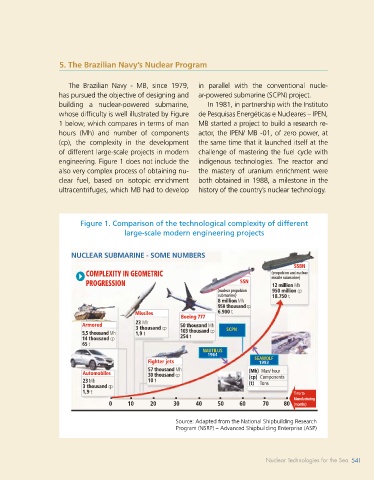
transformative innovation from the in-situ vation and certification of origin and quali- The Brazilian Navy - MB, since 1979, in parallel with the conventional nucle-
energy supply, as made possible by subsea ty. It is reasonable to imagine a scenario in has pursued the objective of designing and ar-powered submarine (SCPN) project.
nuclear generation. Another rapidly devel- which irradiators installed in fishing ports building a nuclear-powered submarine, In 1981, in partnership with the Instituto
oping application that could benefit from will be able to process sea products safely, whose difficulty is well illustrated by Figure de Pesquisas Energéticas e Nucleares – IPEN,
the installation of subsea nuclear reactors quickly and efficiently. 1 below, which compares in terms of man MB started a project to build a research re-
for electricity generation is mining. It is es- Nuclear and isotopic technologies hours (Mh) and number of components actor, the IPEN/ MB -01, of zero power, at
timated that more than 70 billion dollars have been used to monitor and study the (cp), the complexity in the development the same time that it launched itself at the
will be handled by 2030 in technology and ocean acidification process. As they ab- of different large-scale projects in modern challenge of mastering the fuel cycle with
equipment for subsea mining. sorb a quarter of the planet’s CO2 emis- engineering. Figure 1 does not include the indigenous technologies. The reactor and
Also in the subsea core electric gener- sions, the oceans undergo changes in also very complex process of obtaining nu- the mastery of uranium enrichment were
ation, the FlexBlue submersible platform their chemistry, with an increase in acidi- clear fuel, based on isotopic enrichment both obtained in 1988, a milestone in the
developed by the French leader in naval ty that affects marine organisms and bio- ultracentrifuges, which MB had to develop history of the country’s nuclear technology.
technology DCNS (currently Naval Group, geochemical cycles, leading to the corro-
France), which incorporates the main merits sion of calcium carbonates, with impacts
of the SMRs, stands out. The FlexBlue reactor on fisheries, among others. With the
was proposed to supply electricity to coastal mentioned technologies, biological pro- Figure 1. Comparison of the technological complexity of different
and island populations. It would be installed cesses can be studied in order to quantify large-scale modern engineering projects
at a depth of about 100 m, at a distance of and monitor acidification.
about 10 km from the coast and would make In addition, the monitoring of radionu- NUCLEAR SUBMARINE - SOME NUMBERS
use of submerged transmission lines. clides in the sea, on a global scale, is regu- SSBN
Another type of proposal is defended by larly carried out by the IAEA, in partnership COMPLEXITY IN GEOMETRIC (propulsion and nuclear
the Center for Advances in Nuclear Energy, with several marine research organizations PROGRESSION SSN missile submarine)
12 million Mh
from MIT, based on Offshore Floating Nu- around the world, using nuclear technolo- (nuclear propulsion 950 million cp
submarine)
18.750 t
clear Plants – OFNP, which were proposed gies. This, among other applications, allows 8 million Mh
in two versions, one 45m in diameter, gen- detecting any changes arising from the use Missiles 950 thousand cp
6.900 t
erating 300 MWe, and another 75m in di- of nuclear energy in the maritime environ- 23 Mh Boeing 777
Armored 50 thousand Mh
SCPN
ameter, generating 1100 MWe. ment. In monitoring activities, the NUTEC 3 thousand cp 103 thousand cp SCPN
SCPN
5,5 thousand Mh 1,9 t
The evolution of micro and small reac- Plastics program stands out. Using nucle- 14 thousand cp 254 t
65 t
tors will certainly facilitate their installa- ar techniques to quantify the dispersion of NAUTILUS
tion and continuous operation in remote plastics and contaminants, the IAEA sup- 1964 SEAWOLF
Fighter jets 1993
regions. Islands and oceanic bases fall into ports laboratories around the world to gen- 57 thousand Mh (Mh) Man/ hour
this category. SMRs or microreactors, de- erate scientific knowledge on the impacts Automobiles 30 thousand cp (cp) Components
10 t
23 Mh
pending on the need, can be a cost-effec- of plastic pollution on marine and coastal 3 thousand cp (t) Tons
tive solution to guarantee autonomy and ecosystems. In parallel, employing gamma 1,9 t . . . . . . . . . Time to
Manufacturing
energy security to the populations and pro- radiation and electron beams in addition to 0 10 20 30 40 50 60 70 80 (months)
ductive activities of these places. traditional mechanical and chemical meth-
Regarding the fishing and aquacul- ods, certain types of plastic waste can be Source: Adapted from the National Shipbuilding Research
Program (NSRP) – Advanced Shipbuilding Enterprise (ASP)
ture industry, the dissemination of nuclear modified for reuse or recycling.
541
Nuclear Technologies for the Sea
540 BLUE ECONOMIY Nuclear Technologies for the Sea 541

