


Page 76 - Economia Azul - versão: inglês
P. 76
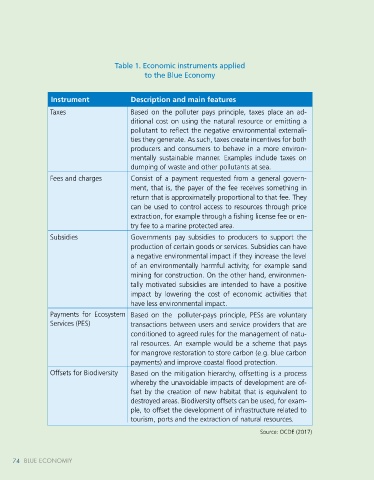
Table 1. Economic instruments applied                                                            As for fees, the charge must be estab-  use. This can lead to conflicts between local
                                            to the Blue Economy                                                                  lished at a level that can actually result in  communities and these areas, jeopardizing
                                                                                                                                 a change in behavior and thus must con-  the enforcement of the protected area and,
                                                                                                                                 sider the price elasticity of the product.  therefore, its ecological impact (POLLNAC
                Instrument              Description and main features                                                            It should also be taken into account that  et al., 2010).
                Taxes                   Based  on  the  polluter  pays  principle,  taxes  place  an  ad-                        revenues raised through environmental       Many countries use a two-tier fee sys-
                                        ditional cost on using the natural resource or emitting a                                taxation  will  not  always  directly  finance  tem and charge foreign visitors higher fees,
                                        pollutant to reflect the negative environmental externali-                               activities to protect marine ecosystems;  such as entry fees into Marine Protected
                                        ties they generate. As such, taxes create incentives for both                            fees established locally may result in the  Areas in Kenya (OECD, 2017). In some ar-
                                        producers and consumers to behave in a more environ-                                     displacement of impacts to other regions  eas, tourists pay more than residents. Final-
                                        mentally sustainable manner. Examples include taxes on                                   (OOSTERHUIS et al., 2014).               ly, institutional factors can also hinder or
                                        dumping of waste and other pollutants at sea.                                               As an application example, it can be-  even prevent the implementation of user
                Fees and charges        Consist of a payment requested from a general govern-                                    highlighted that many protected areas  fees. In Antigua and Barbuda, for example,
                                        ment, that is, the payer of the fee receives something in                                suffer from chronic underfunding (WAT-   three government agencies share responsi-
                                        return that is approximatelly proportional to that fee. They                             SON et al., 2014; GILL et al., 2017), im-  bility for managing marine protected areas.
                                        can be used to control access to resources through price                                 pacting their ability to protect biodiversity  One of them does not have the authority
                                        extraction, for example through a fishing license fee or en-                             and provide ecosystem services. Given the  to charge fees in the region it manages,
                                        try fee to a marine protected area.                                                      direct correlation between funding levels  like the other two government agencies,
                Subsidies               Governments pay subsidies to producers to support the                                    and the effectiveness of conservation and  so some maritime protection areas charge
                                        production of certain goods or services. Subsidies can have                              sustainable use of biodiversity (WALDRON  access fees and others do not. In addition,
                                        a negative environmental impact if they increase the level                               et al., 2017), policies to address funding  fees collected are often returned to the
                                        of an environmentally harmful activity, for example sand                                 shortfalls in maritime protected areas are  central budget, weakening the incentive
                                        mining for construction. On the other hand, environmen-                                  a priority. In this regard, fees have proven  for managers to collect them.
                                        tally motivated subsidies are intended to have a positive                                to be an effective instrument not only to
                                        impact by lowering the cost of economic activities that                                  generate revenue to help cover the cost  2.2. Subsidies
                                        have less environmental impact.                                                          of managing marine protected areas, but
                                                                                                                                 also to control access to high-value marine   Pollution emission reduction subsi-
                Payments for Ecosystem  Based on the  polluter-pays principle, PESs are voluntary
                Services (PES)          transactions between users and service providers that are                                areas (OECD, 2017).                      dies occur when a public authority pays
                                        conditioned to agreed rules for the management of natu-                                     There are challenges and opportunities  the polluter to reduce a certain amount,
                                        ral resources. An example would be a scheme that pays                                    in using fees and charges. The lack of de-  for example, tons of pollution emitted,
                                        for mangrove restoration to store carbon (e.g. blue carbon                               fined access points to maritime areas can  or  when  such  authority  encourages  pol-
                                        payments) and improve coastal flood protection.                                          make it difficult to implement user fees  luters to install equipment to abate their
                                                                                                                                 in maritime protection areas. This creates  emissions (PEARCE; TURNER, 1989; FIELD;
                Offsets for Biodiversity  Based on the mitigation hierarchy, offsetting is a process                             enforcement problems as they can usual-  FIELD, 2014). This instrument works as an
                                        whereby the unavoidable impacts of development are of-                                   ly be accessed from all sides and the cost  opportunity cost analysis, because when
                                        fset by the creation of new habitat that is equivalent to                                of enforcement can be high (OECD, 2017).  the polluter chooses to emit a unit of pol-
                                        destroyed areas. Biodiversity offsets can be used, for exam-                             Social factors can also reduce the effective-
                                        ple, to offset the development of infrastructure related to                                                                       lution, the waiver of receiving the subsidy
                                        tourism, ports and the extraction of natural resources.                                  ness of fees on marine protected areas, for  that he/she could have earned, if he/she
                                                                                                                                 example, if they lead to the exclusion of  had chosen to pollute this unit is in effect
                                                                              Source: OCDE (2017)                                local populations from areas of traditional  (SANTOS, 2014).


     74   BLUE ECONOMIYBLUE ECONOMIY
     74                                                                                                                                                                                      Economic and Financial Instruments  75

