


Page 323 - Economia Azul - versão: inglês
P. 323
the future. There are numerous and evolving   cannot be confined to this chapter alone.   environmental protection (among others) is   Therefore, when one thinks about “pub-
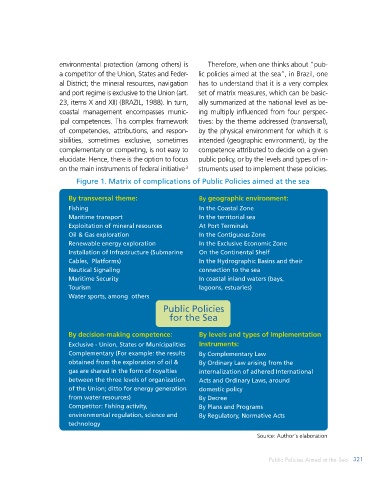
 conceptualizations, most of which converge,   Precisely as a result of this need (and ab-  a competitor of the Union, States and Feder-  lic policies aimed at the sea”, in Brazil, one
 from which a classic by Peters (1986, p. 37-  sence), in 2018, the creation of the Maritime   al District; the mineral resources, navigation   has to understand that it is a very complex
 40) is chosen here, which says that “public   Policy Observatory (OPM) was proposed and   and port regime is exclusive to the Union (art.   set of matrix measures, which can be basic-
 policy is the sum of the activities of govern-  approved (through CAPES/MD Notice Num-  23, items X and XII) (BRAZIL, 1988). In turn,   ally summarized at the national level as be-
 ments, which act directly or through delega-  ber 27/2018 of CAPES/MD - Pro-Defense IV   coastal management encompasses munic-  ing multiply influenced from four perspec-
 tion, and that influence the lives of citizens”.   Notice). The creation of the Maritime Policy   ipal competences. This complex framework   tives: by the theme addressed (transversal),
 They must reflect both the interests of the   Observatory (OPM), based and coordinated   of competencies, attributions, and respon-  by the physical environment for which it is
 State and the “value” (which is more than   at the Naval War School (RJ), was born out   sibilities, sometimes exclusive, sometimes   intended (geographic environment), by the
 just its economic bias, as it includes intrinsic   of cooperation with renowned institutions   complementary or competing, is not easy to   competence attributed to decide on a given
 and extrinsic aspects) that the people give to   spread across a large part of the national ter-  elucidate. Hence, there is the option to focus   public policy, or by the levels and types of in-
 a given theme, here, in this case, to the sea   ritory (UNB – Distrito Federal – decision-mak-  on the main instruments of federal initiative .3  struments used to implement these policies.
 that helped to consolidate the immense Bra-  ing center of many PP; UFC and FURG);  in   Figure 1. Matrix of complications of Public Policies aimed at the sea
 zilian nation (BEIRÃO, 2020).  just over 3 years it has already added 20
 Therefore, it is the manifestation of the   other national and international institutions.   By transversal theme:  By geographic environment:
 Public Power that decides directions  (in   Its objectives, which are also daring (follow-  Fishing  In the Coastal Zone
 the Brazilian case, in general, coming from   ing up, monitoring – including comparative   Maritime transport  In the territorial sea
 the Executive and/or Legislative Powers, at   studies, evaluating and proposing public po-   Exploitation of mineral resources  At Port Terminals
 all levels) with a series of instruments to   licies in six thematic areas) allow for a more   Oil & Gas exploration  In the Contiguous Zone
 bring society  together  around a certain   systemic and methodological view. 2  Renewable energy exploration  In the Exclusive Economic Zone
 path. It can come from typically normative   Thus, it is intended to structure the   Installation of Infrastructure (Submarine   On the Continental Shelf
 acts (laws, decrees, ordinances, normative   present analysis, especially focused on its   Cables,  Platforms)  In the Hydrographic Basins and their
 instructions, plans, projects, etc.), from   contribution to the Brazilian sea economy,   Nautical Signaling  connection to the sea
 the rearrangement of the state machine   based on the main instruments already in   Maritime Security  In coastal inland waters (bays,
 (creation of agencies, new controlling, su-  force (or in an evolutionary process), under   Tourism  lagoons, estuaries)
                     Water sports, among  others
 pervisory, promoters, accountability, etc.)   the broadest national perspective, which
 or even awareness-raising and training   is the federal one. Certainly, such a mul-  Public Policies
 actions (advertising campaigns, booklets,   tisystem issue deserves a joint approach. I   for the Sea
 inclusion  in  educational  training,  etc.).   have already observed (Mello et al., 2019),   By decision-making competence:  By levels and types of Implementation
 This is the complexity of studying public   that activities at sea require coordinated   Instruments:
 policies: one cannot stick to only one of its   actions to act in various areas and that it   Exclusive - Union, States or Municipalities
                     Complementary (For example: the results
 possible instruments.  is up to politics (latu sensu) to coordinate   obtained from the exploration of oil &   By Complementary Law
                                                            By Ordinary Law arising from the
 That said, when it is intended to address,   different spheres of actions and intentions   gas are shared in the form of royalties   internalization of adhered International
 more specifically, Public Policies aimed at the   to take advantage of economic opportu-  between the three levels of organization   Acts and Ordinary Laws, around
 sea, these would have an enormity of instru-  nities that leverage strategic interest and   of the Union; ditto for energy generation   domestic policy
 ments to be compared to absorb the intend-  national development. The Brazilian Con-  from water resources)  By Decree
 ed path in the national maritime vocation.   stitution already provides for this distribu-  Competitor: Fishing activity,   By Plans and Programs
 Also, much of this is an inducing factor for   tion and/or accumulation of tasks. For ex-  environmental regulation, science and   By Regulatory, Normative Acts
 the economy of the sea  and national social   ample, in its art. 24 (Section VI) says that   technology

 and economic development. Such a claim   the  management of fishing resources and   Source: Author‘s elaboration


 320  BLUE ECONOMY                                                               Public Policies Aimed at the Sea  321

