


Page 783 - Economia Azul - versão: inglês
P. 783
land strip, which corresponds to the space   Register of Employed and Unemployed.  metropolitan and non-metropolitan areas.  “workers in fishing and hunting”. We opted
 comprised by the limits of the municipali-  As a result of this proposal, the chapter is   There are occupations that can be more   for such an example cut by the level of aggre-
 ties that are directly influenced by the phe-  divided into 7 sections, in addition to the in-  easily identified as linked to the sea and the   gation presented by the source consulted. In
 nomena occurring in the coastal zone.  troductory one. The second section is dedi-  coast. The stratified cut of the waterway and   other words, occupations related to transport
 The Brazilian coastal zone, according to   cated to exemplifying some classifications of   fishing and hunting sector is presented in   and fishing are disaggregated, allowing di-
 MMA  Ordinance number  34, of February   occupations adopted in countries from three   Table 1: “workers in water transport” and   rect visualization of the data.
 2, 2021, has 443 municipalities. This chap-  different continents; the third refers to notes   Table 1. Breakdown and stratified perspective of the waterway
 ter presents the profile of workers associ-  on formal occupations associated with the   and fishing and hunting sector in the USA
 ated with coastal activities in the Brazilian   sea and the coast of coastal MRs; the fourth    Occupations     SOC    Employment  Projected      Variation
 metropolitan coastal  zone. In  this  sense,   section outlines a profile of the formal occu-      Code[i]       2020    Employment   2020/2030(%)
 aspects of occupations classified as coastal   pations of the Coastal and marine economy              2030
 and of the Brazilian sea will be addressed,   related to the Sea and Coastal Economy; the   Water transport workers (Total)  53-5000   66,7     74,5   12
 considering variables such as: education,   fifth discusses female participation in coast-  Sailors and marine oilers   53-5011   26,4     29,2   10
 gender, age, salary, admitted and discon-  al MRs of the Coastal and Marine Economy;   Captains, mates, and pilots of
 nected according to RAIS - Annual List of   and the sixth presents a comparison  be-  water vessels   53-5021   29,9     33,9   13
 Social Information, document prepared   tween the Coastal and Marine Economy of   Motorboat operators   53-5022   2,6       3    15
 by companies with statistical information   the Coastal MRs and the National Economy,
 on labor relations - and CAGED - General   finally, the conclusions are presented.  Ship engineers   53-5031   7,8     8,4   8
                   Fishing and hunting
 2. Considerations on occupations related to the sea and coast in three  workers (Total)   45-3031   32,3     35,8   11
 heterogeneous continents
                                                Source: Adapted from the US Bureau of Labor Statistics, employment
 The subsection intends to exemplify that   containing  ten  major  occupational  groups.   projections program (2022)
 different countries may or may not adopt   The “occupation” sub-levels are not defined
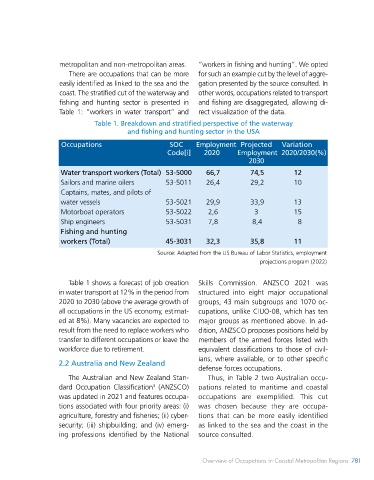
 similar occupational classifications, accord-  in the CIUO-08, as the countries themselves   Table 1 shows a forecast of job creation   Skills Commission. ANZSCO 2021 was
 ing to specificities and needs, in light of the   are expected to develop this sub-level of de-  in water transport at 12% in the period from   structured into eight major occupational
 international classification. It is noteworthy   tail according to their needs. There are sev-  2020 to 2030 (above the average growth of   groups, 43 main subgroups and 1070 oc-
 that the proposal is not to exhaust the   eral countries that adopt this classification,   all occupations in the US economy, estimat-  cupations, unlike CIUO-08, which has ten
 debate entirely, but to exemplify how the   which facilitates the alignment of informa-  ed at 8%). Many vacancies are expected to   major groups as mentioned above. In ad-
 aforementioned data on occupations are   tion regarding the States, and, in some cases,   result from the need to replace workers who   dition, ANZSCO proposes positions held by
 presented in  various nations. This  should   enabling international comparability.  transfer to different occupations or leave the   members  of  the  armed  forces  listed  with
 expose how complex it can be to identi-  Below are some examples of classifica-  workforce due to retirement.  equivalent classifications to those of civil-
 fy the occupations of workers in a country   tions and comparisons between 5 nations.  ians, where available, or to other specific
 that are associated with the coast and the   2.2 Australia and New Zealand  defense forces occupations.
 sea, making it difficult to quantify, qualify   2.1 United States  The Australian and New Zealand Stan-  Thus, in Table 2 two Australian occu-
 and compare the labor market itself.  The US Bureau Labor of Statistics’ Oc-  dard Occupation Classification  (ANZSCO)   pations related to maritime and coastal
                                              3
 The  Brazilian  Classification  of Occupa-  cupational Employment and Wage Sta-  was updated in 2021 and features occupa-  occupations are exemplified. This cut
 tions (CBO) follows the Uniform Interna-  tistics (OEWS) program, annually produc-  tions associated with four priority areas: (i)   was  chosen because they are occupa-
 tional Classification of Occupations (CIUO),   es employment and salary estimates for   agriculture, forestry and fisheries; (ii) cyber-  tions that can be more easily identified
 recommended by the International Labor Or-  more than 800 occupations. These esti-  security; (iii) shipbuilding; and (iv) emerg-  as linked to the sea and the coast in the
 ganization (ILO), updated in 2008 (CIUO-08)     mates are available for the nation, states,   ing professions identified by the National   source consulted.


 780   BLUE ECONOMY                                          Overview of Occupations in Coastal Metropolitan Regions 781

