


Page 176 - Economia Azul - versão: inglês
P. 176
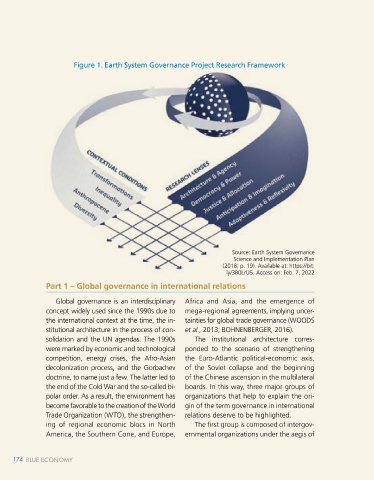
Figure 1. Earth System Governance Project Research Framework                                              the UN and with specific mandates, often    The second group of organizations cor-
                                                                                                                                 guided by debates within the General As-  responds to the Bretton Woods institutions,
                                                                                                                                 sembly and/or the Security Council. Topics   created shortly after the Second World War,
                                                                                                                                 such as hunger and poverty, development,   on the fringes of the UN system: the Inter-
                                                                                                                                 fair trade, food security, human security,   national Monetary Fund (IMF), the World
                                                                                                                                 global climate change, migration, among   Bank System and the General Agreement
                                                                                                                                 many others, have become recurrent in the   on Tariffs and Trade (GATT). In 1995 the
                                                                                                                                 agendas of the United Nations Food and Ag-  WTO updated the trade architecture. There
                                                                                                                                 riculture Organization (FAO), United Nations   were other initiatives over the subsequent
                                                                                                                                 Industrial Development Organization (UNI-  decades, created with their own governance
                                                                                                                                 DO), the United Nations Development Pro-  and principles, in addition to international
                                                                                                                                 gram (UNDP), the United Nations Environ-  development financing banks, such as the
                                                                                                                                 ment Program (UNEP) and the International   Brazilian  National Bank for Economic  and
                                                                                                                                 Labor Organization (ILO), among others.  Social Development (BNDES), among other
                                                                                                                                    The UN system adopted the concept of   arrangements. As they work according to
                                                                                                                                 governance from the Report of the Com-   the logic of financing and economy, the con-
                                                                                                                                 mission  on  Global Governance (UNCGG,   cept of governance that they contributed to
                                                                                                                                 1996). As adopted, the concept of gover-  consolidate refers to the capacity of each
                                                                                                                                 nance carried a strong regulatory burden, in   country’s government to honor its economic
                                                                                                                                 the name of the general interest of human-  and financial commitments, combined with
                                                                      Source: Earth System Governance                            kind. It served, to a large extent, as a general   its political alignment. Thus, what mattered
                                                                      Science and Implementation Plan
                                                                   (2018, p. 19). Available at: https://bit.                     call to solidarity among peoples and to the   less was the  legitimacy  and quality  of  the
                                                                    ly/3B0LrU5. Access on: Feb. 7, 2022                          creation of synergies between the different   regime in power, and more interested in its
               Part 1 – Global governance in international relations                                                             stakeholders, from the public and private   ability to pay its debts with good predictabil-
                                                                                                                                 sectors (market and organized society). The   ity and avoid the risk of a radical change of
                 Global governance is an interdisciplinary   Africa and Asia, and the emergence of                               message was that the unipolar international   government. For the international economic
               concept widely used since the 1990s due to   mega-regional agreements, implying uncer-                            system, with the order assured by the Unit-  and financial system, the flows of loans and
               the international context at the time, the in-  tainties for global trade governance (WOODS                       ed States, the victorious superpower of the   investments are connected and correspond
               stitutional architecture in the process of con-  et al., 2013; BOHNENBERGER, 2016).                               Cold War, would be more  stable,  secure,   to the starting point of governance. Far
               solidation and the UN agendas. The 1990s    The institutional architecture corres-                                and just. In other words, before completing   from the normative concept and sovereign
               were marked by economic and technological   ponded  to the scenario  of strengthening                             fifty years, the UN could finally  exercise  the   equality of the UN system, the idea of  “good

               competition, energy crises, the Afro-Asian   the  Euro-Atlantic political-economic axis,                          functions of regulating international rela-  governance”  was  very  close to  corporate
               decolonization process, and the Gorbachev   of the Soviet collapse and the beginning                              tions for which it was created. This percep-  governance concepts, with imposed models
               doctrine, to name just a few. The latter led to   of the Chinese ascension in the multilateral                    tion could be summarized as the prevalence   for economic success, as in the case of the
               the end of the Cold War and the so-called bi-  boards. In this way, three major groups of                         of Public International Law and the limita-  Washington Consensus of November 1989.
               polar order. As a result, the environment has   organizations that help to explain the ori-                       tion of the use of force. In simple terms, it   The third group of major actors that
               become favorable to the creation of the World   gin of the term governance in international                       would be a unique opportunity for the UN   contributed to the evolution of the concept
               Trade Organization (WTO), the strengthen-  relations deserve to be highlighted.                                   to function, given the end of the East-West   of global governance is composed of the
               ing of regional economic blocs in North     The first group is composed of intergov-                              divide, or the “victory of the West”, with its   European Union (EU) and the emerging
               America, the Southern Cone, and Europe,   ernmental organizations under the aegis of                              model of democracy and free trade.       ones,  mainly  China,  India  and  Brazil.  The


     174   BLUE ECONOMY                                                                                                                                                                Ocean Governance: the Beacons of History  175
     174   BLUE ECONOMY

