


Page 112 - Economia Azul - versão: inglês
P. 112
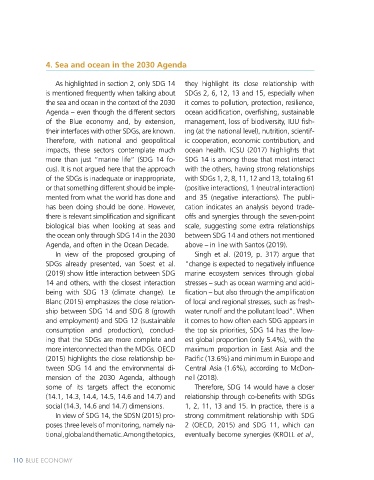
4. Sea and ocean in the 2030 Agenda                                                                                 Table 1. Blue Economy in Agenda 2030 beyond SDG 14, by SDGs and targets

                                                                                                                               SDG/
                 As highlighted in section 2, only SDG 14   they highlight its close relationship with                         Targets   1   2   3   4   5   6   7   8   9   10   11   12   13   14   15   16   17   18   19   a   b   c   d
               is mentioned frequently when talking about   SDGs 2, 6, 12, 13 and 15, especially when                          1     X   X         X                                                 X   X
               the sea and ocean in the context of the 2030   it comes to pollution, protection, resilience,                   2     X   X
               Agenda – even though the different sectors   ocean acidification, overfishing, sustainable                      3             X                  X
               of the Blue economy and, by extension,   management, loss of biodiversity, IUU fish-                            4             X   X   X    X                                          X   X
                                                                                                                               5
                                                                                                                                                   X
               their interfaces with other SDGs, are known.   ing (at the national level), nutrition, scientif-                6     X       X   X   X   X                                           X   X
               Therefore, with national and geopolitical   ic cooperation, economic contribution, and                          7         X                                                           X
               impacts,  these  sectors  contemplate  much   ocean health. ICSU (2017) highlights that                         8     X       X   X              X                                    X
               more  than just “marine life” (SDG 14 fo-  SDG 14 is among those that most interact                             9     X       X   X                                                   X
               cus). It is not argued here that the approach   with the others, having strong relationships                    10        X             X
               of the SDGs is inadequate or inappropriate,   with SDGs 1, 2, 8, 11, 12 and 13, totaling 61                     11        X   X   X   X   X                                              X   X
                                                                                                                                                X
                                                                                                                               12
                                                                                                                                                                                                        X
               or that something different should be imple-  (positive interactions), 1 (neutral interaction)                  13    X   X   X                                                          X
               mented from what the world has done and   and 35 (negative interactions). The publi-                            14    X   X   X   X   X   X   X                                       X   X   X
               has been doing should be done. However,   cation indicates an analysis beyond trade-                            15    X                       X                                       X
               there is relevant simplification and significant   offs and synergies through the seven-point                   16                         X   X                                      X   X
               biological bias when looking at seas and   scale, suggesting some extra relationships                           17            X         X   X    X                       X   X   X
                                                                                                                                                                           Source: Own elaboration based on UN (2016, 2017b)
               the ocean only through SDG 14 in the 2030   between SDG 14 and others not mentioned                                                 Tabela 1. Economia Azul na Agenda 2030 além do ODS 14, por ODS e metas.
                                                                                                                                                            Fonte: Elaboração própria com base em UN (2016, 2017b).
               Agenda, and often in the Ocean Decade.   above – in line with Santos (2019).
                 In  view  of  the  proposed  grouping  of   Singh et al. (2019, p. 317) argue that                              2019) from the appropriate stimuli if mutual   11, 13, 16 and 17, SDG 14 has trade-offs
               SDGs already presented, van Soest et al.   “change is expected to negatively influence                            policies and strategies occur. These SDG 14   and no associations with other SDGs in the
               (2019) show little interaction between SDG   marine ecosystem services through global                             interconnections and trade-offs are indeed   future. Therefore, dealing with seas and
               14 and others, with the closest interaction   stresses – such as ocean warming and acidi-                         limited, because the goal is, in fact, mainly   ocean in the context of the 2030 Agenda
               being with SDG 13 (climate change). Le   fication – but also through the amplification                            about marine life (SANTOS, 2019).        requires a change of perspective, mainly
               Blanc (2015) emphasizes the close relation-  of local and regional stresses, such as fresh-                                                                because it is a cross-cutting issue. This is the
               ship between SDG 14 and SDG 8 (growth    water runoff and the pollutant load”. When                                   “However, as the political framework   main subject of the next subsection.
               and employment) and SDG 12 (sustainable   it comes to how often each SDG appears in                                   that the SDGs provide does not reflect   Table 1 presents all SDGs directly and/
               consumption and production), conclud-    the top six priorities, SDG 14 has the low-                                  the full picture and as some areas and   or indirectly related to the sea/ocean – in
               ing that the SDGs are more complete and   est global proportion (only 5.4%), with the                                 goals are rather weakly connected (in   addition to SDG 14 itself – based on sectors
               more interconnected than the MDGs. OECD   maximum proportion in East Asia and the                                     particular the SDGs 14 Oceans [...]),   related to the Blue Economy. The number
               (2015) highlights the close relationship be-  Pacific (13.6%) and minimum in Europe and                               attempts towards policy integration   of targets for each SDG varies widely, but
               tween SDG 14 and the environmental di-   Central Asia (1.6%), according to McDon-                                     will require the inclusion of studies on   they are all related to maritime and ocean
               mension of the 2030 Agenda, although     nell (2018).                                                                 biophysical, social and economic sys-  activities. Once again, this highlights the
               some  of  its  targets  affect  the  economic   Therefore, SDG 14 would have a closer                                 tems” (NIESTROY, 2016, p. 12).       relevance of the UN Ocean Decade, partic-
               (14.1, 14.3, 14.4, 14.5, 14.6 and 14.7) and   relationship through co-benefits with SDGs                             While it is not the best perspective to   ularly as it sets out to expand knowledge
               social (14.3, 14.6 and 14.7) dimensions.  1, 2, 11, 13 and 15. In practice, there is a                            tackle the relevance of the seas and ocean,   and data on these activities.
                 In view of SDG 14, the SDSN (2015) pro-  strong commitment relationship with SDG                                even the limited analysis that exists based   From the methodological proposal of
               poses three levels of monitoring, namely na-  2 (OECD, 2015) and SDG 11, which can                                only on SDG 14 shows that there are several   this chapter, the seas and the ocean have a
               tional, global and thematic. Among the topics,   eventually become synergies (KROLL et al.,                       co-benefits to achieving its goals. Like SDGs   much broader and transversal spectrum in


     110   BLUE ECONOMY                                                                                                                                                                    Blue Economy and the 2030 Agenda 111
                                                                                                                                                                                            Blue Economy and the 2030 Agenda 111

